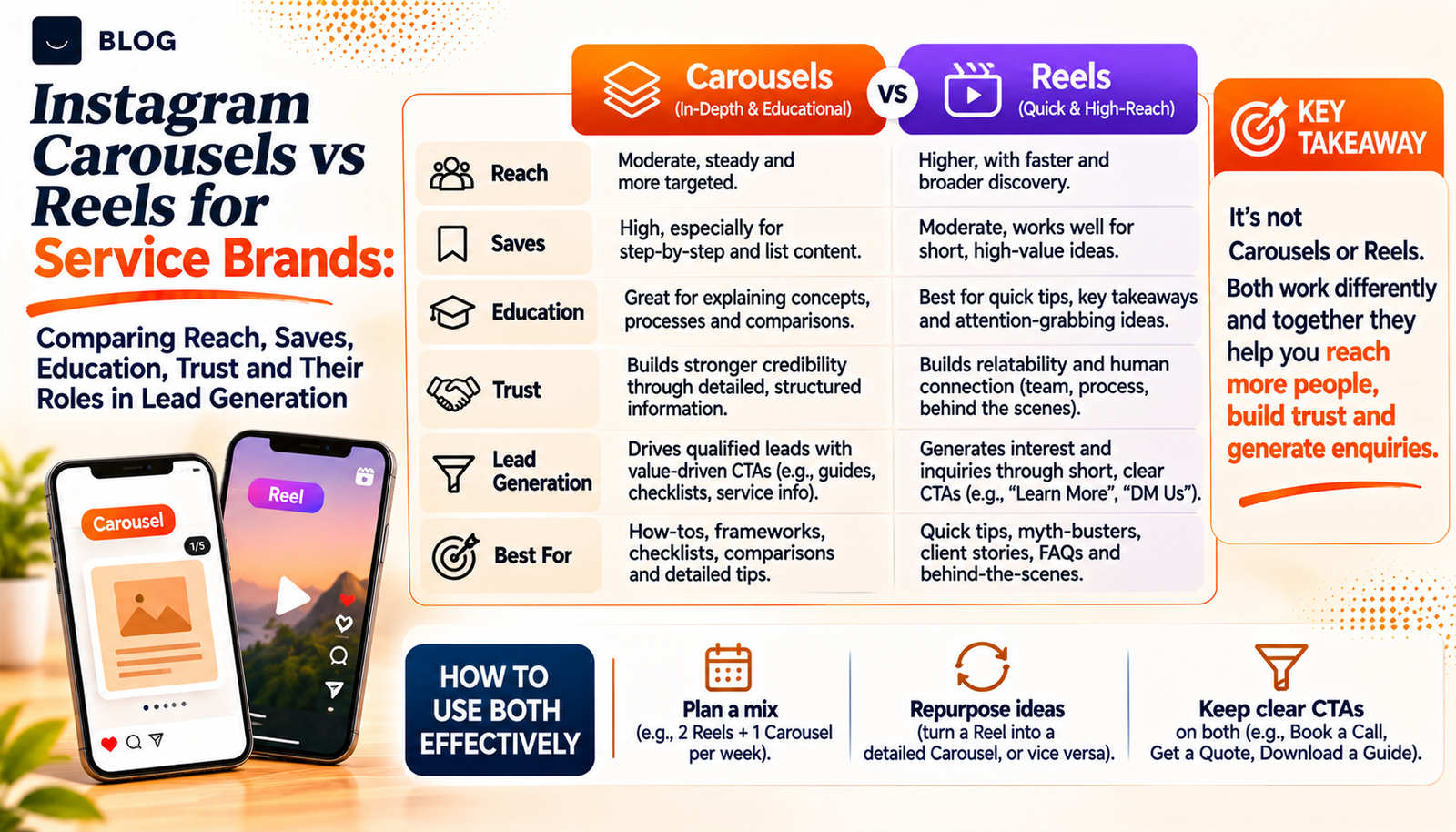
Instagram Carousels vs Reels for Service Brands: Comparing Reach, Saves, Education, Trust and Their Roles in Lead Generation
A plumber, a solar installer and a chartered accountant all want Instagram to bring them enquiries. Each has heard that Reels get the most reach, and each has also heard that carousels get the most saves. Few have a clear sense of which one should carry their plan, or how the two fit together.
The answer is less about which format is better and more about what each one is for. Reels are built to reach people who do not yet follow you, showing your face and your work in motion. Carousels are built to hold attention and be kept, with the swipe-through structure that rewards explanation, checklists and reference material.
This guide compares the two formats on reach, saves, education, trust and their role in lead generation. It also sets out which goal each suits, the mistakes that waste effort and a simple way to decide what to post each week. It does not claim one format always wins, because results depend on your audience, your account and how well each post is made.
What a format comparison can and cannot decide
A comparison can show where each format tends to find people, what it asks of the viewer and what kind of response it earns. It can help you match the format to the job the post needs to do, whether that is being discovered, being trusted or being saved and returned to.
It cannot tell you what your account will achieve. Published figures about reach and saves vary widely between studies, they often come from vendors or from accounts of different sizes, and Instagram changes its ranking systems. Treat any benchmark as a starting point, and measure your own results for each format over at least several weeks.
Reach: who each format finds
Reels are the stronger discovery format for most accounts. Instagram places Reels in front of people who do not follow the account, which is why a Reel is usually the first thing a new prospect sees. For a service business with a small following, that matters, because the audience you need is largely outside your current network.
Carousels usually reach a narrower group at first. Most of their distribution comes from followers, from people who visit your profile and from the fact that a saved carousel can be shown again. Some carousels do reach new people, particularly when the first slide makes a clear promise, but reach from carousels is generally less broad than from Reels.
The practical conclusion is simple: if you need people to discover you, lead with Reels. If you need people who already know you to trust you enough to act, carousels are often the stronger tool.
Carousels and Reels at a glance
| Factor | Reels | Carousels |
|---|---|---|
| Main job | Discovery: reaching people who do not follow you yet | Depth: explaining, showing and being kept |
| Who sees it | Often non-followers, through Reels and Explore placements | Mostly followers and profile visitors, with some reach through feed and Explore |
| Attention pattern | Short, often passive watching, with the first few seconds deciding everything | Active swiping, with time spent on each slide |
| Typical response | Views, shares and follows | Saves, shares and profile visits |
| Best content | Quick demonstrations, your face, a surprising point, a day at work | Checklists, step-by-step guides, comparisons, price factors, FAQs |
| Production effort | Filming, editing and captions for video | Design and copywriting, with reusable templates |
| Lead generation role | Introduces you to new people | Turns interest into a saved reference and a next step |
Saves and education: why carousels get kept
A save is a bookmark. Someone who saves a post intends to come back to it, which makes saves one of the clearest signals that content is useful. Carousels are well suited to earning saves because they package information the reader can scan, reuse and share with a colleague: a checklist for choosing a provider, a comparison of options, or a list of questions to ask before hiring.
Education is where carousels usually have the edge. Each slide can carry one point, so the reader moves through an argument step by step. A reel can explain a single idea well, but it is harder to hold a long list of details on screen, and a viewer cannot easily return to the third step.
Reels can also educate, particularly when the lesson is visual or quick to demonstrate. Showing how a service works, or answering a common question in under a minute, often works better as video. The strongest accounts usually use each format for the part of the lesson it handles best.
Trust: showing the person behind the business
Buyers of services are judging risk. They want to know who they will deal with, whether that person knows the subject and whether the business is real. Reels are strong at this because the viewer sees a face, hears a voice and watches the work happen. A short video of the owner explaining a common problem can build more trust in a few seconds than a page of text.
Carousels build trust differently. They show that the business has thought the subject through: the process, the terms, the questions answered in order, the credentials explained clearly. A carousel that sets out what a customer should expect at each stage can reassure a prospect who is still deciding.
For most service businesses the strongest approach combines both. A Reel introduces the person, and a carousel explains how the work is done.
Lead generation: how each format fits the path to an enquiry
Neither format generates enquiries by itself. Each one does a different job on the way to a conversation.
Reels usually bring the first contact. A new viewer sees a short video, decides the business is worth a closer look and visits the profile. The Reel's job is to make that visit happen.
Carousels often bring the decision. A follower who saves a checklist or a comparison is holding a useful reference, and may come back to it when they are ready to act. A clear final slide with one next step, such as a request for a quote or a message with a keyword, turns that saved reference into a conversation.
The question to ask of every post is simple: what should the viewer do next? If the answer is "nothing", the post is entertaining at best. If it is "save this", "send this to a colleague" or "message us", the post has a job.
Which format for which goal
| Your goal this week | Format to lead with | Why |
|---|---|---|
| Reach people who have never heard of you | Reel | Non-followers are the main audience |
| Explain a process a buyer finds confusing | Carousel | Slides can take the reader through each step |
| Build trust in you as a person | Reel | Face and voice carry more trust than text |
| Give followers something to save | Carousel | Checklists and comparisons earn saves |
| Answer a question you hear often | Either | A Reel for a quick answer, a carousel for a full one |
| Announce an offer | Single image or Story | The offer needs a clear call to action, not a long format |
Common mistakes to avoid
Treating reach and saves as the same goal. A Reel can have a large audience and a poor save rate, and a carousel can be saved often and reach few new people. Decide which goal the post serves.
Copying a whole article into slides. A carousel with forty words per slide is hard to read on a phone. One idea per slide works better.
Filming a Reel with no hook. The first seconds decide whether anyone keeps watching. Open with the answer or the surprising point.
Posting carousels and Reels with no call to action. Every post should lead somewhere, whether that is a save, a share, a comment or a message.
Judging formats by someone else's numbers. Published figures vary widely and often come from vendors or from accounts of different sizes. Compare your own results over several weeks.
Dropping one format entirely. Many service accounts do best with a mix. Abandoning carousels because a Reel went further, or the reverse, rarely pays off.
Conclusion
Reels and carousels are not rivals. Reels are the better tool for being found by people who do not yet know you. Carousels are the better tool for explaining, earning saves and giving people a reference they will return to. Service businesses usually need both: Reels to bring new viewers in, and carousels to show how the work is done and make the next step easy.
For the next four weeks, post two Reels and two carousels a week. Keep a simple record of reach, saves, profile visits and messages for each post, then decide which format to weight more heavily for your business.
If you would like help planning a mixed Instagram content programme for your service business, Crescent Digital Solutions can plan the topics, script and design the Reels and carousels, and track which formats bring enquiries. Our social media, video editing and graphic design teams work together on exactly this.
← Back to all postsFrequently asked questions
For most accounts, Reels are the stronger discovery format because they reach people who do not follow you. Carousels usually reach a narrower group first, though they can be shown again after they are saved.
Carousels are generally the stronger format for saves because they hold useful content the reader can return to. Published figures vary, so measure your own saves for each format.
Use both. Lead with Reels to reach new people, and use carousels to explain processes, checklists and comparisons that people save and share.
Instagram's head, Adam Mosseri, has said hashtags do not meaningfully increase reach. Clear captions, on-screen text and keywords matter more for discovery in either format.
Track reach, saves, shares, profile visits and messages for each post over several weeks, and compare like with like. A single post tells you little.
Ready to build what's next?
Tell us where you're headed. We'll come back with a plan to get there.
Book an intro call