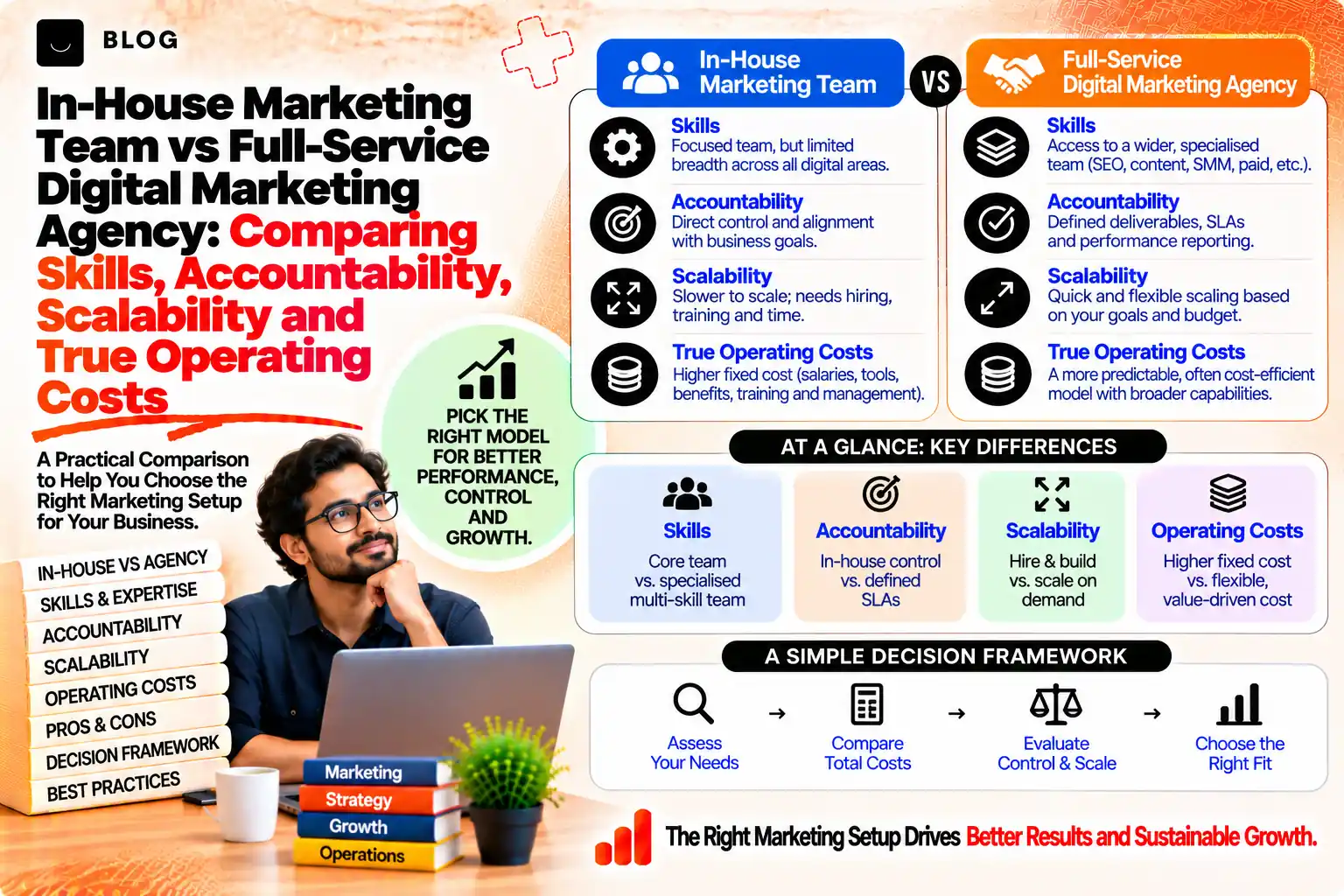
In-House Marketing Team vs Full-Service Digital Marketing Agency: Comparing Skills, Accountability, Scalability and True Operating Costs
Most businesses reach the same point sooner or later. Enquiries are slowing, the website needs work, or someone has asked why nobody is running the Google Ads account. The question is whether to hire a marketing team or to hand the work to an agency. Both can deliver good results. The costs and risks are different, and the wrong choice is expensive to undo.
An in-house team is employees who work only for your business. A full-service agency is an external partner, usually covering several disciplines such as SEO, paid media, content, social and web work for a monthly fee. Many businesses also use a mix of the two.
This guide compares the models on skills, accountability, scalability and true operating cost. It explains where each one tends to work best, the mistakes that waste money and how to decide.
What a comparison of models can and cannot decide
It can show how each model gets work done, who is responsible for results and what the full cost looks like once you include tools, management time and recruitment. It can help you match the model to your size, budget and the kind of marketing you need.
It cannot tell you which candidate or agency is good. Quality depends on the people, their experience in your sector and how well the working relationship is set up. Costs also vary by location, seniority and scope, so check current quotes and salary data in your market.
In-house team vs full-service agency at a glance
| Factor | In-house team | Full-service agency |
|---|---|---|
| Skills | Deep knowledge of your business; coverage limited to who you hire | Several specialists across disciplines; depth varies by agency |
| Accountability | Direct line management; performance reviewed internally | Contracted service levels and account management; depends on the contract |
| Scalability | Scaling means recruiting, training and sometimes redundancy | Scaling up or down is usually easier, subject to notice terms |
| Knowledge of your business | Builds over time and stays with the company | Must be built, and can be lost if the account team changes |
| Cost structure | Fixed costs: salaries, benefits, tools, training, management time | Recurring fee, often with extras for ad spend, tools or additional work |
| Speed to start | Slower: recruitment takes time | Usually faster, once contracted |
| Main risk | A single hire leaves, or the team lacks a skill you need | Over-reliance on the agency, weak communication or unclear scope |
Skills: what you need and where it comes from
Start with the skills your marketing actually requires. A typical service business needs some combination of search optimisation, website and content work, paid advertising, social media, analytics and sales follow-up. Few small teams can cover all of these well.
An in-house team gives you people who understand your products, customers and internal approvals. That knowledge helps with messaging and speed. The limitation is coverage. A two-person team will be strong in some areas and thin in others, and you pay for every skill you hire, whether or not you use it all the time.
A full-service agency gives you access to several specialists without hiring each one. This can cover gaps quickly and bring experience from other clients. The limitation is that depth varies, and the people who pitch the work are not always the people who do it. Ask who will be on the account and what they have done in your sector.
Many businesses find that a small in-house team that owns strategy and decisions, combined with specialist support for execution, covers their needs well.
Accountability: who answers for results
In-house accountability is direct. Managers set objectives, review performance and make changes. The team knows the business and can be questioned in person. The weakness is that marketing accountability can drift if objectives are unclear or no one measures results properly.
Agency accountability depends on the contract. Good agreements define deliverables, reporting frequency, response times and what success looks like. They also name who is responsible for each part of the service. Weak agreements focus on activity, such as posts published or hours used, rather than outcomes such as enquiries and sales.
Whichever model you choose, agree the measures before work starts. Cost per qualified lead, enquiry volume, conversion rate and revenue from the channel are more useful than activity counts.
Scalability: growing and reducing the work
An in-house team scales through hiring. That takes time, and each hire brings recruitment costs, a training period and a commitment to a fixed salary. Reducing the team is slow and can be difficult. The benefit is stability: the people who know your business stay with it.
An agency scales more flexibly. You can often add work or reduce it with notice, subject to the contract. That suits businesses with seasonal peaks, new product launches or uncertain budgets. The trade-off is less control over who does the work and how quickly they respond to changes.
If your marketing needs are predictable and will grow steadily, an in-house team can be efficient. If they change often, an agency or a flexible mix may fit better.
True operating costs
The most common mistake is comparing a salary with an agency fee. A fair comparison includes everything the model costs over a year.
For an in-house team, include:
- salaries and employer contributions
- recruitment and onboarding
- training and development
- software and tools
- management time
- holiday and sickness cover
- equipment and workspace
- a plan for when someone leaves
For an agency, include:
- the monthly fee or project fee
- ad spend, which is usually paid separately
- software or tool charges passed on to you
- extra fees for work outside the agreed scope
- your own management time for briefing, approvals and reviews
- notice periods and exit costs
Make each provider show their assumptions in writing. A low agency fee can become expensive if it excludes ad spend or requires a great deal of your time. A cheap hire can cost more if they leave within a year.
Which model fits which business
An in-house team tends to suit you if marketing is central to your growth, you need deep knowledge of your products and customers, the work is predictable and steady, you can recruit and retain skilled people, and you can give them clear objectives and tools.
A full-service agency tends to suit you if you need several skills quickly, your marketing needs change often, you lack the volume of work to keep specialists busy, or you want to test a channel before hiring for it.
A hybrid tends to suit you if you want an internal owner for strategy and approvals, and specialist support for execution. For example, a marketing manager who sets direction and works with an agency for SEO, paid media and web development.
Some questions help decide: what you need to achieve in the next twelve months, which skills are missing today and which are needed every month, who would manage the work and how much of their time they can give, how quickly you need results, and how you will measure whether the model is working.
Common mistakes to avoid
Comparing salaries with agency fees. Include every cost on both sides, including management time.
Hiring one person to do everything. Marketing covers many skills. A single generalist can struggle to cover them all well.
Choosing an agency on price alone. A low fee with unclear scope or weak reporting usually costs more in the end.
Failing to set objectives. Without agreed measures, neither a team nor an agency can be judged fairly.
Keeping knowledge in one person. Whichever model you choose, document the accounts, logins, reports and decisions so the business is not dependent on one individual.
Ignoring the contract. Check notice periods, data ownership, who owns the ad accounts and what happens to your work if the relationship ends.
Conclusion
An in-house team gives you depth, control and knowledge that stays with the business. A full-service agency gives you breadth, flexibility and faster access to specialists. Neither is automatically cheaper or better. The right choice depends on your skills gaps, how predictable your marketing needs are and whether you can manage the work well.
Before deciding, write down the twelve-month objectives, the skills you need, the true cost of each option and how you will measure success. Then test the model on a limited scope before committing fully.
If you are weighing these options, Crescent Digital Solutions works with businesses that want an agency partner, and also helps teams that are building their own capability. We can review your current marketing, identify the gaps and set out the costs of each model so you can choose with clear figures.
Frequently asked questions
It depends on scope. An in-house team has fixed costs that can be high if you need several specialists. An agency can be cheaper for a limited scope, but costs rise if the work grows. Compare full costs over a year.
It typically covers several disciplines, such as SEO, paid advertising, content, social media, web development and analytics, under one contract. Scope varies by agency, so check what is included.
Yes. Many businesses keep an internal owner for strategy and approvals, and use specialist agencies for execution. Agree who makes which decisions.
Ask who will work on your account, what they have done in your sector, how they report results and what they will measure. Ask for references and read the contract carefully.
Keep accounts, logins, reports and documentation in company hands, not personal ones. Build a handover process so the work can continue while you recruit.
Ready to build what's next?
Tell us where you're headed. We'll come back with a plan to get there.
Book an intro call