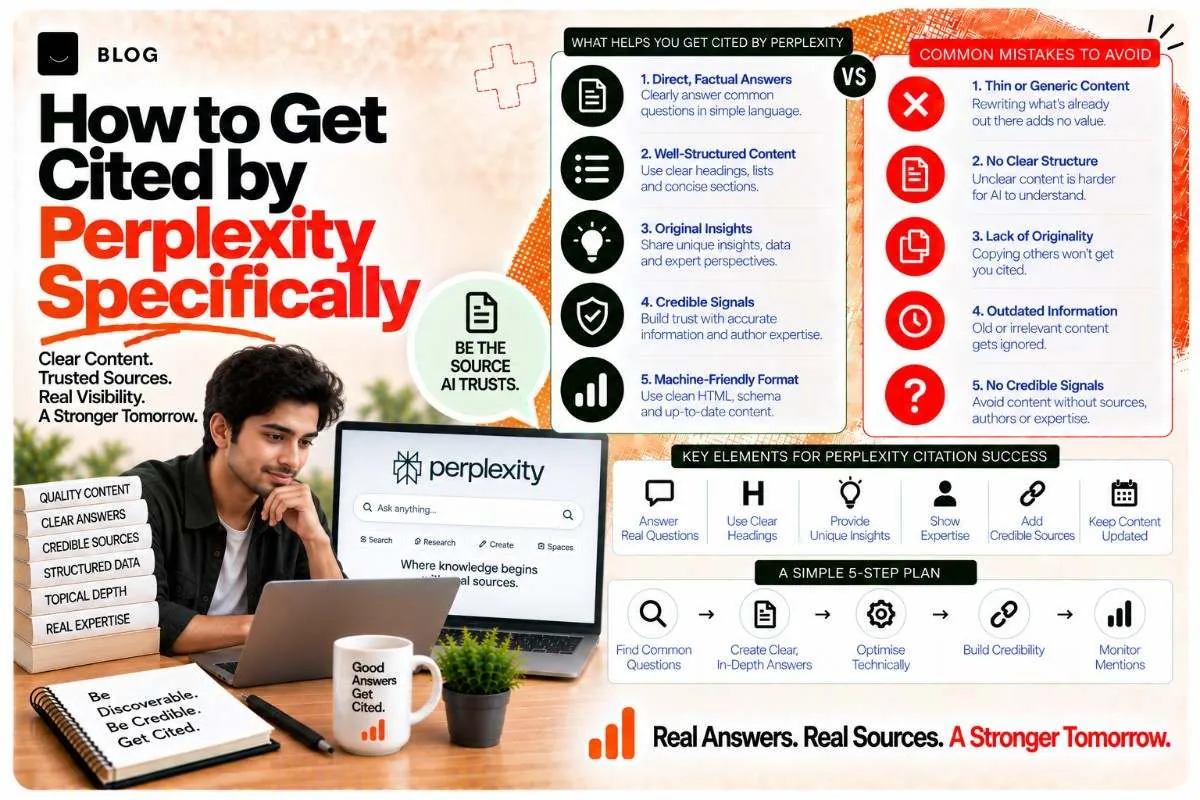
How to Get Cited by Perplexity Specifically
Perplexity cites its sources differently from most other AI assistants — visibly, individually, with clickable links attached to specific claims rather than a general list at the end of a response. That difference is not cosmetic. It changes what earns a citation, makes Perplexity the single easiest AI platform to audit your own visibility on, and rewards a slightly different set of content traits than a generic "optimise for AI search" strategy assumes.
A note on verifying what follows
VERIFY: Perplexity's citation mechanism, sourcing behaviour and any specific named features change as the product iterates. Confirm current behaviour against Perplexity's own documentation and recent, credible independent testing before publishing. This post describes durable, observable patterns in how Perplexity behaves rather than internal mechanics Perplexity has not disclosed — treat any specific claim about a named feature as needing same-day verification.
Why Perplexity deserves its own strategy, not a generic "AI search" one
Most GEO advice treats "AI answer engines" as one undifferentiated category — optimise the content well and hope it gets picked up somewhere. That approach leaves real, achievable specificity on the table, because the major platforms do not all behave the same way.
Perplexity is built around search and citation as its core product function, more explicitly than a general-purpose assistant that happens to search when needed. That difference in what the product is fundamentally for shows up directly in how visibly and specifically it cites what it draws on — which is also exactly why it is the most useful platform for testing whether your own content strategy is working at all, covered in more detail below.
How Perplexity's citation behaviour differs from ChatGPT and Gemini
The most observable, durable difference: Perplexity attaches numbered, clickable citations directly to specific claims within its answer, not only as a general source list at the end. A reader can see, sentence by sentence in many cases, exactly which source supported which specific claim.
This has a practical consequence worth naming plainly: you can verify your own citation status on Perplexity directly and immediately, by running a query and reading exactly which sources it names and what it attributes to each — a considerably more direct test than trying to infer sourcing from a synthesised answer that does not show its work as explicitly.
What Perplexity appears to weight when choosing a source
Based on observable, repeatable patterns rather than disclosed internal mechanics:
Specific, extractable facts over general claims. A sentence stating a specific number, date, or named detail is more citable, in the literal sense of being attachable to one clickable reference, than a paragraph of general description that does not reduce to one attributable claim.
Recency, for time-sensitive queries. Consistent with the freshness argument covered throughout this library, a query where the answer could plausibly have changed appears to favour recently-updated sources, likely reflecting Perplexity's real-time search orientation more directly than platforms drawing more heavily on training-time knowledge.
Clear, direct language over hedged or vague phrasing. A directly stated fact is easier to attribute cleanly to one source than a heavily qualified, ambiguous statement — which rewards the same direct-answer writing discipline this library recommends throughout its AEO guidance, for a slightly different underlying reason here.
VERIFY: No claim above should be read as confirmed Perplexity mechanics — these are observable patterns, not disclosed ranking factors, and should be described that way if further specifics are added to this post.
The practical implications for how you write
Make individual sentences independently attributable. Since Perplexity often cites at the sentence or claim level rather than only at the page level, a paragraph where each sentence stands as a complete, specific, checkable statement is more useful to this platform than a paragraph that only makes sense as a whole.
Front-load the specific fact, then explain. State the number, the date, or the named detail first, then elaborate — rather than building up to it through several sentences of context, which reduces how cleanly any single sentence can be extracted and attributed.
Date-stamp anything time-sensitive, visibly. Given the apparent recency weighting for queries where the answer could change, a visible "as of [date]" on time-sensitive claims both serves the reader and gives Perplexity's real-time-oriented retrieval a clearer signal of currency.
Avoid burying the specific claim inside a long, hedged sentence. "It's generally considered that pricing might typically range somewhere around X, though this can vary" is far less attributable than "Pricing was X as of [date]." The second is a claim a citation can point at cleanly.
Where Perplexity's citation behaviour helps you measure GEO work generally
This is a genuinely useful secondary benefit worth calling out explicitly, connecting to the measurement discipline covered throughout this library's GEO measurement cluster.
Because Perplexity shows its sourcing so explicitly, it is the easiest of the major AI platforms to use for the manual citation testing method recommended throughout this library — running a fixed set of real buyer-intent prompts and recording whether and how a business is cited. On Perplexity specifically, that test also tells you which exact sentence or claim earned the citation, which is diagnostic information the other platforms' less transparent sourcing does not give you as directly.
A practical habit worth adopting: when Perplexity cites a competitor instead of your own site for a query you care about, read exactly what claim it attributed to them. That specific sentence is very often the gap in your own content — the exact fact your page does not state clearly enough, or at all.
A testing method specific to Perplexity
- Build the same fixed set of ten to twenty buyer-intent prompts used elsewhere in this library's measurement guidance.
- Run each through Perplexity specifically, monthly, alongside the broader multi-platform test.
- For each answer, note not just whether you are cited, but which specific sentence or claim carries the citation.
- Where a competitor is cited instead, read the specific claim attributed to them and compare it against what your own content actually states on that point.
- Where the gap is a fact your content lacks entirely, add it. Where the gap is a fact your content states but buries in vague or hedged language, rewrite that specific sentence to be directly attributable.
What does not work here, even if it works elsewhere
Keyword density or repetition. Perplexity's retrieval is not matching keyword strings; padding a page with repeated phrases does nothing for citability and may actively hurt readability, which matters for whether a sentence reads as a clean, direct claim.
Long, unstructured pages with the useful facts buried mid-paragraph. The sentence-level attribution behaviour specifically rewards facts stated cleanly near where a reader — and the retrieval system — would expect them, not facts technically present somewhere in a wall of text.
Vague hedging to avoid liability on a claim that is actually true and verifiable. A business that knows a fact and states it vaguely out of unnecessary caution loses citability it could otherwise have earned, without gaining any real protection the vague version did not already lack.
Frequently asked questions
Based on observable patterns rather than disclosed mechanics: Perplexity appears to favour specific, extractable facts over general claims, recently-updated sources for time-sensitive queries, and clearly stated rather than hedged language, since each of these is easier to attribute cleanly to a specific clickable citation.
The most observable difference is that Perplexity attaches numbered, clickable citations to specific claims within an answer rather than only listing general sources, making it the most directly testable of the major platforms for checking your own citation status and understanding exactly which claim earned it.
Run a fixed set of real buyer-intent prompts through Perplexity directly and read the answer's citations. Because Perplexity often shows which specific sentence or claim each citation supports, this is a more diagnostic test than platforms with less transparent sourcing, and it can be repeated on a monthly schedule to track change over time.
Read exactly which claim was attributed to the competitor and compare it against your own content on that same point. The gap is often either a fact your content does not state at all, or one it states but in vague or hedged language that is harder to attribute cleanly to a specific citation.
It appears to. Direct, specific sentences that front-load a fact before explaining it seem more citable than long, hedged or heavily qualified sentences, since Perplexity's sentence-level attribution rewards claims that stand cleanly on their own.
It appears to matter somewhat more for queries where the answer could plausibly have changed, likely reflecting Perplexity's real-time search orientation. Visibly date-stamping time-sensitive claims serves both the reader and the platform's apparent recency weighting
Ready to build what's next?
Tell us where you're headed. We'll come back with a plan to get there.
Book an intro call