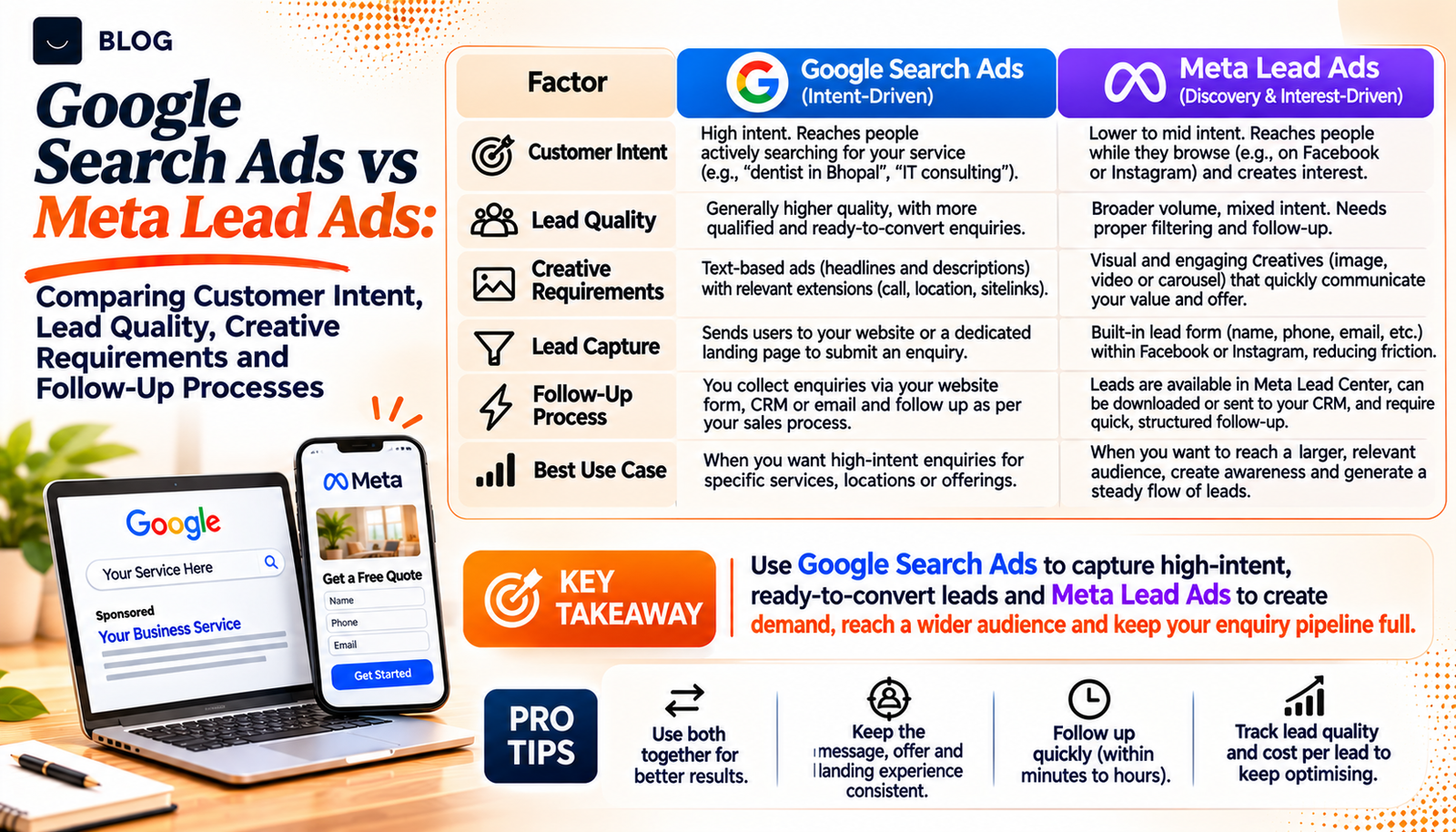
Google Search Ads vs Meta Lead Ads: Comparing Customer Intent, Lead Quality, Creative Requirements and Follow-Up Processes
A dental clinic wants more patients. One agency suggests Google Search ads, another suggests a Facebook and Instagram lead campaign. Both promise enquiries, and both can deliver them. The difference is what the person was doing when they saw the ad, how much they have already decided and how much work the business must do before a sale.
Google Search ads show up when someone types a query, such as "emergency dentist near me" or "invisalign cost". The person is actively looking for a solution. Meta lead ads appear in the feed of someone who was not looking for anything in particular. They are interrupted, not searching, so the offer and the form have to earn attention.
This guide compares the two channels on customer intent, lead quality, creative requirements and follow-up. It also covers how to choose between them, and how to combine them without wasting budget. It does not declare one channel the winner, because the right choice depends on what you sell, how buyers decide and what your team can handle.
What a channel comparison can and cannot decide
A comparison can show how each channel reaches people, what information you get from them and what each one asks of your sales process. It can help you match a channel to the stage of the buyer's journey you want to influence.
It cannot tell you what a lead will cost in your market. Costs depend on competition, location, season, offer and how well the campaign is set up. Treat any benchmark as a starting point to test, and measure cost per qualified lead rather than cost per form fill.
Google Search ads vs Meta lead ads at a glance
| Factor | Google Search ads | Meta lead ads |
|---|---|---|
| Where the ad appears | On Google results when someone searches | In Facebook and Instagram feeds, Stories and Reels placements |
| Customer intent | High: the person is looking for a service now | Lower to medium: the person is interrupted and may not be looking |
| How the enquiry is captured | Usually a landing page, call or form on your website | An instant form inside the app, pre-filled from the person's profile |
| Lead volume | Depends on search demand for your terms | Often higher, because forms are quick to complete |
| Lead quality | Often higher for active searchers, but depends on search terms and location settings | Often more variable, and quality depends on the offer, form and qualification questions |
| Creative needs | Concise headlines and descriptions, plus extensions such as call and location | Images or video, a clear offer, and a form designed to qualify |
| Follow-up | Fast response to calls and form submissions, with a page that matches the search | Fast response essential, with CRM routing and clear qualification |
| Best for | Services people search for urgently or research before buying | Offers that need attention, lead magnets, appointments or high-consideration sales with nurture |
Customer intent: what the person was doing
Intent is the single biggest difference between the two channels.
On Google Search, the person has told you what they want. A search for "same-day plumber in Bhopal" or "accounting software for small firms" carries strong intent. The ad only needs to match that intent with a relevant headline, a clear offer and a page that answers the question. Google's Ads Help advises checking the search terms report to see the actual queries that triggered your ads, so you can confirm whether they match your service.
On Meta, the person has not asked for anything. They are scrolling, and the ad interrupts them. Intent has to be created by the offer, the creative and the form. A guide, checklist or free consultation can work well because it gives a reason to respond without a purchase decision. A direct request for a costly service usually needs more trust before it converts.
This means the same service can be right for one channel and wrong for the other. A consultation offer may suit Meta. An urgent repair may suit Search better.
Lead quality: volume is not the same as value
Both channels can produce plenty of enquiries. The question is how many become customers.
Google Search leads often come from people who are already comparing options. Their query tells you something about their need, and call and form data can be linked to the search terms that produced them. The main quality risks are irrelevant search terms, such as job seekers, students or people looking for free services, and location settings that reach people outside your service area. The search terms report and location options are where most quality problems are fixed.
Meta lead ads can generate a larger number of enquiries, because the form is quick to complete from a profile that Meta already holds. That speed is also the risk. Accidental submissions, curious users and people who cannot afford the service all add to the count. Meta offers two instant form types: More Volume, which favours fast completion, and Higher Intent, which adds a review step to help people decide before submitting. Conditional logic can also end a form for people who do not meet your criteria. Use these features to qualify the lead before it reaches your team.
Whichever channel you use, measure the outcome that matters. Cost per form fill tells you little if most fills never become appointments or sales. Track cost per qualified lead and, where possible, feed the outcome back to the platform.
Creative requirements
The creative that works on each channel is different, and the difference is easy to underestimate.
Google Search needs clear, relevant copy. Headlines should match the query and say what you offer and where. Extensions such as call buttons, location details and sitelinks give people more ways to act. Responsive ads let Google combine headlines and descriptions, so write a range of options that are each accurate on their own.
Meta lead ads need a visual that stops the scroll, with a headline that gives a reason to respond. Video often performs well for explaining a service, and a short, plain offer works better than a long one. Keep the instant form short for volume campaigns and purposeful for higher-intent ones. Avoid misleading images or claims, which Meta's advertising standards do not allow.
In both cases, the landing page or form is part of the creative. An ad that promises a free audit should lead to a form that asks for what the audit needs, not a generic contact page.
Follow-up: where most leads are won or lost
A lead is only valuable if someone responds to it well. Both channels need a fast, consistent process, but the work differs.
Search enquiries arrive through calls, forms and messages, and the person usually expects a reply quickly. The landing page should match the search, and the first contact should confirm what they asked for. Call tracking helps you link a phone enquiry to the search that caused it.
Meta enquiries arrive as form submissions, often with less context. Send them to a CRM or inbox the team checks promptly, and use the answers to the qualification questions to route them. A welcome message that refers to what the person asked for, followed by a short call or booking option, helps convert interest into a conversation. Meta's documentation lists Ads Manager, Business Suite and connected CRM options for downloading leads, so choose one your team will actually use.
In either case, record what happened to each lead: whether it was qualified, booked, won or lost. That data is what tells you which channel is worth more budget.
Which channel fits which business
Google Search tends to suit you if people already search for your service by name, your offer answers a specific need, your sales process depends on a phone call or a quote, or you serve a clearly defined local area.
Meta lead ads tend to suit you if your offer is easy to understand and attractive without a search, you can make a compelling visual or video, you have a simple way to qualify leads through the form, or you need to build an audience for a service with a long consideration period.
Some questions help decide:
- What do people type into Google when they need your service?
- Would a stranger respond to an offer on Instagram or Facebook, or do they need to be actively looking?
- How long does a typical sale take, and how much nurturing does it need?
- Can your team respond to a new enquiry within an hour?
- How will you measure which leads become customers?
Combining the two channels
You do not have to choose one forever. Many businesses use Search to capture existing demand and Meta to create demand among people who have not yet searched. The risk is double-counting. A person who saw a Meta ad and later searched for your brand may be credited to Search, and both platforms may report the same lead. Compare results with your CRM, use one agreed definition of a qualified lead and test budget changes one channel at a time.
Common mistakes to avoid
Judging channels by cost per form fill. A cheap lead that never answers the phone costs more than it appears. Track cost per qualified lead and cost per customer.
Sending Meta leads to a slow inbox. Interest fades quickly. Set response expectations and monitor them.
Ignoring search terms. Irrelevant queries and broad location targeting can waste a large share of Search budget. Review them regularly.
Using the same creative on both channels. A search headline and a feed visual do different jobs. Adapt each one.
Asking too much on a Meta form. Long forms reduce volume. Ask only what you need now, and qualify with a question or two that matter.
Scaling before the process works. Increase budget only after the follow-up and tracking are reliable.
Conclusion
Google Search and Meta lead ads reach people at different points in their decision. Search meets people who are already looking, so the work is to be relevant and easy to contact. Meta creates interest among people who were not looking, so the work is to make the offer and the form compelling and well qualified. Neither channel rescues a weak offer or a slow team.
Start by reviewing your current enquiries: where they come from, how many become customers and how quickly they are answered. That shows which channel to test first.
If you would like help deciding where paid lead generation fits your business, Crescent Digital Solutions can review your offer, set up tracking for both channels, and plan a test that compares them fairly. Our performance marketing team works across Google and Meta, and we also review the landing pages and follow-up process that determine whether a lead becomes a customer.
← Back to all postsFrequently asked questions
Neither is better in every case. Google Search suits services people already search for, while Meta lead ads suit offers that create interest among people who were not looking. Test both against cost per qualified lead.
Instant forms are quick to complete, and they can pre-fill details from the person's profile. That speed increases volume but can also bring lower-quality submissions, so use qualification questions and Higher Intent forms where appropriate.
Review the search terms report regularly, add irrelevant queries as negative keywords, check your location settings and make sure each ad leads to a page that matches the search.
Often, yes, but compare results carefully. A person may see a Meta ad and later search for your brand, so both platforms can claim the same lead. Use one agreed definition of a qualified lead and your CRM as the source of truth.
Cost per qualified lead, and ideally cost per customer. Cost per form fill or click is useful for diagnosis but does not show whether the budget is producing business.
Ready to build what's next?
Tell us where you're headed. We'll come back with a plan to get there.
Book an intro call