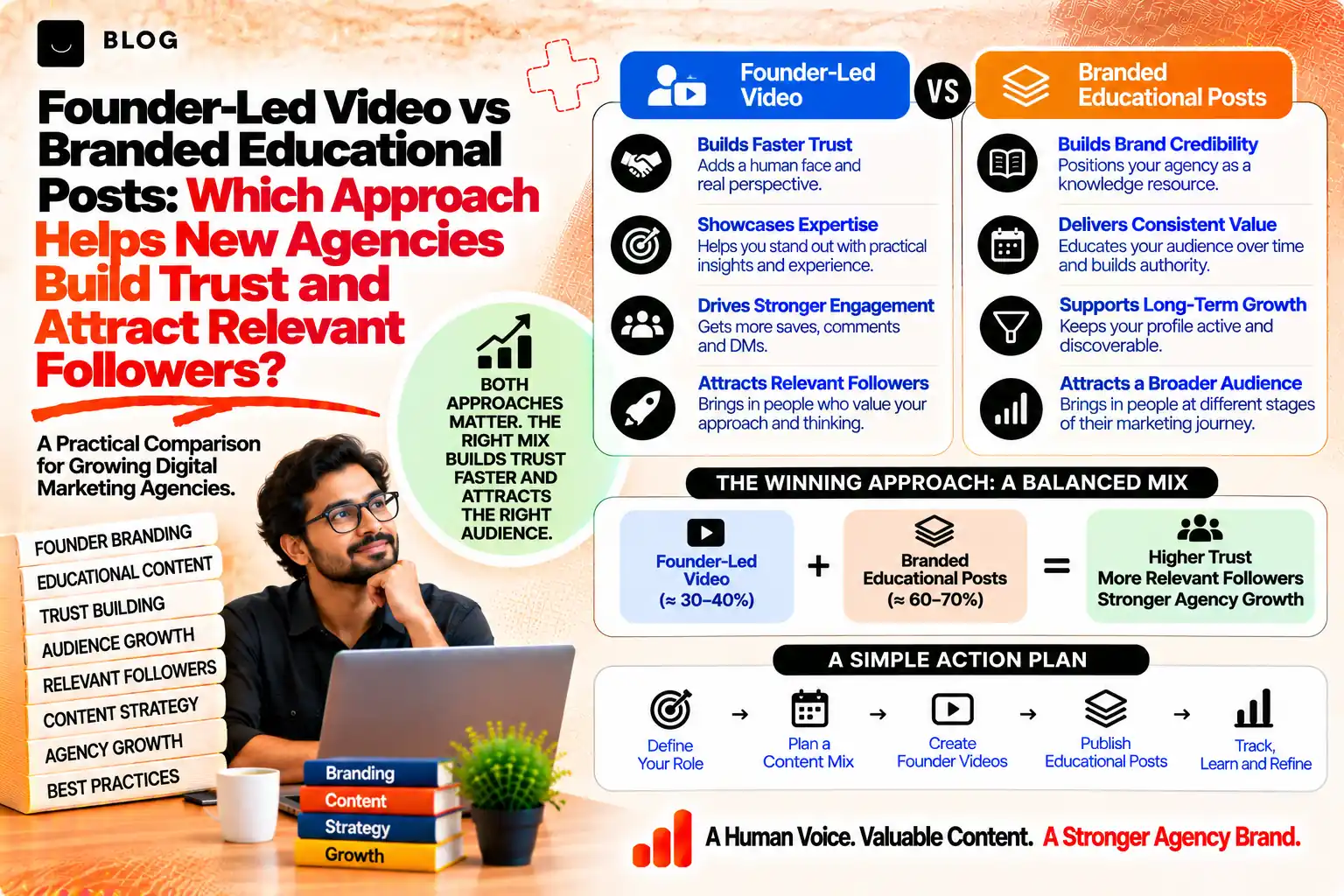
Founder-Led Video vs Branded Educational Posts: Which Approach Helps New Agencies Build Trust and Attract Relevant Followers?
A new agency has two obvious options for its Instagram. The founder can appear on camera, speaking to the audience in their own voice. Or the business can publish polished educational posts under the company name, with a consistent design and a clear message. Both can work. They build trust in different ways, and they ask for different amounts of time and confidence.
The choice matters most in the first year, when a new account has no reputation to borrow. A founder who is willing to be seen can attract followers who want to work with a person they know. A branded account can build a library of useful content quickly and let the business speak with one voice, even when the people behind it change.
This guide compares the two approaches on trust, reach, consistency, production effort and risk. It shows when each one suits a new agency, why many agencies combine them and how to decide what your founder can realistically sustain.
What a comparison of presenting styles can and cannot decide
It can show how each approach builds credibility, what it asks of the person presenting and how easily it can be kept going. It can help you decide who should appear on camera and what the rest of the content should look like.
It cannot decide whether a particular founder is good on camera, and it cannot guarantee followers or enquiries. Results depend on the quality of the content, the audience you reach and the next step you give people.
Founder-led video and branded posts at a glance
| Factor | Founder-led video | Branded educational posts |
|---|---|---|
| Who the audience meets | A real person, with a face, voice and opinions | The business, through its name, design and message |
| Main trust signal | Personal credibility and visible experience | Clarity, consistency and useful information |
| Typical content | Opinions, stories, lessons learned, answers to questions | Checklists, explainers, comparisons, process guides |
| Reach to new people | Often strong when the founder's perspective is distinctive | Depends on topic and format; reliable when content is evergreen |
| Consistency over time | Depends on the founder's time and comfort on camera | Easier to sustain with a planned calendar and templates |
| Production effort | Filming, editing and a person willing to show up | Design, writing and a clear template system |
| Risk | Dependence on one person; comments may be personal | Can feel impersonal if nothing shows who is behind the work |
Trust: why people buy from people
A new agency has no track record to point to. Potential clients are asking a simple question: who am I trusting with this? A founder on camera answers that question directly. Viewers see how the person speaks, what they care about and how they handle a hard question. For many service buyers, that impression matters more than a polished logo.
Branded educational posts build trust in another way. They show the business knows its subject, explains things clearly and gives something useful without asking anything in return. A prospect who has saved three checklists from an agency may trust its judgement before they have ever heard its founder speak.
Neither route is more trustworthy by default. A founder who speaks vaguely or avoids real opinions can undermine trust. A branded account full of generic tips can look like content for its own sake. The strongest accounts make the expertise visible and make the people behind it recognisable.
Reach and new followers
For a new account, reach usually depends on how well a post matches what people are looking for, whether or not they already follow the account. Both approaches can work.
Founder-led video can travel well when the opinion is specific and the story is clear. A short, distinctive take on a common frustration can attract people who share the view and want more. The risk is that generic opinions get little response, while controversial ones attract the wrong attention.
Branded educational posts travel well when they answer a common question clearly. A checklist built around a real buyer problem tends to be saved and shared, which helps it reach people who are not yet followers. The limitation is that similar informational posts appear across many accounts, so distinctive framing and original examples matter.
For a new agency, the better test is which approach brings in people who fit the ideal client. Relevant followers matter more than large numbers, and both formats can attract them when the topic is specific.
Consistency and production effort
Consistency is where many agencies fail, regardless of format.
Founder-led content depends on one person. It needs time to film, edit and respond to comments, and it can stop when that person is travelling, busy or tired. It works best when the founder has a repeatable routine, such as a monthly batch filming session, and a clear set of topics.
Branded educational content is easier to plan and hand over. Templates, a content calendar and a shared approval process let several people produce consistent posts. The trade-off is that the work must be designed carefully, or the account will feel like a template with no personality.
A useful rule: choose the approach your team can sustain for six months, not the one that looks best in the first week.
Risk and reputation
Founder-led video concentrates attention on one person. If the founder leaves, the account may need to change direction, and public comments can be personal. Clear boundaries help: decide which opinions to share, what to keep private and how to respond to criticism before it happens.
Branded content carries different risks. A business that publishes inaccurate or unsupported claims can damage trust quickly, and staff who are not named can feel disconnected from the account. Keep sources, check facts and show who does the work.
Which approach fits which business
Founder-led video tends to suit you if the founder is comfortable on camera or willing to become so, the business is built on personal judgement and relationships, your buyers choose partly on trust in an individual, and the founder can commit to a regular filming routine.
Branded educational posts tend to suit you if the founder prefers to stay behind the scenes, your team has several subject experts who can contribute, your sales depend on a clear process or comparison, or you need content that can continue when people change roles.
Most new agencies benefit from both. Let the founder appear in short videos that explain their point of view, and let the branded account carry the reference material: checklists, processes, comparisons and answers to common questions. Link the two, so a viewer who likes the founder can find the useful guides, and a reader who saves a guide can meet the person behind it.
Before deciding, ask whether the founder will show up on camera every week for at least six months, which opinions they are comfortable sharing publicly, who on the team can contribute expert content, what the one next step for viewers should be, and how you will measure whether trust turns into conversations.
Common mistakes to avoid
Expecting a founder to become a creator overnight. Comfort on camera grows with practice. Plan a few weeks of short, low-pressure clips before judging the format.
Scripting every word. Scripted founders often sound stiff. Use bullet points and speak from notes.
Publishing only generic tips under the company name. Without a point of view, branded content can look like anyone else's.
Letting the founder be the only voice. If the account depends entirely on one person, a holiday can stall it. Build a small bench of contributors.
Ignoring the call to action. Trust-building content still needs a next step, such as a save, a message or a booking link.
Judging by one post. Both formats need several weeks of results before you decide which to weight more heavily.
Conclusion
Founder-led video and branded educational posts answer the same question in different ways. The founder shows who is behind the work. The branded content shows what the business knows and how it helps. For a new agency, the strongest position is usually a visible founder and a useful library, linked so each supports the other.
For the next month, record three short founder clips and publish three branded guides. Compare which ones bring saves, messages and conversations, and adjust the mix from there.
If you would like help deciding how your founder and your brand should appear online, Crescent Digital Solutions can plan the content mix, script and edit founder videos, design the branded guides and track which approach brings the right enquiries.
Frequently asked questions
Neither is better in every case. Founder-led video builds trust through a visible person, while branded posts build trust through clear, useful content. Many new agencies use both.
Not at first. Comfort grows with practice. Short, low-pressure clips over several weeks are a fair test.
They can, when the opinion is specific and the story is clear. Reach varies by topic, so measure it over several weeks.
Yes, if they have the expertise and the confidence to speak about it. A team of contributors also protects the account if one person is unavailable.
Add your own examples, your own process and a clear point of view. Generic tips with no sources or experience rarely stand out.
Ready to build what's next?
Tell us where you're headed. We'll come back with a plan to get there.
Book an intro call