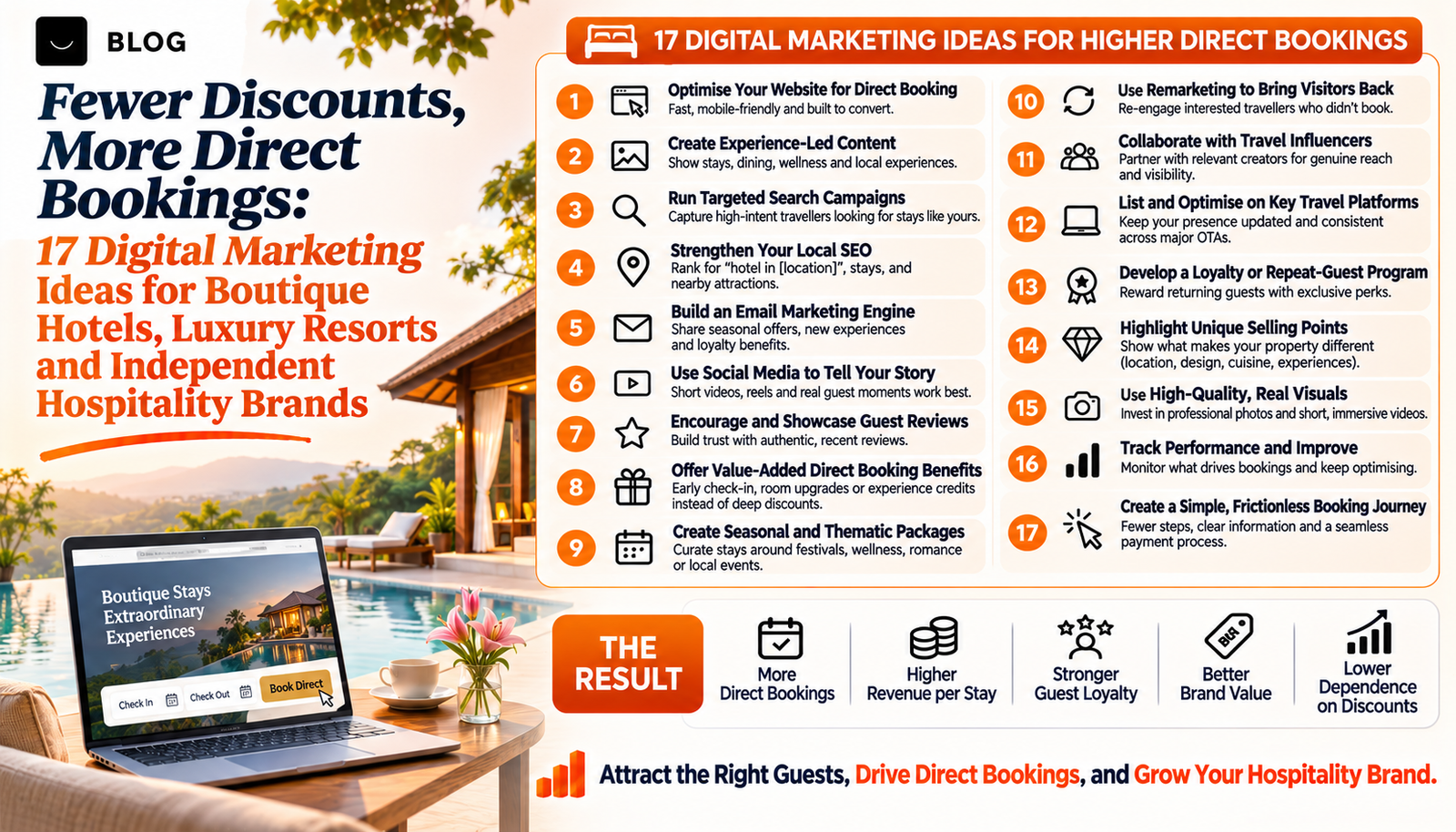
Fewer Discounts, More Direct Bookings: 17 Digital Marketing Ideas for Boutique Hotels, Luxury Resorts and Independent Hospitality Brands
Independent hotels often find themselves in the same trap. Online travel agencies bring bookings, but they also bring commission, and the guest relationship belongs partly to someone else. To fill the gaps, the hotel offers a discount, which trains guests to wait for the next one.
A guest who books direct has usually decided that your property fits what they want. Winning that decision does not depend on the lowest price. It depends on being easy to find, easy to trust, easy to book and different from the next listing.
This guide covers 17 digital marketing ideas for boutique hotels, luxury resorts and independent hospitality brands, grouped into five areas: being found, the website and booking experience, content and social media, email and loyalty, and paid media and measurement. Each idea has a practical action and a pitfall to avoid.
What direct-booking marketing can and cannot do
It can raise the share of guests who book with you, give you more control of pricing and guest data, and reduce reliance on discounts. It also builds a brand that guests remember, rather than a listing they compare.
It cannot replace online travel agencies altogether. They bring reach, especially to new audiences, and many hotels treat them as a discovery channel while working to convert repeat and returning guests direct. Commission terms and any rate-parity clauses vary by contract, so check your agreements before changing pricing or availability. Results also depend on your location, season and competition, so treat the ideas below as tests to measure, not guarantees.
Part 1: Be easy to find
1. A complete, accurate Google Business Profile
What to do: Claim your profile and keep the name, address, phone number, hours, categories, photos, amenities and website link current. Google's guidance says its AI search features can include information about local businesses and that keeping Business Profile details up to date helps.
Watch out for: Letting seasonal changes, such as closures and opening dates, lag behind.
2. Free booking links on Google
What to do: Google offers free booking links that can show your direct booking site in hotel results. Google says hotels pay no fee for them, bids do not affect their ranking and they are ranked on their usefulness to users. Connect your rates and availability through your booking engine or channel manager, or through Hotel Center, and confirm eligibility in Google's Hotel Center help.
Watch out for: Rates on the booking link that differ from your website. Mismatched prices cause drop-off and erode trust.
3. Destination content written from first-hand knowledge
What to do: Publish guides that only your team can write: a weekend itinerary near the property, seasonal tips, how to reach it, where the staff eat. Google's guidance prizes content with a unique point of view over summaries of what is already online.
Watch out for: Mass-producing near-identical "things to do in [town]" pages. Google warns that separate pages for every query variation can breach its scaled content abuse policy.
4. Consistent details for AI assistants
What to do: Make sure your room types, amenities, policies and contact information read the same on your website, Google profile and listing sites, and answer common guest questions in plain text. The AI search readiness checklist post covers the checks in detail.
Watch out for: Policies that exist only in a PDF or image.
Part 2: Make the website and booking experience win
5. Direct-only perks instead of blanket discounts
What to do: Offer benefits that cost you little but guests value, such as a welcome drink, early check-in, a room upgrade when available or a late checkout. Present them clearly beside the booking button.
Watch out for: Perks you cannot deliver reliably. Broken promises damage reviews.
6. A fast, simple booking path
What to do: Test the process on a phone. Show the total price early, keep the number of steps low, make the booking engine look like your brand and offer more than one way to ask a question, such as WhatsApp or phone.
Watch out for: Redirecting guests to a booking page that looks like a different company. Check the website checklist post for page-level fixes.
7. Room pages that sell the experience
What to do: For each room type, show real photos and a short video, the view, the size, a floor plan, who it suits and what is included. Describe the feeling and the practical details.
Watch out for: Stock images, or photos that flatter the room beyond reality.
8. Visible trust signals
What to do: Show recent guest reviews with their sources, your cancellation policy, accreditations you hold and any sustainability or wellness claims you can substantiate.
Watch out for: Claims that cannot be verified, such as "best hotel in the region".
Part 3: Content and social media that sells the stay
9. Show the stay, not the building
What to do: Post short videos and carousels of arrival, breakfast, the pool at sunset, the team preparing the rooms and a typical day. Instagram favours original content, and real footage of your property is exactly that. The Instagram content ideas post has formats you can adapt.
Watch out for: Polished imagery with no people. Guests want to imagine themselves there.
10. Guest content with permission
What to do: Invite guests to share their photos and ask permission before republishing, crediting them clearly. Consider a branded tag that makes sharing easy.
Watch out for: Using photos without consent, or relying on reposts for most of your feed, which can reduce eligibility for Instagram recommendations.
11. A seasonal and event calendar
What to do: Plan content around festivals, weddings, workations, school holidays and local events months ahead, so offers and posts reach guests while they are planning.
Watch out for: Last-minute campaigns with no time to build interest.
12. Partnerships with local businesses
What to do: Work with local chefs, guides, wedding planners, tour operators and artisans to create experiences, and co-promote them with clear terms.
Watch out for: Partnerships that do not fit your brand, or that rely on commission arrangements you have not set out in writing.
Part 4: Email and loyalty
13. Capture email addresses with permission
What to do: Ask for consent at booking, on the website and at check-in, and explain what subscribers will receive. Use a clear unsubscribe link in every email.
Watch out for: Buying lists or adding guests without consent. Follow the data protection and marketing rules that apply to your market.
14. Pre-arrival and post-stay emails
What to do: Send a pre-arrival message with useful information and optional extras like spa bookings or airport transfers, and a post-stay message that thanks guests, asks for feedback and invites them back.
Watch out for: Generic mail-merge messages. Reference the guest's trip where you can.
15. Recognition for returning guests
What to do: Create a simple way to recognise repeat guests, such as a room upgrade when available, a handwritten note or early access to new packages. Record preferences with consent so the team can use them.
Watch out for: Complicated points schemes that cost more to run than they return.
Part 5: Paid media and measurement
16. Protect your brand search and test metasearch
What to do: Run small, well-managed ads on your own brand name so that your direct site appears when guests search for you, and consider Google's hotel ads alongside free booking links. The Google Ads account checks post explains how to audit before raising budgets.
Watch out for: Spending heavily on generic terms without tracking bookings.
17. Measure direct share, not just revenue
What to do: Track the share of bookings by channel, cost per booking, repeat guest rate and the booking value of each source. Connect your booking engine to analytics so you can see which pages and campaigns lead to reservations.
Watch out for: Counting an OTA booking as a direct one because the guest first visited your website. Record the final booking channel.
Where to start
You do not have to do all 17 at once. This order suits most independent properties.
| When | Ideas | Why |
|---|---|---|
| Start now | 1, 2, 4, 6 | They make you findable and remove friction from the booking path |
| Next 30 days | 5, 7, 8, 13, 14 | Perks, room pages, trust signals and email build the direct offer |
| Next quarter | 3, 9, 10, 11, 12, 15, 16 | Content, partnerships, loyalty and paid media add depth and reach |
| Ongoing | 17 | Measurement shows which of the above is working |
Common mistakes to avoid
Competing on price alone. Discounts attract guests who compare on price, and they set an expectation you must keep meeting. Compete on experience and direct-only value.
Treating online travel agencies as the enemy. They reach people who do not know you yet. The goal is to convert returning and well-matched guests to book direct, not to disappear from the platforms.
Breaching rate-parity terms by accident. Review your agreements before offering direct-only rates or changing availability.
Letting photos and descriptions fall behind reality. Guests notice differences, and they show up in reviews.
Ignoring reviews. Reply to all of them, particularly critical ones, and fix recurring problems.
Not tracking the final booking source. Without it you cannot tell what is working, and budgets drift to the wrong channels.
Conclusion
More direct bookings come from a chain of small, practical improvements: being visible where guests look, offering a clear reason to book with you, making booking simple and staying in touch after the stay. None of them needs a discount, and each one strengthens the brand as well as the booking numbers.
Begin with the four "start now" ideas, measure your direct share each month and add the rest in order.
If you run a boutique hotel, resort or independent hospitality brand and want to build a stronger direct channel, Crescent Digital Solutions can review your website, search presence, social content and campaigns and recommend a prioritised plan. We work across SEO, web development, social media marketing and performance marketing, so the plan covers the whole guest journey.
← Back to all postsFrequently asked questions
Make the property easy to find, give guests a clear reason to book direct, such as added-value perks, and make booking fast on a phone. Then stay in touch by email so past guests return.
Google says hotels pay no fee for free booking links and that bids do not affect their ranking. You still need accurate rates, availability and a landing page, usually supplied through a booking engine, channel manager or Hotel Center.
Not necessarily. They reach guests who do not know you yet. A common approach is to use them for discovery while working to convert returning and well-matched guests to book direct. Check your contracts first.
Not always. Added-value perks such as early check-in, upgrades or a welcome drink can persuade guests without lowering your rate, though some properties also test a modest direct-only rate.
Track the share of bookings by final channel, cost per booking, repeat-guest rate and revenue per source. Connect your booking engine to analytics so you can see which pages and campaigns lead to reservations.
Ready to build what's next?
Tell us where you're headed. We'll come back with a plan to get there.
Book an intro call