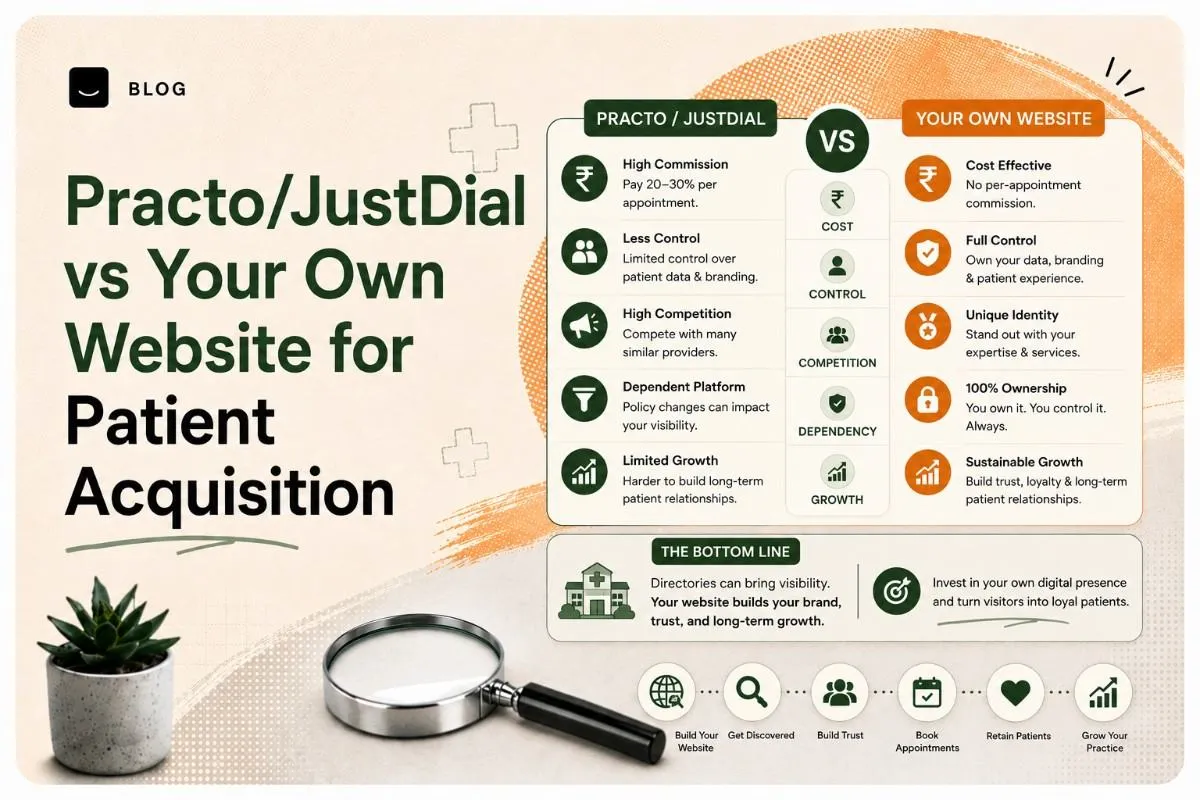
Practo/JustDial vs Your Own Website for Patient Acquisition
Most Indian doctors and clinics use directories like Practo and JustDial to get patients, and many rely on them entirely. The honest comparison: directories deliver patients faster, your own website delivers patients cheaper over time — and only one of the two is an asset you actually own.
This isn't an argument for abandoning directories. It's an argument for understanding exactly what each one does, and what it costs you, so you can decide deliberately rather than by default.
The short answer
Use directories to fill the calendar now. Build your own presence so you're not dependent on them in three years.
A new clinic with empty slots should absolutely be on Practo — the patients are already there, searching. But a clinic that's still getting 90% of its patients through a directory after five years has built someone else's business, not its own.
The cost per patient never stops, the relationship never becomes yours, and the platform can change its rules whenever it likes.
Side-by-side comparison
| Practo / JustDial | Your Own Website | |
|---|---|---|
| Time to first patient | Days | Weeks to months |
| Upfront effort | Low — create a profile | Higher — build, write, optimise |
| Ongoing cost | Recurring, and typically rises with volume | Mostly fixed hosting plus periodic updates |
| Who owns the patient relationship | The platform | You |
| Who you compete against | Every other doctor on the same page | Only search results, not a curated list |
| Control over how you're presented | Limited to the platform's template | Complete |
| Long-term compounding | None — stop paying, visibility stops | Content and authority accumulate |
| Visibility in AI search | Platform gets cited, you're a line item | Your clinic can be cited directly |
| Best at | Fast, high-intent patient volume | Trust, differentiation, durable acquisition |
What directories genuinely do well
It's worth being fair here, because a lot of marketing content dismisses directories unreasonably.
They have the demand already. Patients search Practo the way they search Google. Being listed puts you in front of people actively looking for a doctor in your speciality and city, today.
They remove friction. Profile, reviews, availability and booking in one place. A patient can go from searching to booked in under a minute — a conversion path most clinic websites never match.
They require almost nothing from you. No build, no content strategy, no technical work. For a solo practitioner with no marketing time, that's a genuine advantage.
They work immediately. SEO takes months. A directory listing works this week. For a new clinic, that difference is the difference between an empty diary and a full one.
Where directories cost you
You rent the relationship
Every patient who finds you through a directory found the directory first. The platform owns that discovery moment, and it can charge you for it indefinitely.
You're not building an audience — you're paying for access to someone else's, repeatedly.
You compete with the doctor beside you
A directory listing places you on a page full of alternatives, sorted by criteria the platform controls.
Your profile sits beside three similar doctors with similar ratings. Differentiation is nearly impossible when everyone gets the same template.
The cost rises with your success
Directory economics tend to scale against you. The more patients you want, the more visibility you need, and the more visibility costs.
There's no point at which the acquisition cost drops away — unlike content and search presence, which get cheaper per patient as they mature.
What your own website does that a listing can't
It lets you explain yourself. A directory profile shows credentials and reviews. A website lets you explain your approach, your speciality focus, what a first consultation involves, and why a nervous patient should choose you.
That's the difference between being listed and being chosen.
It answers questions before the call. Most patients have the same questions — consultation fees, timings, what to bring, whether you handle their specific condition, parking, insurance.
Answering these properly on your own site converts patients who would otherwise not have called at all.
It compounds. A useful page you write once keeps bringing patients for years. Directory visibility resets to zero the moment you stop paying.
It's the foundation for local search. Your website works together with your Google Business Profile to win "doctor near me" and map-pack visibility — an acquisition channel that runs parallel to directories and costs nothing per patient.
You control it. No platform policy change, ranking algorithm shift, or pricing increase can take it away.
The AI search factor most clinics haven't considered
Here's the newer dimension, and it's shifting the calculation.
Patients increasingly ask AI assistants — ChatGPT, Perplexity, Google's AI Overviews — questions like "best paediatrician in [city]" or "which doctor should I see for [condition] near me."
When an AI answers, it draws on sources it can read and trust.
If your only presence is a directory profile, the directory tends to get cited — you're one entry inside a page about many doctors.
If you have your own site with clear, specific, well-structured content about your speciality and location, your clinic can be named directly.
This is generative engine optimization (GEO), and it favours owned presence over rented listings in a way traditional search never did quite so sharply.
Clinics building their own content now are positioning for a discovery channel most of their competitors haven't noticed.
So which should you choose?
For most Indian clinics, the honest answer is both, in a deliberate ratio that changes over time.
- A brand-new clinic should lean heavily on directories. You need patients now, and SEO doesn't deliver in week one.
- An established clinic should be actively reducing directory dependence — not eliminating it, but making sure it isn't the only channel.
- A specialist with a differentiated practice benefits most from an owned presence, because a directory template can't communicate what makes you different.
- A clinic in a highly competitive urban market needs both: directories for volume, owned presence to stand out.
The failure mode isn't using directories. It's using only directories for years, and discovering you have no independent way to reach patients.
How to shift the balance over time
You don't need to choose overnight. A practical sequence:
- Keep the directory listings running. Don't switch off a working channel.
- Claim and complete your Google Business Profile — free, fast, and the highest-return owned asset for a local clinic.
- Build a real website with proper pages for each speciality or condition you treat, not a single-page brochure.
- Answer patient questions on it — fees, timings, what to expect, conditions you handle. This is what makes you findable and citable.
- Ask patients for Google reviews, not only directory reviews. Reviews on your own profile build an asset you keep.
- Track where new patients come from. A single "how did you hear about us?" question at reception tells you whether the balance is actually shifting.
- Re-evaluate the directory spend annually against what it's returning, once other channels are contributing.
Directories aren't the enemy — they're a tool that does one job well and another job not at all. Use them for what they're good at, and spend the time you save building something no platform can take away from you.
Want a patient acquisition plan that reduces your directory dependence over time?
Contact Crescent for a free consultation.
Frequently asked questions
They do different jobs. Directories like Practo deliver patients faster because the demand is already there, while your own website acquires patients more cheaply over time and remains an asset you own. Most clinics benefit from using both, leaning on directories early and building owned presence to reduce dependence over time.
A directory profile uses the same template as every competing doctor, and the platform owns the patient relationship. A website lets a clinic explain its approach, answer common patient questions, build local search visibility, and compound in value over time rather than resetting when payments stop.
A website and Google Business Profile typically take weeks to months to generate meaningful patient enquiries, compared with days for a directory listing. This is why new clinics usually need directories initially, while established clinics benefit from shifting the balance toward owned channels.
When a clinic's only presence is a directory profile, the directory itself tends to be cited as the source rather than the individual doctor. A clinic with its own clear, well-structured content about its speciality and location can be named directly in AI answers, which is why owned presence matters more in AI search.
A new clinic usually needs directories first, because they deliver patients within days while search visibility takes months to build. The recommended approach is to run directories for immediate volume while simultaneously building a Google Business Profile and website so dependence reduces over time.
Ready to build what's next?
Tell us where you're headed. We'll come back with a plan to get there.
Book an intro call