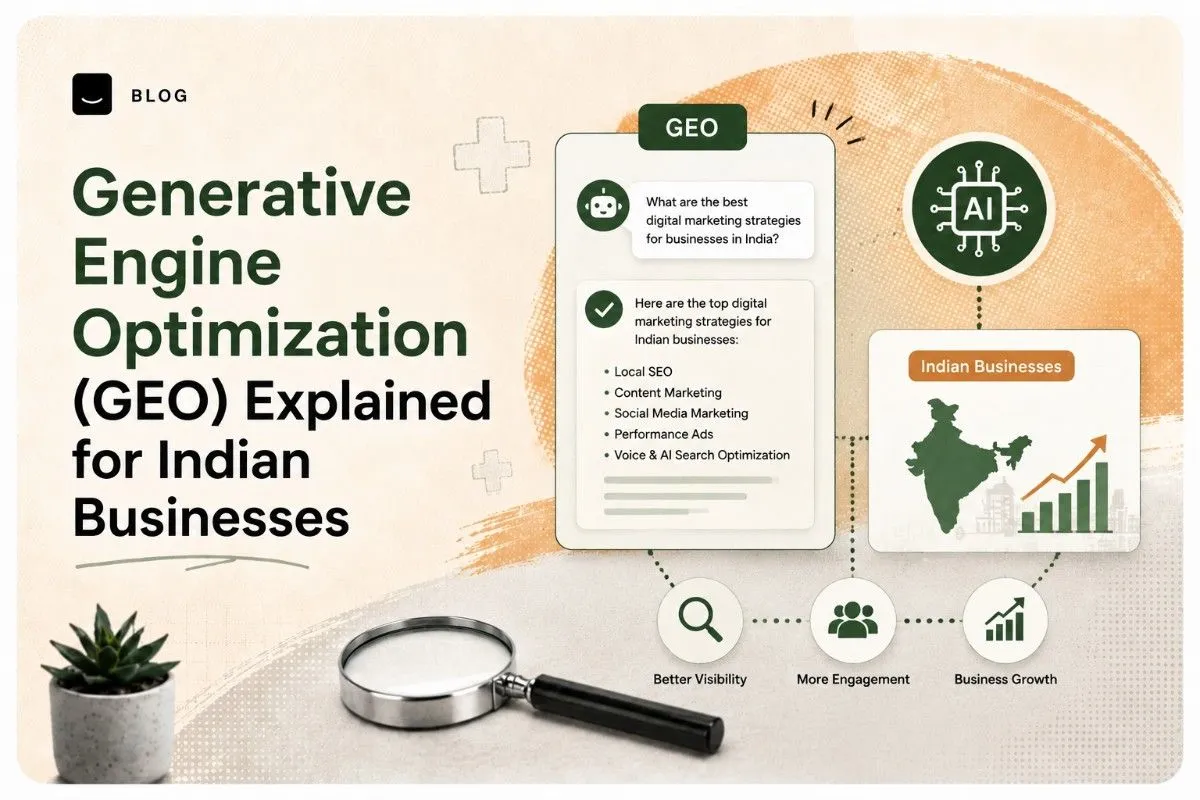
Generative Engine Optimization (GEO) Explained for Indian Businesses
Generative Engine Optimization (GEO) is the practice of shaping your content so AI answer engines — ChatGPT, Perplexity, Google's AI Overviews and Gemini — name your business when they answer a question. Traditional SEO competes for a click on a results page. GEO competes to be the source the AI cites inside its answer, before any click happens.
For Indian businesses, this shift is already underway. A growing share of buyers ask an AI assistant a question and act on the answer without visiting ten blue links. If your business isn't part of that answer, you're invisible to them — no matter how well you rank in classic search.
One clarification up front: on this site, and throughout this guide, GEO means Generative Engine Optimization — optimising to be cited by generative AI. It does not mean geographic or "geographical SEO." When we talk about ranking in a specific city, we call that Local SEO.
What is generative engine optimization (GEO)?
Generative engine optimization is the work of making your content the kind of source an AI model trusts, understands, and repeats. When someone asks ChatGPT or Perplexity "who's a good digital marketing agency in Udaipur?" or "how much does a solar system cost in India?", the model assembles an answer from sources it considers credible — and sometimes names them. GEO is how you become one of those named sources.
It sits alongside two related disciplines:
- SEO (Search Engine Optimization) earns rankings on a traditional results page.
- AEO (Answer Engine Optimization) earns featured snippets, People Also Ask boxes, and voice answers.
- GEO (Generative Engine Optimization) earns citations inside AI-generated answers.
They overlap heavily. Good GEO is built on good SEO — but it adds a new goal: being repeated, not just ranked.
GEO vs SEO: what actually changes?
The mechanics rhyme, but the target moves.
| SEO | GEO | |
|---|---|---|
| Goal | Rank a page, earn a click | Be cited inside an AI answer |
| Who "reads" you | A searcher scanning results | A language model synthesising an answer |
| Winning looks like | Position 1–3 on Google | Your brand named in ChatGPT / Perplexity / AI Overviews |
| Core levers | Keywords, links, technical health | Clear answers, entity signals, third-party mentions, freshness |
| Success metric | Traffic and rankings | Citation share and brand mentions in AI answers |
The most important difference: in GEO, a "win" often produces no click at all. The AI answers the question using you as the source, and the user never lands on your site. That feels strange to anyone raised on traffic metrics — but a citation still builds authority, trust, and brand recall, and it's frequently the moment a buyer first hears your name.
Why GEO matters for Indian businesses right now
Three things make this urgent, specifically in India.
AI-first search is growing fast here. India is one of the largest user bases in the world for AI assistants, and adoption is climbing in exactly the tier-2 and tier-3 markets where many Indian businesses compete.
Most Indian businesses haven't started. Global agencies write generic GEO advice for Western buyers. Very few publish India-specific, vernacular, or vertical playbooks. That gap is an opportunity: the businesses that build GEO authority now will be the ones AI models have learned to cite by the time competitors wake up.
The buyer journey has quietly changed. A customer researching a service increasingly opens ChatGPT or Perplexity before Google. If your competitors are the ones being named in those answers, you've lost the shortlist before the buyer ever reached a search results page.
How do AI answer engines decide who to cite?
No one has the full algorithm, and anyone claiming a guaranteed formula is overselling. But across how these systems behave, four factors show up consistently.
1. Clear, extractable answers
AI models favour content that answers a question plainly and early. A page that states its core point in the first two sentences — then supports it — is far easier to quote than one that buries the answer under five paragraphs of preamble. Lead with the answer.
2. Third-party mentions and consistency
Models weigh what other credible sources say about you, not just what you say about yourself. Being mentioned, listed, and reviewed across directories, publications and reputable sites reinforces that your business is real and relevant. Consistency of your name, address and details across the web matters more than most businesses realise.
3. Entity clarity
An AI needs to understand what your business is with zero ambiguity — the category you're in, where you operate, what you offer. Clear "about" content, structured data, and consistent naming help a model file you correctly and retrieve you for the right questions.
4. Freshness
AI answers lean toward recently updated, current information. Content that's obviously maintained tends to be favoured over pages that haven't been touched in years. A quarterly refresh habit is a genuine GEO advantage.
How to start with GEO: a practical checklist
You don't need new tools to begin. Start here:
- Answer real questions plainly. For each key topic, write the direct answer in the first 40–60 words, then expand.
- Add clear definitions and FAQs. Question-and-answer content is the format AI models extract most readily.
- Fix your entity signals. Make sure your business name, category, location and contact details are consistent everywhere they appear online.
- Earn third-party mentions. Get listed in credible directories and cited by real publications — the same off-page work that helps SEO helps GEO.
- Add structured data. Organisation, FAQ and relevant schema help models understand and trust your content.
- Keep content fresh. Update your most important pages on a regular cycle rather than publishing once and forgetting.
- Measure citations, not just clicks. Ask the major AI engines the questions you want to own, and track whether — and how — you get named. We cover exactly how in our guide on running an AI visibility audit.
GEO, AEO and SEO: do you need all three?
For most Indian businesses, yes — because they're layers, not alternatives.
SEO keeps you findable in traditional search, which still drives enormous volume. AEO wins the snippets and voice answers that sit above the results. GEO earns the citations inside AI answers that increasingly replace the click entirely. Skipping SEO to chase GEO is like building a roof with no walls — the foundation is shared, and GEO is strongest when it sits on genuinely good SEO underneath.
The good news: the work compounds. A clear, well-structured, frequently-updated page that earns third-party trust performs across all three at once.
Common GEO mistakes to avoid
- Treating GEO as a trick. There's no schema tag or hidden file that forces an AI to cite you. GEO is earned through genuine clarity and authority, not gamed.
- Confusing GEO with geographic SEO. They're different disciplines with an unfortunately shared acronym. Getting this wrong muddles your whole strategy.
- Chasing citations while ignoring the basics. If your entity signals are inconsistent and your content buries its answers, no amount of GEO effort will land.
- Publishing once and walking away. Freshness is a ranking and citation factor. Stale content quietly loses ground.
Want to know whether AI already mentions your business — and how to fix it if it doesn't?
Contact Crescent for a free consultation.
Frequently asked questions
Generative engine optimization (GEO) is the practice of shaping content so AI answer engines like ChatGPT, Perplexity, Google's AI Overviews and Gemini cite your business when they answer a question. It focuses on being named as a source inside an AI answer, rather than only ranking on a traditional results page.
No. GEO stands for Generative Engine Optimization — optimising to be cited by generative AI answer engines. It is not geographic or geographical SEO. Ranking in a specific city is called Local SEO, which is a separate discipline.
SEO aims to rank a page and earn a click on a search results page. GEO aims to be cited inside an AI-generated answer. The two share a foundation — clear, credible, well-structured content — but GEO adds the goal of being repeated by a language model, often with no click involved.
While the exact process isn't public, AI answer engines consistently favour content with clear, extractable answers, strong and consistent third-party mentions, unambiguous entity signals about what the business is, and recently updated information.
Most need all three, because they are layers rather than alternatives. SEO keeps a business findable in traditional search, AEO wins featured snippets and voice answers, and GEO earns citations inside AI answers. They share the same foundation, so the work compounds. Generative engine optimization isn't a replacement for everything you already do — it's the next layer, and Indian businesses are unusually early to it. The ones that start now will be the names AI answer engines have learned to trust.
Ready to build what's next?
Tell us where you're headed. We'll come back with a plan to get there.
Book an intro call