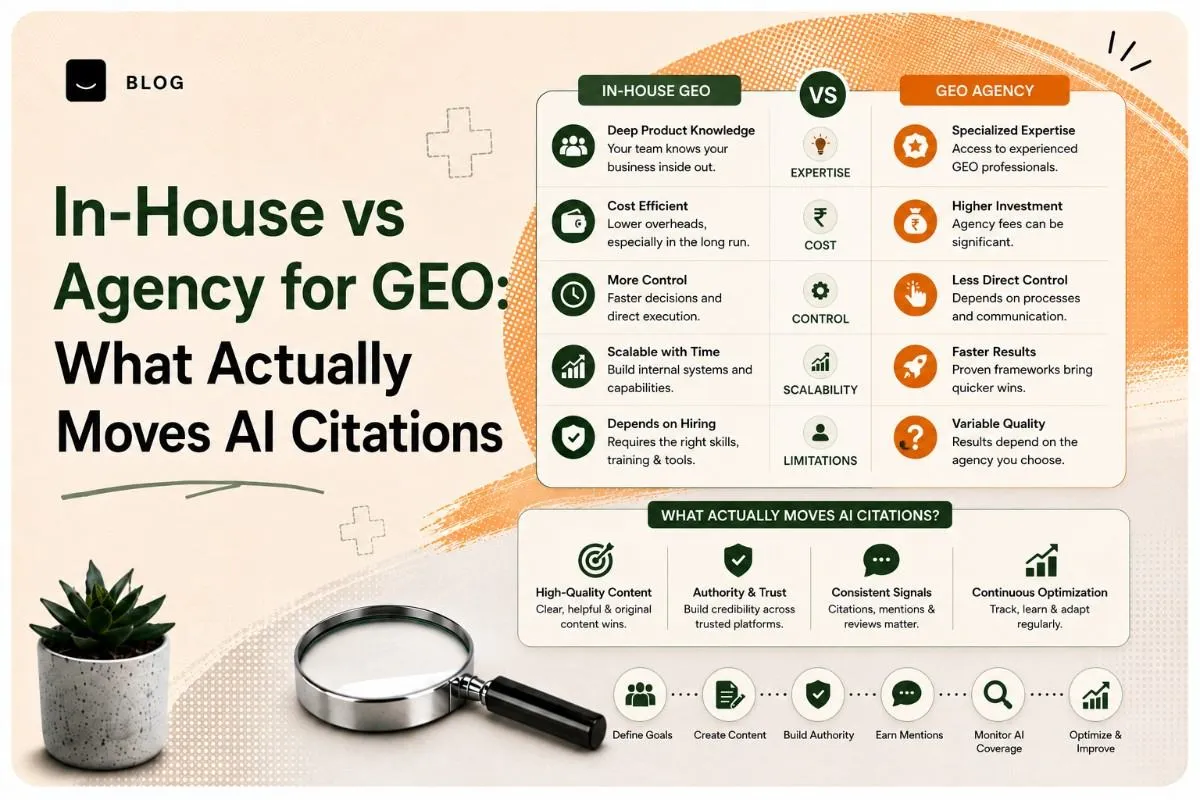
In-House vs Agency for GEO: What Actually Moves AI Citations
Whether to build generative engine optimization in-house or hire an agency comes down to one question: do you already have someone who can write genuinely authoritative content about your business, consistently, every month? what GEO actually is (and is not)
If yes, in-house is usually cheaper and better. If no, an agency fills a gap that hiring won't fill quickly.
That's the honest version. GEO isn't a technical specialism you can buy your way out of — the single biggest driver of AI citations is content that genuinely knows what it's talking about, and that's often easier to find inside a business than outside it.
Terminology: GEO means Generative Engine Optimization — being cited by AI answer engines like ChatGPT, Perplexity and Google's AI Overviews. Not geographic SEO.
What GEO work actually involves
Before comparing, it's worth being specific about the work, because "GEO" gets sold as something more mysterious than it is. In practice it's five things:
- Content that answers real questions clearly — the largest share of the effort by far.
- Entity and consistency work — making your business details identical everywhere online so models know who you are.
- Technical access — making sure AI crawlers can read your site, and your structured data is clean.
- Third-party presence — being mentioned and reviewed on sources models trust.
- Measurement — tracking citation share, referral traffic and branded search lift over time. How to run an AI visibility audit
Notice that only items 3 and 5 are genuinely specialist. Items 1, 2 and 4 depend more on subject knowledge and consistent execution than on GEO expertise.
Side-by-side comparison
| In-House | Agency | |
|---|---|---|
| Subject expertise | Strong — you know your business | Needs to be transferred, takes time |
| Speed to start | Slow if hiring; fast if someone already exists | Fast — they start with a process |
| Cost | Salary (fixed, ongoing) | Retainer (flexible, scalable) |
| Consistency | Depends on protecting the time | Contractual — output is the deliverable |
| Tooling | You buy it | Included, usually better |
| Technical depth | Rare in a generalist marketer | Standard |
| Knows what's changing | Hard to keep up alongside other work | It's their job to track it |
| Risk | Person leaves, capability leaves | Agency leaves, you keep the content |
When in-house is the right call
You already have a subject-matter writer. If someone in your business can write authoritatively about your field and has the time protected, you have the hardest part of GEO already.
A doctor who writes, a founder who explains their category well, an engineer who can be interviewed — that's the raw material agencies spend the most effort trying to extract from clients.
Your category is narrow and technical. In a highly specialised field, the learning curve for an outsider is steep and the content risks being generic. Generic content doesn't get cited.
You publish frequently and want speed. An internal person can publish the same afternoon. Agency cycles involve briefs, drafts and approvals.
Budget is genuinely tight and time isn't. If someone can spend a few focused hours a week and you can wait longer for results, in-house is the cheaper path.
When an agency is the right call
Nobody currently has the time. This is the most common real reason, and it's a good one.
GEO fails on inconsistency more than on strategy — three months of publishing followed by six months of nothing produces nothing. An agency's structural advantage is that the work happens whether your team is busy or not.
You need the technical layer done properly. Crawler access, schema, site structure and measurement setup are genuine specialisms. Even businesses that keep content in-house often outsource this once.
You're starting from zero and want a system, not experiments. An agency arrives with a process — prompt sets, content structure, measurement — instead of building it by trial and error.
You need multiple skills at once. GEO touches content, technical SEO, and analytics. Hiring one person who does all three well is hard and expensive; an agency spreads that across a team.
You want to compare notes across clients. An agency working across several businesses sees which tactics move citations faster than a single in-house team can learn from one dataset.
The hybrid model most businesses land on
In practice, the most effective arrangement is usually split rather than either-or:
- In-house keeps the subject expertise — your people supply the knowledge, answer questions, review for accuracy, and are named as authors. This matters more than it sounds: named, credentialed authors are themselves a GEO signal.
- The agency handles structure, technical work and consistency — turning that knowledge into properly structured content, fixing entity signals, managing schema and crawler access, and reporting on citation share.
This works because it puts each side on what it's actually good at. The business supplies authority; the agency supplies execution and specialism.
A pure agency model that never extracts real internal expertise tends to produce content that reads plausible and gets ignored by both readers and models.
What to ask a GEO agency before hiring
Five questions that separate substance from pitch:
- "How will you measure this?" Measuring what GEO returns They should describe citation share tracking, referral segments and branded search lift — not just traffic. If measurement is vague, so is the work.
- "How will you get my expertise into the content?" Look for a real process — interviews, subject-matter reviews, named authorship. "We'll research it" usually means generic output.
- "What will you do in the first 90 days?" Expect entity fixes, technical access checks, and a baseline audit before content volume. Anyone starting with volume is skipping the foundation.
- "What can't you promise?" A credible answer exists. GEO has no guaranteed placements, and anyone who won't say that is overselling.
- "What happens if I leave?" Content and site improvements should stay yours. Ask explicitly what you keep.
Red flags in a GEO pitch
- Guaranteed AI citations or rankings. Nobody controls what an AI cites. This is the clearest tell.
- "Secret" techniques or proprietary tricks. GEO is largely public knowledge applied consistently. Mystery usually covers thin substance.
- Pure volume plans. "Forty articles a month" with no expertise input produces content models don't cite.
- No measurement plan beyond traffic. GEO's biggest wins are zero-click; measuring only sessions guarantees the reporting will look like failure or fiction.
- llms.txt sold as the solution. It's cheap infrastructure with uncertain payoff, not a strategy.
What it costs either way
Rather than quote figures that would be guesses, here's how to compare honestly:
In-house cost = the salaried time actually spent (not the intent to spend it) + tooling + the opportunity cost of what that person stops doing.
The common failure is counting only the first item.
Agency cost = the retainer, plus your internal time for briefing and review — which is never zero, and is exactly the time that determines whether the output is authoritative or generic.
The more useful comparison isn't monthly cost but cost per published, genuinely authoritative piece, tracked over six months. why updated content wins AI citations
In-house often looks cheaper on paper and more expensive in practice, because the output rate is lower than planned. Agencies look more expensive monthly and often produce more consistently.
Measure the actual output, not the intended one.
Want an honest assessment of whether you need an agency for this?
GEO consulting from Crescent Contact for a free consultation — we'll tell you if you don't.
Frequently asked questions
It depends mainly on whether you already have someone who can write authoritatively about your business every month with protected time. If you do, in-house is usually cheaper and produces more credible content. If you do not, an agency provides consistency and technical specialism that hiring would take a long time to build.
Five things: creating content that answers real questions clearly, making business entity details consistent across the web, ensuring AI crawlers can access the site and structured data is clean, building third-party mentions on trusted sources, and measuring citation share, referral traffic and branded search lift.
No. No agency controls what an AI answer engine cites, and a guarantee of citations or rankings is a clear warning sign. A credible agency will explain what it cannot promise and describe how it measures progress instead.
In the hybrid model, the business supplies subject expertise through interviews, accuracy review and named authorship, while the agency handles content structure, technical work such as schema and crawler access, entity consistency and measurement. It matches each side to what it does best.
Compare cost per published, genuinely authoritative piece over six months rather than monthly cost. In-house costs should include tooling and the opportunity cost of the time actually spent, while agency costs should include your own briefing and review time, which determines whether the output is authoritative or generic. There's no universal answer, and any agency telling you there is has an interest in the conclusion. If you have protected internal expertise and time, start in-house. If you don't, an agency buys consistency and specialism you'd otherwise take a year to build. Most businesses end up somewhere in the middle — and that's usually the right place to be.
Ready to build what's next?
Tell us where you're headed. We'll come back with a plan to get there.
Book an intro call