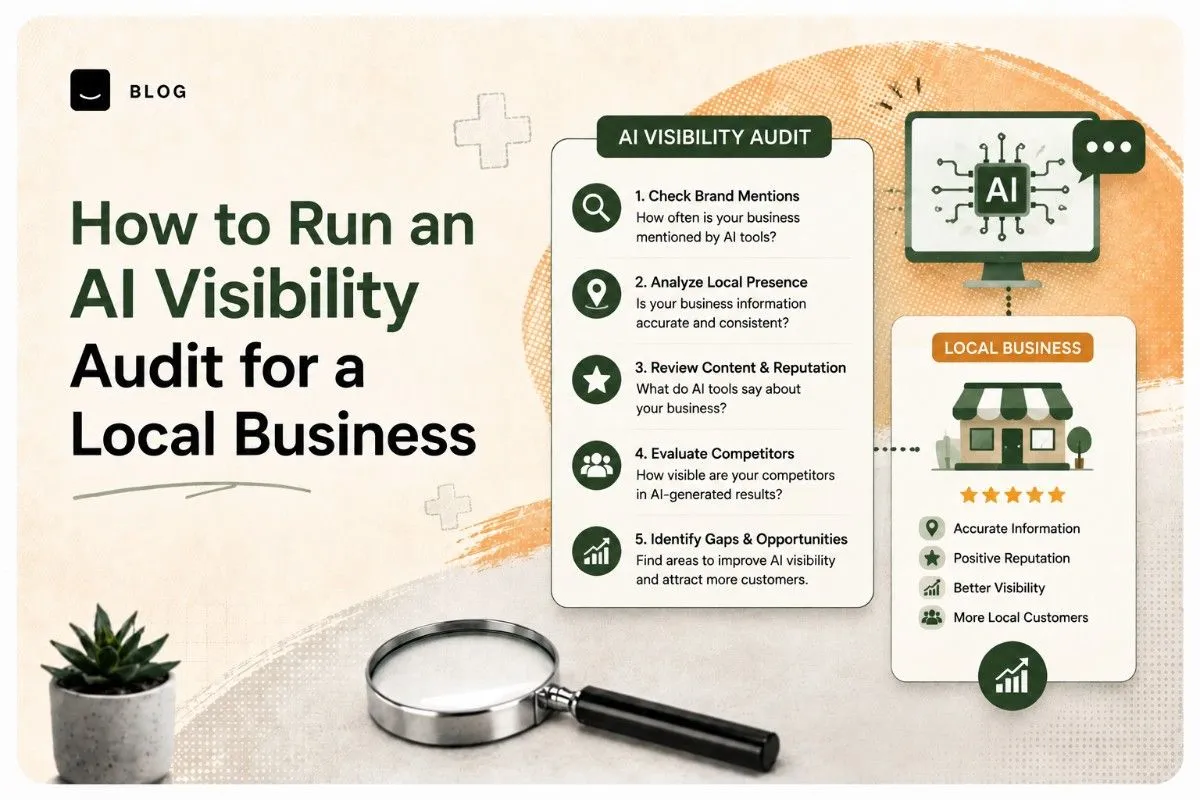
How to Run an AI Visibility Audit for a Local Business
An AI visibility audit checks whether AI answer engines — ChatGPT, Perplexity, Gemini and Google's AI Overviews — mention or cite your business when people ask the questions you should be the answer to. You can run a basic one in about an hour, with no paid tools, using nothing but the free versions of the major AI assistants.
It's fast becoming an essential check. Buyers increasingly ask an AI assistant for recommendations before they ever open a search results page. If the AI names your competitors and not you, you've lost the shortlist silently — and the only way to know is to look. why AI answers name some businesses and not others
What is an AI visibility audit?
An AI visibility audit is a structured test of how — and whether — AI answer engines represent your business. You ask the AI the real questions your customers ask, then record whether your business appears, whether it's cited as a source, and how accurately it's described.
It's the AI-era equivalent of Googling yourself, but more revealing: instead of checking a ranking, you're checking whether the machine that increasingly replaces the ranking knows you exist. You need also test the Google's Rich Results Test if your website is have structured data or not
Also know - turning AI mentions into measurable leads
Why AI visibility matters now
Traditional SEO tells you where you rank. It doesn't tell you whether ChatGPT recommends you. Those are now two different questions, and the second one is growing in importance every quarter.
When an AI answer engine names a business, it does two things at once: it puts you on the buyer's shortlist, and it lends you the engine's own credibility. When it omits you, neither happens — and unlike a low Google ranking, there's no results page for the buyer to scroll down and find you anyway. You're simply not in the answer.
What you'll need before you start
Nothing paid. Just:
- Free access to ChatGPT, Perplexity and Gemini (and Google Search, to see AI Overviews).
- A simple spreadsheet to record results.
- A short list of your main competitors.
- 45–60 minutes of focused time.
Step 1: Build your question list
List 10–20 questions a real customer would ask an AI assistant when looking for what you offer. Mix three types:
- Category + location: "best digital marketing agency in Udaipur", "solar installers near Bhopal".
- Problem-based: "how do I get more patients for my clinic", "who can build an ecommerce website in India".
- Comparison / shortlist: "top social media agencies in India", "which agency is good for startups".
Write them the way a person actually talks to an AI — full, natural questions, not keyword fragments. These prompts are your new keywords.
Step 2: Test the main AI engines
Ask each question in each engine — ChatGPT, Perplexity, Gemini, and Google (watch for an AI Overview). Use a fresh chat each time so past conversation doesn't skew the answer, and avoid signing in with an account that already knows your brand, which can bias results.
Read each answer carefully. You're looking for three things: is your business there, are your competitors there, and is anything about you wrong.
Step 3: Record mentions vs citations
This distinction matters. In your spreadsheet, mark each result as:
- Cited — the AI named your business and linked or clearly attributed it as a source. The strongest outcome.
- Mentioned — your business came up, but without a link or clear source attribution.
- Absent — you didn't appear at all.
- Inaccurate — you appeared, but the details were wrong (wrong service, wrong location, outdated info).
A wall of "Absent" and "Inaccurate" rows is exactly what this audit exists to surface. Wrong information can be worse than absence — it actively misinforms a buyer.
Read More- Rethinking SEO KPIs for AI search
Step 4: Check your competitors
For every question where you're absent, note who did appear. Then look at why. Do they have a detailed page answering that exact question? Strong reviews? Mentions across directories and publications? Fresh, recently-updated content?
This turns the audit from a scoreboard into a map. Your competitors' presence shows you precisely what "being citable" looks like in your category.
Step 5: Diagnose why you're missing
Most absence traces back to a short list of fixable causes:
- No content that answers the question. The AI can't cite an answer you never published.
- Answers buried too deep. Your page may cover the topic, but not plainly or early enough to be extracted.
- Weak or inconsistent entity signals. Your business name, category and location aren't consistent across the web, so the model isn't confident what you are.
- Thin third-party presence. Few directories, reviews or citations reinforce that you're real and relevant.
- Stale content. Your pages haven't been updated in a long time, and AI answers favour current information.
Step 6: Turn findings into an action list
Convert the audit into a ranked to-do list. A practical order:
- Fix inaccuracies first. Wrong information actively costs you — correct the source pages and directory listings feeding it.
- Create answer content for high-value questions where you're absent but competitors appear.
- Tighten entity signals — make your name, category, location and contact details identical everywhere.
- Build third-party presence — credible directories, reviews, and genuine mentions.
- Refresh your most important pages and set a recurring update cycle.
This list is your generative engine optimization roadmap — the audit just showed you where to point it. Know more about why AI cites recently updated content
How often should you re-run the audit?
Quarterly is a sensible baseline for most local businesses. AI answers shift as models update and as your competitors publish, so a once-a-year check misses too much. Re-run sooner if you've just made a big push on content or reviews and want to see whether the AI has caught up.
Want us to run a full AI visibility audit for your business and hand you the fixes?
Contact Crescent for a free consultation on Crescent's AI search visibility services
Frequently asked questions
An AI visibility audit is a structured test of whether AI answer engines like ChatGPT, Perplexity, Gemini and Google's AI Overviews mention or cite your business when people ask the questions your customers ask. You record whether your business appears, whether it is cited as a source, and whether the details are accurate.
Ask ChatGPT the real questions your customers would ask — such as category-plus-location or comparison questions — using a fresh chat, and record whether your business is named, whether it is cited as a source, and whether the description is accurate. Repeat across Perplexity, Gemini and Google's AI Overviews for a full picture.
A mention is when the AI names your business without a clear link or source attribution. A citation is when the AI names your business and attributes or links it as a source. Citations are the stronger outcome because they pass the engine's credibility to your brand and can drive a click.
No. A basic AI visibility audit can be run for free using the standard versions of ChatGPT, Perplexity and Gemini plus Google Search, along with a simple spreadsheet to record results. Paid tools can automate and scale the process, but they are not required to start.
Quarterly is a sensible baseline for most local businesses, because AI answers change as models update and competitors publish new content. Run one sooner after a significant content or reviews push to see whether AI answers have caught up. You can't improve what you haven't measured. An AI visibility audit takes an hour and tells you something no rank tracker can: whether the AI assistants your customers now ask are recommending you — or quietly sending them to someone else.
Ready to build what's next?
Tell us where you're headed. We'll come back with a plan to get there.
Book an intro call