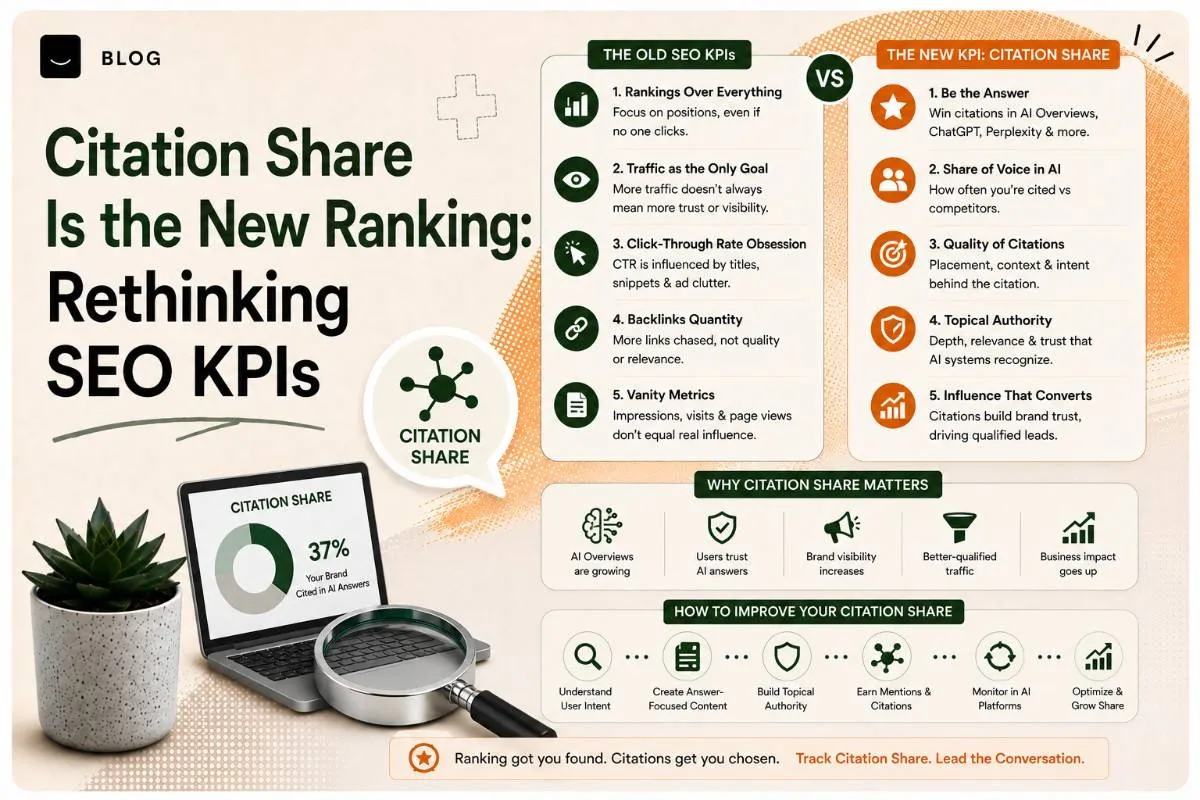
Citation Share Is the New Ranking: Rethinking SEO KPIs
For twenty years, "where do we rank" was close enough to "are we visible" that businesses could use the two interchangeably. That is no longer reliably true. A page can rank in position one and still lose the visitor to an AI-generated answer sitting above it — an answer that may or may not mention the business at all.
Citation share — how often a business is named as a source in AI-generated answers — is emerging as the metric that actually tells you whether you're visible in the place buyers increasingly look first.
This is not a replacement for rank tracking. It's an addition that's become necessary, and most reporting hasn't caught up yet. Its how generative engines pick their sources
The KPI that made sense until it didn't
Ranking position worked as a proxy for visibility because, for most of search history, a high ranking reliably led to a click.
The assumption baked into every SEO report was simple: rank higher, get more clicks, get more business. That chain held well enough that "position" became the default way agencies and businesses talked about success.
The chain still holds in many searches. But a growing share of queries now end with an AI-generated answer sitting above the results — and when that happens, a meaningful share of searchers get their answer and never scroll down to click anything.
A business can improve its ranking and see traffic stay completely flat, because the ranking improvement never converts into a visit the way it used to.
Must Read :- How GEO ROI gets measured
What citation share actually measures
Citation share is the proportion of a defined set of relevant questions where an AI answer engine — ChatGPT, Perplexity, Gemini, Google's AI Overviews — names your business as a source when answering.
You build a fixed list of the real questions your customers ask, test it across the major engines on a regular schedule, and track how often you're actually named.
It's a different kind of number than a ranking.
A ranking is discrete and mechanical — position one, four, or twelve on a specific results page. refreshing content so AI keeps citing it
Citation share is closer to a batting average: out of the questions that matter to your business, how many currently produce your name in the answer.
Why ranking #1 no longer guarantees what it used to
Two businesses can rank identically well for the same term and have completely different outcomes if only one of them is also the source an AI answer cites.
The one that's cited gets named directly in front of the searcher, inside an answer they're actively reading. The one that isn't gets a ranking that increasingly sits below content the searcher may never scroll to.
This doesn't mean rankings stopped mattering — a page usually has to be genuinely good, and often has to rank reasonably well, before it becomes a source an AI system trusts enough to cite.
But ranking well is now a precondition for citation, not a guarantee of visibility on its own.
Reporting that stops at position is reporting half the picture.
Citation share vs mention share — a real distinction
Not every appearance in an AI answer is equal, and lumping them together produces a misleading number.
Citation is when an AI answer names your business with clear attribution — a link, or an unambiguous "according to [business]."
Mention is when your business comes up in the answer without that clear sourcing — present, but not credited as clearly.
Both have value: a mention still puts your name in front of a reader. But a citation carries more weight, because it's the version that most directly builds recognisable authority and, where a link is included, can actually drive a visit.
A useful monthly practice is tracking both separately rather than folding them into one combined number — the ratio between them tells you something a single blended figure hides.
How this changes what a monthly report should contain
Most SEO reports are still built entirely around rankings and organic traffic.
That's not wrong, but it's increasingly incomplete.
A report built for the current search landscape should include citation share alongside the traditional metrics, not instead of them — tracked against a fixed set of real customer questions, tested consistently across the same AI engines month over month.
It should also separate the cited-versus-mentioned split, since a business climbing from mostly "mentioned" to mostly "cited" is making real progress that a combined number would hide.
And it should track branded search — when an AI answer doesn't include a link, the natural next step for an interested user is often to search the business name directly, which shows up in Search Console as rising branded queries.
That's an imperfect but genuinely useful proxy for the zero-click visibility that citation itself doesn't otherwise reveal in traffic numbers.
What doesn't change
None of this makes rankings, technical SEO or content quality irrelevant — if anything, they matter more, because they're now the entry requirement for citation rather than the finish line.
A page that doesn't rank well and isn't technically sound is unlikely to be cited either.
Citation share sits on top of solid SEO fundamentals; it doesn't replace them, and treating it as a shortcut around good foundational work misunderstands what it's actually measuring.
A simple way to start tracking it this month
You don't need specialised tools to begin, an AI visibility audit for a local business though they help at scale once the habit is established.
- Write down 15-20 real questions your customers ask, in their own words.
- Ask each one in ChatGPT, Perplexity and Gemini, plus Google for an AI Overview, using a fresh session each time.
- Record for each: cited, mentioned, absent, or inaccurate.
- Calculate citation share as a simple percentage — questions where you were cited, divided by total questions tested.
- Repeat monthly on the same question list, and watch the trend rather than fixating on any single month's number.
The absolute figure matters less than the direction.
Movement from three cited answers out of twenty to nine out of twenty over a few months is a real, trackable result — the same way a ranking report has always tracked movement rather than treating a single snapshot as the whole story.
Conclusion
Rankings answer "can I be found."
Citation share answers "am I the answer."
Both questions matter now, and a report that only answers the first one is describing a search landscape that no longer fully exists.
The businesses that start tracking citation share now will simply understand their own visibility more accurately than the ones still reading a rankings report as if it were the complete picture.
Want your citation share measured against the questions your actual customers ask?
Contact Crescent for a free consultation and explore our search and AI visibility services to understand how your business appears across traditional search and AI-generated answers.
Frequently asked questions
Citation share is the proportion of a defined set of relevant customer questions where an AI answer engine such as ChatGPT, Perplexity, Gemini or Google's AI Overviews names a business as a source when generating its answer. It is measured by testing a fixed question list across the major engines on a regular schedule.
No. Citation share adds to ranking-based metrics rather than replacing them, since ranking well and having technically sound content are generally a precondition for being cited by an AI answer engine. Citation share reveals whether that ranking is also translating into visibility inside AI-generated answers.
A citation is when an AI answer names a business with clear attribution, such as a link or an unambiguous credit. A mention is when the business comes up in the answer without that clear sourcing. Citations generally carry more weight for building recognisable authority and driving visits.
Write a fixed list of fifteen to twenty real customer questions, ask each one in ChatGPT, Perplexity and Gemini using a fresh session, and record whether the business is cited, mentioned, absent or described inaccurately. Repeat monthly on the same question list and track the percentage cited over time.
A growing share of searches now end with an AI-generated answer appearing above the results, and many searchers read that answer without scrolling down to click anything. A page can rank well and still see flat traffic if it is never named as a source in the AI answer sitting above the results.
Ready to build what's next?
Tell us where you're headed. We'll come back with a plan to get there.
Book an intro call