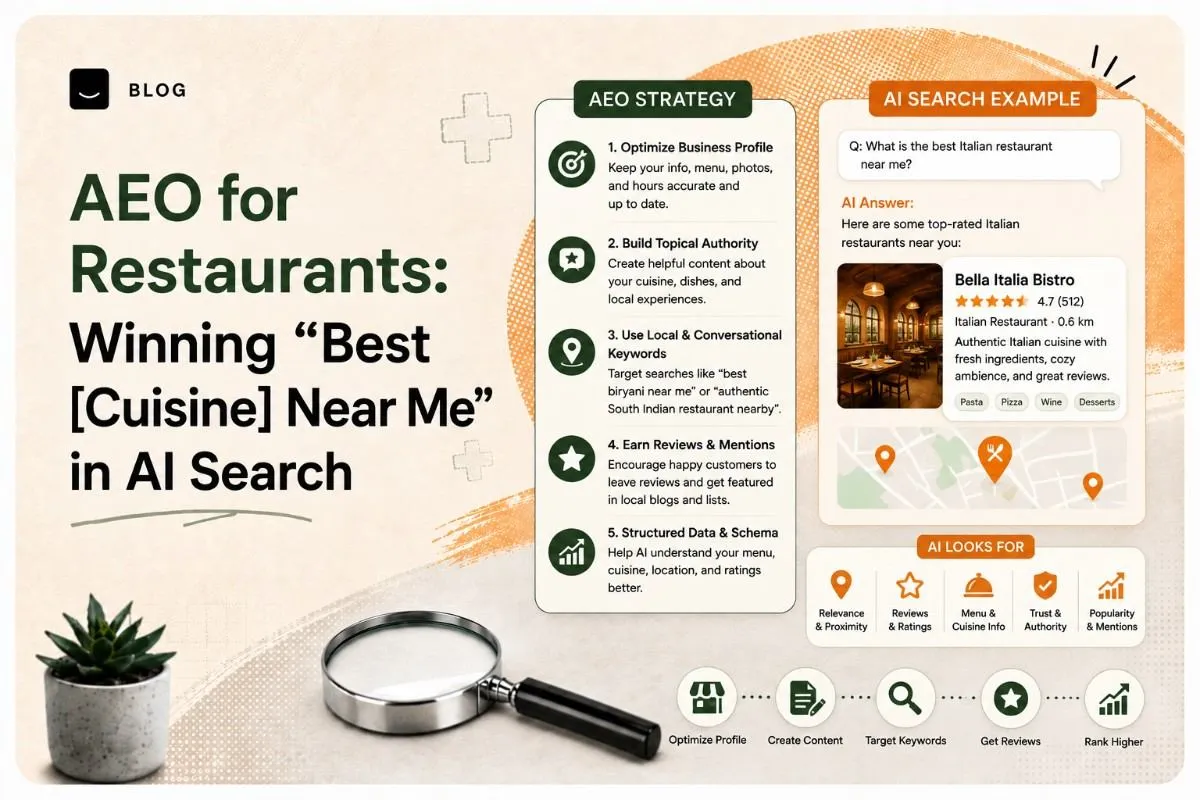
AEO for Restaurants: Winning "Best [Cuisine] Near Me" in AI Search
AEO for restaurants — answer engine optimization — is the work of making your restaurant the one that gets named when a diner asks Google, ChatGPT or Gemini for the best place to eat nearby. It's how you show up in AI Overviews, featured snippets and voice answers, not just in the list of results below them.
The shift is already visible. A diner used to search "best biryani near me" and scroll a list. Now they increasingly get a short answer naming two or three places — and those places get the booking. Everyone else is invisible, no matter how good the food is.
What is AEO for restaurants?
Answer engine optimization is structuring your restaurant's online presence so search and AI systems can confidently answer a question with your name in it.
That's a different goal from traditional SEO. Ranking fifth on a results page still gets you seen by someone scrolling. Being absent from an AI answer means you're not in the conversation at all — there's no scrolling past the answer to find you.
For restaurants, this is closely tied to local search and, increasingly, to GEO (Generative Engine Optimization — being cited by AI assistants). The three overlap heavily here, because a restaurant recommendation is almost always a local recommendation.
How diners actually search now
Diner queries have become conversational and specific. Instead of "restaurants Bhopal", people ask things like:
- "Where can I get good vegetarian food near me that's open now?"
- "Best place for a family dinner with parking nearby"
- "Which restaurants near me are good for a birthday?"
- "Cheap places to eat close to [landmark]"
Notice what these have in common: they're full questions, they carry constraints (open now, parking, family, budget, occasion), and they're phrased the way someone would speak.
Answer engines are built to handle exactly this — and they answer using whatever information they can find and trust about your restaurant.
If nothing on the internet clearly states that you're vegetarian-friendly, have parking, and take family bookings, you can't be the answer to that question.
What AI engines look at when recommending a restaurant
Reviews — and what's in them
For restaurants, reviews carry unusual weight. But it isn't only the star rating. AI systems read the text of reviews, and that text is often where the specific details live — whether the place is good for groups, whether the service is fast, whether the parking is easy.
This means the language in your reviews effectively becomes part of your discoverability. More on that below.
Your Google Business Profile
For a restaurant, the profile does enormous work: cuisine type, price level, hours, dine-in and delivery options, photos, and attributes like outdoor seating or family-friendly.
Incomplete attributes are a direct cause of missing out on constraint-based queries. If you haven't filled in that you have parking, you won't surface for "with parking."
Menu content that's actually readable
Many restaurant sites publish the menu as an image or a PDF. Both are effectively invisible to search engines and AI models — the machine cannot read the dishes, prices or descriptions.
Any restaurant doing this is hiding its most useful content.
Third-party presence
Listings and reviews across food platforms, directories and local publications reinforce that you exist, where you are, and what you serve.
Consistency across all of them matters — the same name, the same address, the same cuisine description.
Write your menu for humans and machines
Publishing your menu as real, selectable text on your website is the single most under-appreciated restaurant AEO fix. Do that first, then make the text work harder:
- Describe dishes properly. "Paneer Tikka" tells a machine almost nothing. "Paneer Tikka — cubes of cottage cheese marinated in yoghurt and spices, char-grilled in a tandoor, served with mint chutney" is specific, useful to a diner, and rich in the terms someone might actually search.
- State dietary information explicitly. Vegetarian, vegan, Jain, gluten-free, contains nuts. These are exactly the constraints diners put into queries.
- Include prices where you can. Price-based questions are common, and price is a factor in most recommendations.
- Add Menu and Restaurant schema so the structure is unambiguous to a machine.
The FAQ most restaurants never publish
Restaurants answer the same questions on the phone a hundred times a week and almost never publish the answers. That's a large, easy AEO opportunity, because a question-and-answer page is the format answer engines extract from most readily.
Publish clear answers to the real ones:
- Do you take reservations, and how far ahead?
- Is there parking, and where?
- Do you have vegetarian, vegan or Jain options?
- Are you child-friendly? Do you have high chairs?
- Can you host a group of 15? Do you do private events?
- Do you deliver, and through which platforms?
- Are you wheelchair accessible?
- What are your busiest times?
Each one directly matches a constraint people put into conversational searches. Answer each in a couple of clear sentences, and mark the page up with FAQ schema.
Why review language matters more than review count
Most restaurants chase star ratings. The more useful goal is descriptive reviews.
A five-star review saying "great food" tells an AI nothing it can use. A four-star review saying "the mutton biryani was excellent and they had space for our group of eight on a Saturday without booking" tells it several things it can use to answer several different questions.
You can't script reviews, and you shouldn't try. But you can shape them slightly by what you ask.
Instead of "please leave us a review," try asking a satisfied customer to mention what they ordered and what the occasion was. That single change tends to produce far more specific, more citable reviews — and it's entirely honest, because you're asking for their real experience in more detail, not dictating the content.
Recency matters too. A steady flow of recent reviews signals an active, current restaurant far better than a large pile of old ones.
A practical AEO checklist for restaurants
- Publish your menu as real text on your website — not a PDF or an image.
- Write proper dish descriptions with ingredients, preparation and dietary information.
- Complete every Google Business Profile attribute — cuisine, price range, hours, parking, seating, delivery, accessibility.
- Add a genuine FAQ page answering the questions your staff answer on the phone.
- Add Restaurant, Menu and FAQ schema to your site.
- Ask for descriptive reviews — encourage customers to mention the dish and the occasion.
- Keep hours ruthlessly accurate, including holidays. "Open now" queries depend entirely on this.
- Add real photos regularly — food, interior, exterior for navigation.
- Check consistency of your name, address and cuisine description across every platform you appear on.
How to check whether it's working
Ask the AI engines the questions your diners would ask. Open ChatGPT, Perplexity and Gemini, and try:
- "best [your cuisine] near [your area]"
- "where to eat near [nearby landmark]"
- "family-friendly restaurants in [your area]"
- Queries using your specific constraints, such as vegetarian or parking
Record whether you're named, whether the details are correct, and which competitors appear instead.
Where you're absent, look at what the named restaurants have published that you haven't. Re-run it every few months.
Most restaurants are still optimising for a list of blue links while their customers have quietly moved to asking a question and taking the answer. The fixes here are unglamorous — a readable menu, complete attributes, an honest FAQ, descriptive reviews — but they're what makes a restaurant answerable.
Want to know whether AI assistants are recommending your restaurant right now?
Contact Crescent for a free consultation.
Frequently asked questions
AEO, or answer engine optimization, for restaurants is the practice of structuring a restaurant's online presence so that search engines and AI assistants name it when a diner asks a question such as "best food near me." It targets AI Overviews, featured snippets and voice answers rather than only a position in the results list.
Menus published as images or PDFs are effectively unreadable to search engines and AI models, so the dishes, descriptions and prices cannot be used to answer diner questions. Publishing the menu as real, selectable text on the website makes a restaurant's most useful content visible to answer engines.
By having a complete Google Business Profile with all attributes filled in, a readable text menu with detailed dish and dietary descriptions, a published FAQ answering common diner questions, accurate hours, consistent listings across platforms, and a steady flow of recent, descriptive reviews.
Yes, and the text of reviews matters as much as the star rating. Reviews that describe specific dishes, occasions and details such as group seating or parking give AI systems concrete information to use when answering constraint-based questions. A short review saying only "great food" provides little usable detail.
The questions staff answer on the phone most often — reservations, parking, vegetarian, vegan and Jain options, child-friendliness, group and private event capacity, delivery platforms, wheelchair accessibility and busiest times. These match the constraints diners include in conversational searches.
Ready to build what's next?
Tell us where you're headed. We'll come back with a plan to get there.
Book an intro call