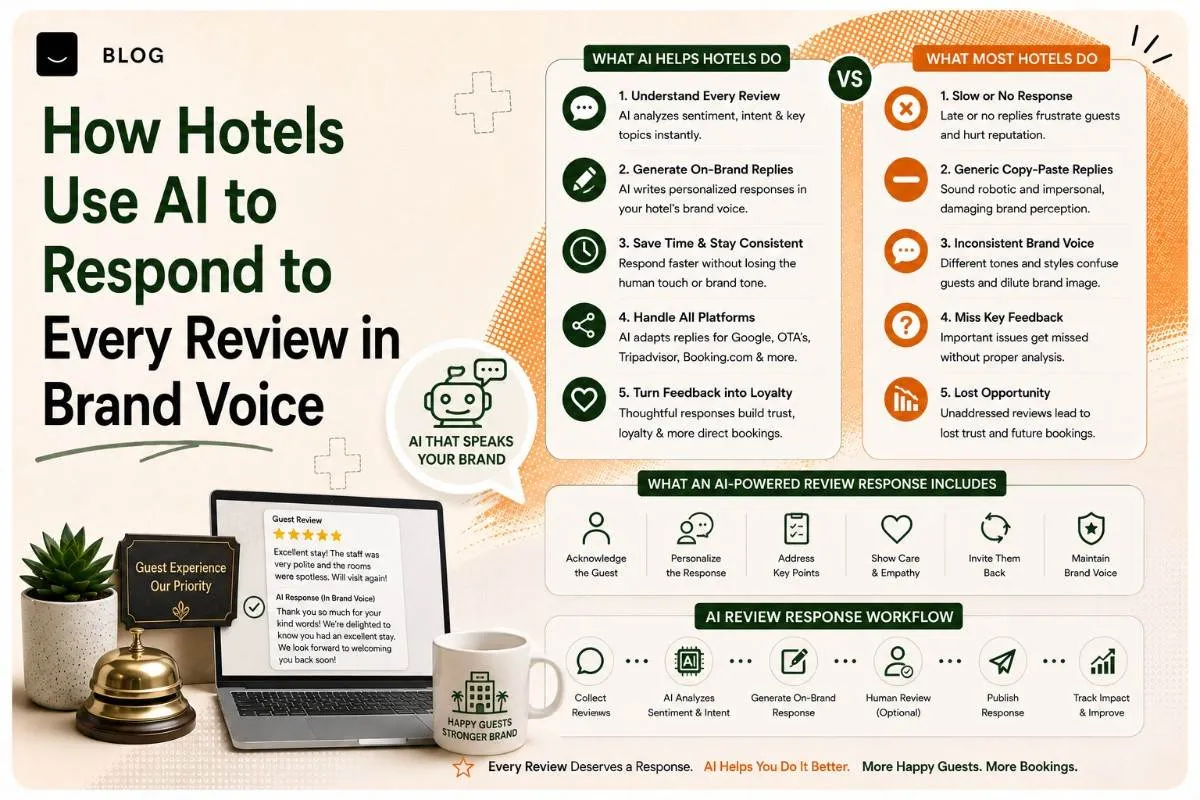
How Hotels Use AI to Respond to Every Review in Brand Voice
Hotels that reply to every review — not just the bad ones — show future guests that someone is paying attention, and give search engines and AI assistants more text describing what the property is actually like. AI makes replying at that volume realistic for a small team. The catch is that a generic AI reply is worse than no reply, so the process below is built around a brand-voice brief and a human pass that stays short but never gets skipped.
Why answering every review is worth the effort
Most properties reply to complaints and ignore compliments. That is backwards, for three reasons.
The audience is not the reviewer. It is the person reading reviews three weeks from now deciding between you and two other hotels. What they see is a pattern: a property that responds to everything, or one that only shows up when something has gone wrong.
Replies are where you get to add context. A guest writes "lovely stay, great location." Your reply can name the neighbourhood, mention the walk to the lake, note the breakfast timing. That detail is not in the original review and it is exactly what a future guest — and an AI assistant summarising your property — needs.
Volume is the reason it does not happen. A property receiving thirty reviews a month across Google, TripAdvisor, Booking.com and MakeMyTrip is looking at a real weekly workload for someone who already has a job. That is the constraint AI removes.
Why review replies matter for AI search, not just Google
This is the part most hospitality advice still misses.
When someone asks an AI assistant "which hotels in Udaipur are good for a family with a toddler" or "quiet hotels near the lake with good breakfast", the assistant assembles an answer from whatever text about your property it can find. Review text is a large part of that. Your replies are part of that text — and unlike the reviews themselves, you write them.
A reply that says "Thank you for your feedback" contributes nothing. A reply that says "Glad the connecting rooms worked for your family — we hold two on the garden side specifically for guests travelling with young children" contributes a fact about your property that an assistant can use when someone asks a question it answers.
This is Generative Engine Optimization applied to a channel most hotels already have and are not using. It costs nothing extra beyond writing the reply well.
One boundary worth stating plainly: replies are not a ranking lever you can pull. They add descriptive text and they show responsiveness, both of which help. Anyone promising a specific ranking improvement from review replies is overstating it.
VERIFY: Do not include any figure about review-response impact on rankings or bookings in this post unless it comes from a named primary study.
Build the brand voice brief first
This is the step that determines whether the output sounds like your hotel or like every other hotel. Write it once, reuse it forever. Half a page:
- Property name, location, and what it actually is. Heritage hotel, business hotel, boutique property, resort — plus the three things guests most consistently value.
- Voice. Warm or crisp? First person plural ("we") or a named signatory? How formal?
- Words you use. Do you say guests, or visitors? Property, hotel, or the house?
- Words you never use. Most hotels have a short list — corporate filler like "we value your feedback", or overclaiming like "world-class". Include it.
- Signature. Who signs? General Manager, Guest Relations, a named person? Consistency here matters more than the choice.
- Length. Two to four sentences is right for most replies. Long replies read as defensive.
- Language handling. If you receive reviews in Hindi, Gujarati or Marathi, decide now whether you reply in the review's language, in English, or both. Replying in the guest's own language is a genuine differentiator and most properties do not do it.
- Three examples of replies you were happy with. Real ones. This teaches voice better than any description.
Paste this brief at the top of every prompt. It is what makes the difference between usable output and something that could belong to any property in the country.
The four review types and how each should be handled
Positive and specific
The guest named something — a staff member, a room, a dish. Acknowledge the specific thing. Name the staff member back if they named one; it costs nothing and matters internally more than you would expect. Add one detail they did not mention. Invite them back.
Positive but generic
"Nice hotel, good stay." There is nothing to work with, so this is where you add the information. Thank them, then name something concrete about the property. These replies do the most work for AI visibility precisely because the review itself is empty.
Mixed or constructive
A good stay with one real complaint. Address the complaint directly and specifically. Vague acknowledgement reads as evasion. If it is fixed, say so. If it is not, say what is happening. Do not bury it under thanks for the positives.
Negative
The rules change here. AI drafts, a human decides. Never post an AI-generated reply to a negative review without a manager reading it, and never on the same emotional beat as reading the review. Acknowledge specifically, do not argue publicly, do not blame the guest, and move the detail offline with a direct contact.
If the complaint involves a safety, health, discrimination or legal issue, AI is not part of the process at all — that goes straight to management.
A prompt template you can copy
You are drafting a reply to a guest review for our hotel. Follow the brand voice brief exactly. BRAND VOICE BRIEF: [paste your half-page brief here] REVIEW DETAILS: Platform: [Google / TripAdvisor / Booking.com / MakeMyTrip] Rating: [x/5] Guest name: [as shown] Review text: [paste exactly] Stay type: [family / couple / business / solo — if known] WHAT I KNOW THAT THE REVIEW DOES NOT SAY: [e.g. the AC issue in 204 was fixed last week; Ramesh from the front desk is the person they mean; breakfast now runs to 10:30] Write a reply that: - Is 2-4 sentences, in our voice, signed as specified in the brief - Responds to the specific things this guest actually mentioned - Adds ONE concrete, factual detail about the property that a future guest reading this review would find useful - Does not use any phrase from the "never use" list in the brief Rules: - Do NOT invent facts about the property, staff, amenities, policies or anything that happened during this stay. Use only the review and the notes above. - If you think a detail would strengthen the reply but I have not given it, write [ADD DETAIL: what is needed] instead of inventing it. - Do not promise compensation, refunds, upgrades or specific remediation. - Do not repeat wording from replies to other reviews — vary the phrasing.
The [ADD DETAIL] instruction is what keeps this honest. It converts the model's tendency to fill gaps with plausible invention into a prompt for the person who actually knows.
What must never be automated
- Posting without a human reading it. No auto-publish integrations. Not for positive reviews either.
- Replies to negative reviews, unread. Draft with AI, decide with a person.
- Anything involving a safety, health, discrimination, harassment or legal complaint. Management handles these directly, and depending on severity, so does your legal advisor.
- Compensation, refunds or upgrades. A model will offer these readily. Only a person with the authority should.
- Any factual claim about the property. AI does not know your breakfast hours, your pet policy, or whether the pool is heated. It will guess confidently. Every factual detail comes from you.
- Replies to reviews that describe something you have not verified internally. Check what happened before responding publicly to a specific incident.
The human pass, and how long it should take
Roughly sixty seconds per reply, four checks:
- Is every fact in it true? The most common AI failure here is a warm, fluent reply containing an amenity you do not have.
- Does it sound like us? If it could be any hotel, send it back.
- Does it repeat the last five replies? Guests scroll. Identical replies signal automation more clearly than anything else.
- Are there any [ADD DETAIL] placeholders left? Fill or remove.
Sixty seconds × thirty reviews is half an hour a month. That is the actual cost of this system, and it is what makes the difference between a review page that builds trust and one that quietly destroys it.
A workable weekly routine
- Monday, 30 minutes. Pull the week's new reviews from every platform into one list.
- Sort by type. Negative first — those need the most thought and the fastest turnaround.
- Draft all of them in one session. Same brief, same context, better consistency than drafting one at a time across the week.
- Human pass on every draft. Negatives go to the manager.
- Post, and log anything operational. Reviews are your cheapest source of operational feedback — a recurring complaint about the same room is information, not just a reputation problem.
How to tell whether it is working
- Response rate. The only metric fully in your control. Aim for every review, every platform, within a week.
- Review volume and rating trend. Watch the direction over months, not weeks, and do not attribute movement to replies alone — a genuinely fixed operational problem moves ratings far more than any reply does.
- AI visibility. Once a month, ask ChatGPT, Perplexity and Gemini a handful of questions a real guest would ask about your city and category. Note whether your property is named and what it is described as. If the description does not match how you want to be understood, your replies are one of the levers for changing it.
- Google Business Profile insights — direction requests and calls, as a rough proxy for local discovery.
Frequently asked questions
Yes, and it is one of the more practical uses of AI in hospitality. AI can draft replies quickly and consistently when given a brand voice brief and the specific review. Every draft should be read by a person before posting, because a language model will confidently invent details about amenities, staff or policies it has no way of knowing.
Yes. Future guests read the pattern of responses, not individual replies, and a property that only appears when something goes wrong reads as defensive. Positive reviews are also the best opportunity to add useful factual detail about the property, since the reviewer has left the door open rather than raising a problem to address.
They will if the only input is the review text. A written brand voice brief — covering tone, vocabulary, signature, length and three real example replies — is what produces output that sounds like a specific property. Without that brief, the output will read like every other hotel's replies, which readers notice quickly.
Replies add descriptive text about the property that AI assistants can draw on when summarising or recommending hotels. A reply naming a specific amenity, location detail or guest situation contributes information a generic thank-you does not. It is a contributing factor rather than a ranking lever, and should be treated as one input among several.
Use AI to draft, never to post. A manager should read and approve every reply to a negative review before it goes live. Reviews involving safety, health, discrimination or legal matters should be handled directly by management without AI involvement, and detailed resolution should always move to a private channel rather than a public thread.
Two to four sentences suits most replies. Longer replies to criticism tend to read as defensive, and long replies to praise read as padding. The reply should acknowledge what the guest actually said, add one concrete detail, and close warmly.
Replying in the guest's own language is a meaningful differentiator, particularly for reviews written in Hindi or other Indian languages, since most properties reply only in English. If you do this, have a fluent speaker check the reply — machine translation errors in a public response are more damaging than a well-written English reply would have been.
Ready to build what's next?
Tell us where you're headed. We'll come back with a plan to get there.
Book an intro call