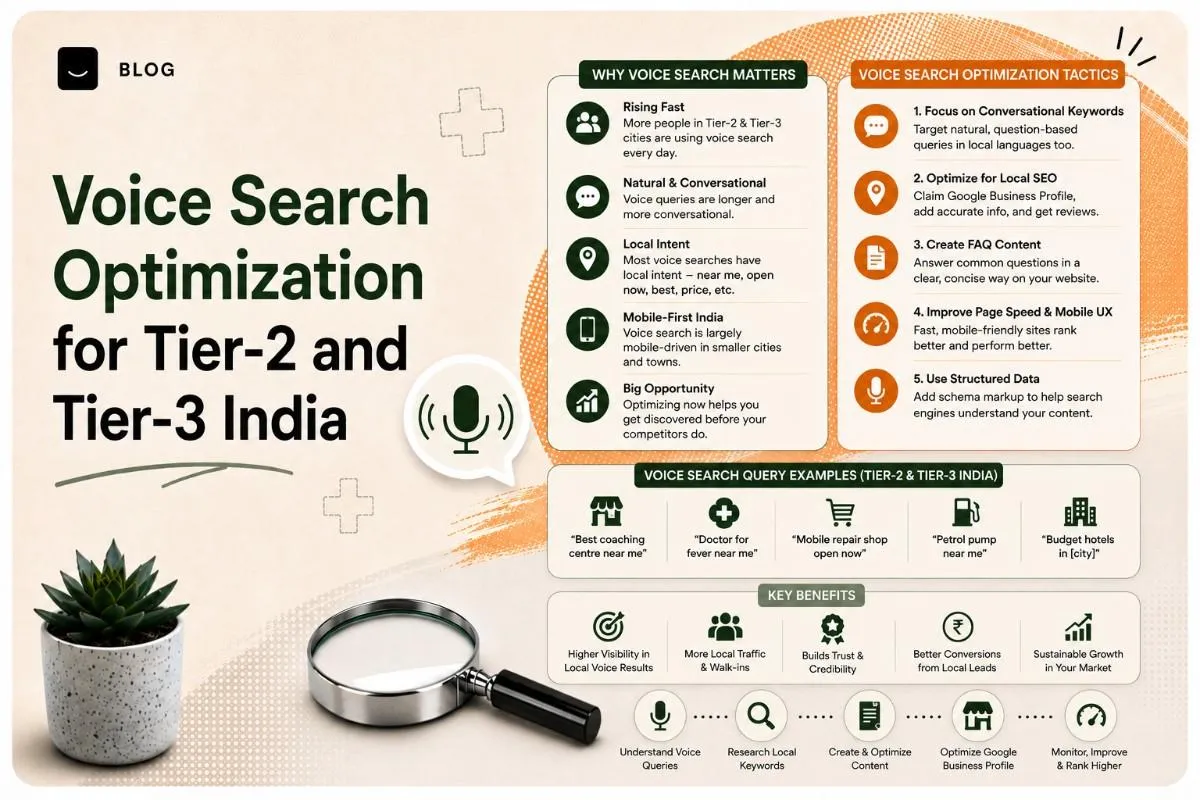
Voice Search Optimization for Tier-2 and Tier-3 India
Voice search optimization means structuring your content so a spoken question gets answered with your business — a conversational, question-shaped answer rather than a keyword-stuffed page. Generative Engine OptimizationIn tier-2 and tier-3 India, this matters more than in the metros, because a large share of users search by speaking rather than typing, often in a regional language.
The reason is practical, not cultural: speaking is faster than typing on a phone keyboard, especially in Devanagari or a regional script, and it removes the spelling barrier entirely. For millions of users, voice isn't a convenience feature — it's the primary way they search.
Why voice matters more outside the metros
Three things converge in smaller Indian cities.
Typing is harder than speaking. Regional-script keyboards are slower and less familiar than voice input. For a user comfortable speaking Hindi or Marathi but not typing it, voice is simply the easier tool.
Mobile-first users skipped the desktop habit. Many users' entire internet experience is a phone. Voice fits that far more naturally than a keyboard does.
Local intent dominates. Ask Maps and what it reads about your business Voice searches skew heavily toward immediate, local needs — finding a shop, checking whether somewhere is open, getting directions, calling a business. That's exactly the high-intent traffic local businesses want.
How a spoken query differs from a typed one
The same need produces very different queries depending on the input method.
| Typed | Spoken | |
|---|---|---|
| Length | 2–4 words | Full sentence or question |
| Form | Fragments — "dentist bhopal" | Questions — "which dentist is open near me right now" |
| Language | Often English, even for Hindi speakers | Often the speaker's own language, or mixed |
| Intent | Broad research | Immediate, local, actionable |
| Result expected | A list to scan | One spoken answer |
That last row is the one that changes strategy most.
The one-answer problem
When someone types, they see ten results and can scroll. When someone asks aloud and gets a spoken response, they typically get one answer.
There's no second place in a voice result. Either your business is the answer, or your business wasn't part of the interaction at all.
This makes voice much closer to AEO and GEO than to traditional SEO — the goal isn't ranking on a page, it's being the extracted answer.
It also means the fundamentals matter more, not less. Being the single answer requires clarity, accuracy and trust signals a search engine can rely on confidently enough to speak on your behalf.
How to optimize for voice search
1. Write the way people speak
Voice queries are conversational, so content phrased conversationally matches better. Use natural question phrasings as headings and answer them directly.
"Kitne baje तक khula hai" and "what time do you close" are the same question — your content should read like a person answering it, not like a keyword-optimised sentence.
2. Answer in 30 words, then expand
A spoken answer is short. Content that states the answer in one or two crisp sentences before elaborating gives an assistant something clean to read aloud.
Burying the answer three paragraphs down makes your page unusable for voice, even if it ranks well otherwise.
3. Build an FAQ from real spoken questions
The most effective source of voice-optimised content is what customers actually ask on the phone. Log the questions your staff answer daily, write each one exactly as it's asked, and answer it plainly.
These map almost perfectly to voice queries — "do you deliver to [area]", "are you open on Sunday", "how much does [service] cost", "where do I park" — because they are the spoken questions, just previously asked to a person.
4. Get your Google Business Profile exact
For local voice search,the difference between SEO and local SEO this is the single most important asset. Voice assistants pull business hours, address, phone, and attributes from it directly.
Two things matter disproportionately: hours must be exactly right, including holidays, because "open now" queries are a huge share of voice search; and attributes must be filled in, because spoken queries carry constraints such as "with parking", "that delivers", and "wheelchair accessible" that can only be answered from structured attributes.
5. Handle regional languages and mixed speech
getting cited by AI in Hindi, Tamil and Telugu If your customers speak Hindi, Tamil or Marathi, publish content in that language — written natively rather than machine-translated, since translated text doesn't match how people actually speak.
Also account for mixed-language speech, which is extremely common. "Best dentist near me kaun hai" is a real query shape.
You can't write your whole site that way, but your FAQ section is the natural place to phrase a question the way a customer would genuinely say it. Most competitors have ignored this entirely.
6. Make the page fast on a weak connection
Voice search happens on mobile, often on inconsistent connections. A slow page is less likely to be used as a source and far less likely to be useful when someone acts on the answer.
Compress images, keep pages light, and test on a genuinely slow connection rather than office wifi.
Voice and AI assistants are converging
Worth understanding, because it changes what you're optimising for.
Voice search used to mean asking a search engine a question aloud. Increasingly it means asking an AI assistant — and getting a synthesised answer rather than a read-aloud snippet.
The line between voice search optimization, AEO and GEO is dissolving.
The practical implication is reassuring: the work overlaps almost entirely. Clear conversational answers, question-shaped headings, accurate business data, and content in your customers' actual language serve voice search, featured snippets, and AI citations simultaneously.
You're not choosing between three strategies — you're doing one thing that pays off in three places.
How to test your voice visibility
Do it with an actual phone, not a tool:
- Write 10–15 questions customers would ask aloud, in the languages they'd use.
- Speak each one into Google Assistant, your phone's assistant, and an AI app.
- Record what comes back — is it you, a competitor, an aggregator, or nothing local at all?
- Check whether the details spoken about you are correct — wrong hours or an old number is worse than absence.
- Note which questions return no useful local answer. Those are open gaps you can fill immediately.
Re-run quarterly, and after any change to your hours or services.
A starting checklist
- Log the questions customers actually ask by phone — this is your content brief.
- Publish an FAQ answering each in plain, spoken-sounding language.
- Put the direct answer in the first 30 words under every question heading.
- Fill in every Google Business Profile field, especially hours and attributes.
- Verify hours are correct, including holidays.
- Add content in your customers' regional language, written natively.
- Include naturally mixed-language phrasing in FAQ questions where it's genuine.
- Add FAQ and LocalBusiness schema.
- Test page speed on a slow mobile connection.
- Run a spoken-query test with a real phone, quarterly.
Want to know whether voice assistants are recommending your business — and saying the right things about it?
Explore our AEO and voice search work WithContact Crescent for a free consultation.
Frequently asked questions
Voice search optimization is structuring content so a spoken question is answered with your business. It means writing conversational, question-shaped content that states the answer in the first sentence or two, alongside accurate local business data such as hours and attributes that voice assistants read directly.
Speaking is faster and easier than typing on a regional-script keyboard, many users' entire internet experience is mobile-first, and voice queries skew heavily toward immediate local needs such as finding a shop, checking opening hours or getting directions.
Typed searches are short fragments of two to four words, while spoken searches are full questions in natural sentences, often in the speaker's own or a mixed language. Voice results also typically return a single spoken answer rather than a list, so there is effectively no second place.
Publish an FAQ using the questions customers actually ask by phone, answer each in the first thirty words, complete every Google Business Profile field with exact hours and attributes, add content in your customers' regional language written natively, add FAQ and LocalBusiness schema, and keep pages fast on slow mobile connections.
They are converging. Voice search increasingly means asking an AI assistant rather than a search engine. The same work — clear conversational answers, question-shaped headings, accurate business data and native-language content — serves voice search, featured snippets and AI citations at the same time. Voice search rewards the least glamorous work available: accurate business hours, plainly answered questions, and content written in the language your customers actually speak. In tier-2 and tier-3 India, where voice is often the default input, that unglamorous work is worth more than almost anything else on your marketing list.
Ready to build what's next?
Tell us where you're headed. We'll come back with a plan to get there.
Book an intro call