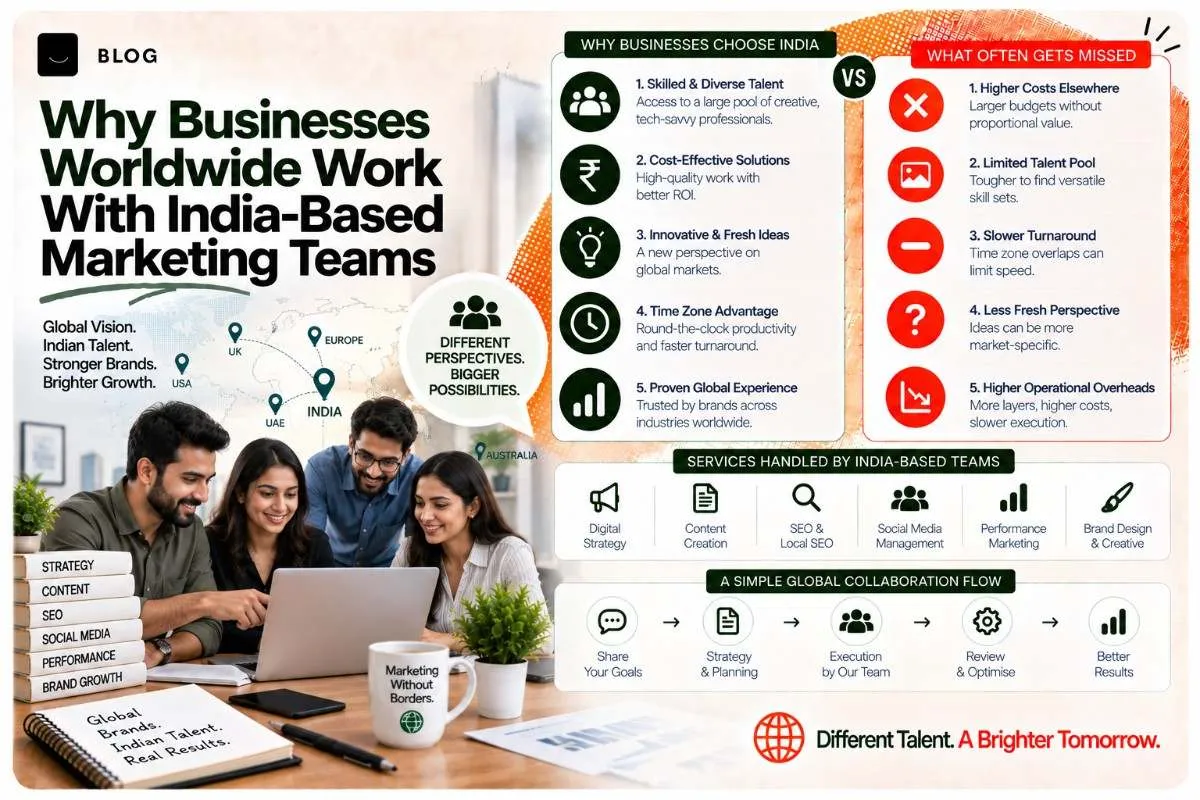
Why Businesses Worldwide Work With India-Based Marketing Teams
Working with a marketing team based in India is no longer primarily a cost decision — for businesses that get the relationship right, it is a decision about time zone coverage, technical depth, and access to a genuinely broad talent pool inside one coordinated team. This post makes that case honestly, including the parts that do not transfer automatically and have to be built deliberately, because an overclaimed pitch serves nobody and the real advantages are strong enough not to need one.
A note on what this post is
Unlike most of what we publish, this one is explicitly about us — it is Crescent's own case for why a business based anywhere else might choose to work with an India-based team. We have written it with the same standard we hold everything else to: no invented statistics, no vague superlatives, and an honest accounting of the trade-offs alongside the advantages.
The honest case, not the sales pitch
Time zone coverage that actually extends a working day
India's time zone sits in a genuinely useful position relative to much of the world — work can be completed and delivered while a client in North America or Europe is asleep, ready for review when their working day starts. This is not "we work odd hours to seem responsive." It is a structural overlap that, handled well, functions like having a second shift on a project without actually running one.
The honest caveat: this only works with deliberate process — clear handoffs, written context, and communication that does not assume real-time back-and-forth. A team that simply works different hours without building for asynchronous handoff wastes the advantage entirely.
Technical depth at a sustainable cost structure
India produces a very large number of skilled marketing, design and development professionals, and the cost structure of operating from India means a client's budget typically buys more senior attention and more hours of skilled work than the same budget would in many other markets. This is real and it is the most commonly cited reason for the arrangement — but it deserves an honest caveat too: cost efficiency is not a reason to accept lower quality, and a client should expect the same standard of strategic thinking and execution regardless of where the team sits.
A genuinely global talent pool inside one country
India's digital marketing and technology sector has matured enough that most disciplines — SEO, paid media, content, design, development — have deep, experienced talent pools, often with direct experience serving clients in exactly the markets a prospective client operates in. A team is not learning on a client's project; the experience genuinely exists.
English-language fluency without a translation layer
For English-speaking clients specifically, this removes a friction point that exists with some other outsourcing markets — briefs, strategy documents and reporting happen in the same language a client thinks and writes in, without translation in either direction.
What does not automatically transfer, and has to be built deliberately
Honesty here matters more than anywhere else in this post, because these are the things a prospective client should actually be asking about.
Cultural and market context. A team based in India does not automatically understand the specific cultural nuances, competitive landscape or regulatory environment of a client's local market. This has to be built deliberately — through genuine research, through the client's own input, and through a team that asks rather than assumes. A team that treats every market as interchangeable will produce interchangeable, generic work.
Real-time availability during a client's working hours, if that matters for a specific relationship. The time-zone advantage described above works well for asynchronous handoff; it does not automatically mean live availability during a client's own business hours without deliberate scheduling.
Local nuance in language and tone, for markets where English is spoken differently than it is by an India-based team — the difference between British, American, Australian and Indian English usage is real and matters for brand voice, and a client should expect a team to adapt to it rather than assume it is automatic.
Trust, which has to be earned through delivery, not assumed from geography in either direction. This applies equally whichever way the relationship runs.
The questions worth asking any India-based team
For a business genuinely evaluating this, regardless of who they are evaluating:
- How does the team handle asynchronous handoff, specifically — what does a typical 24-hour cycle on a live project actually look like?
- What is the team's actual experience with businesses in my specific market and category, not just "international clients" generally?
- How does the team build market and cultural context for a client, rather than assuming it?
- What does communication actually look like week to week — is it real written context, or is quality dependent on a live call happening?
- Can the team show real examples of adapting tone and approach for different English-speaking markets specifically?
A team that answers these specifically and concretely is a stronger signal than any claim about experience or capability made in the abstract.
What "connected thinking" means in practice
This is Crescent's own stated positioning — "growth isn't built through isolated services, it's built through connected thinking" — and it is worth being concrete about what that means for a client anywhere in the world, rather than leaving it as a slogan.
It means one team, coordinating SEO, content, paid media, design and development as a single connected effort rather than as separate vendors each optimising their own piece in isolation. For a client managing relationships across time zones, that coordination matters more, not less — a single point of accountability is considerably easier to manage remotely than five specialist vendors each requiring separate coordination.
Who this genuinely suits, and who it does not
Suits well: businesses that value structured, documented communication over constant real-time availability; businesses whose category and market can be genuinely researched and understood by a team willing to do that work properly; businesses that want a coordinated team rather than a collection of specialist vendors; businesses for whom the cost structure genuinely matters to what they can invest in the work overall.
Suits less well: businesses that specifically need in-person presence or same-timezone, live-availability collaboration as a hard requirement; businesses in a category with such specific local regulatory or cultural nuance that anything short of an in-market team creates real risk — though even here, a well-run remote team with genuine local input can often close that gap, it deserves honest acknowledgment as a harder case.
Frequently asked questions
Primarily three reasons: a time zone position that allows work to be completed overnight relative to many other markets, a cost structure that typically buys more senior attention per budget, and a mature talent pool across most marketing disciplines. English-language fluency removes translation friction for English-speaking clients specifically.
The main risks are assuming cultural and market context transfers automatically rather than being built deliberately, assuming real-time availability during the client's working hours without explicit scheduling, and underestimating the language and tone differences between English as spoken in different markets. These are manageable with the right questions asked upfront, not automatic problems.
Not inherently — cost efficiency in this arrangement typically reflects a different cost structure, not lower standards, and a client should expect the same quality of strategic thinking and execution regardless of location. Quality depends on the specific team's capability and process, which should be evaluated directly rather than assumed from geography.
Work completed during India's working hours can be ready for review when a client in North America or Europe starts their own working day, functioning similarly to an extended working cycle on a project. This only works well with deliberate process for asynchronous handoff — clear written context and structured communication rather than reliance on real-time availability.
How the team handles asynchronous handoff specifically, what real experience they have in the client's specific market and category, how they build cultural and market context rather than assuming it, what week-to-week communication actually looks like, and whether they can show concrete examples of adapting tone for different English-speaking markets.
It suits businesses comfortable with structured, documented communication and a coordinated single-team model well. It suits less well businesses with a hard requirement for in-person or same-timezone live collaboration, or categories with regulatory or cultural nuance specific enough that anything short of an in-market team creates meaningful risk — though a well-run remote team with genuine local input can often address even that.
One coordinated team handling SEO, content, paid media, design and development together, rather than separate specialist vendors each optimising their own piece independently. For a client managing relationships across time zones, a single point of accountability is generally easier to manage than coordinating several separate vendors.
Ready to build what's next?
Tell us where you're headed. We'll come back with a plan to get there.
Book an intro call