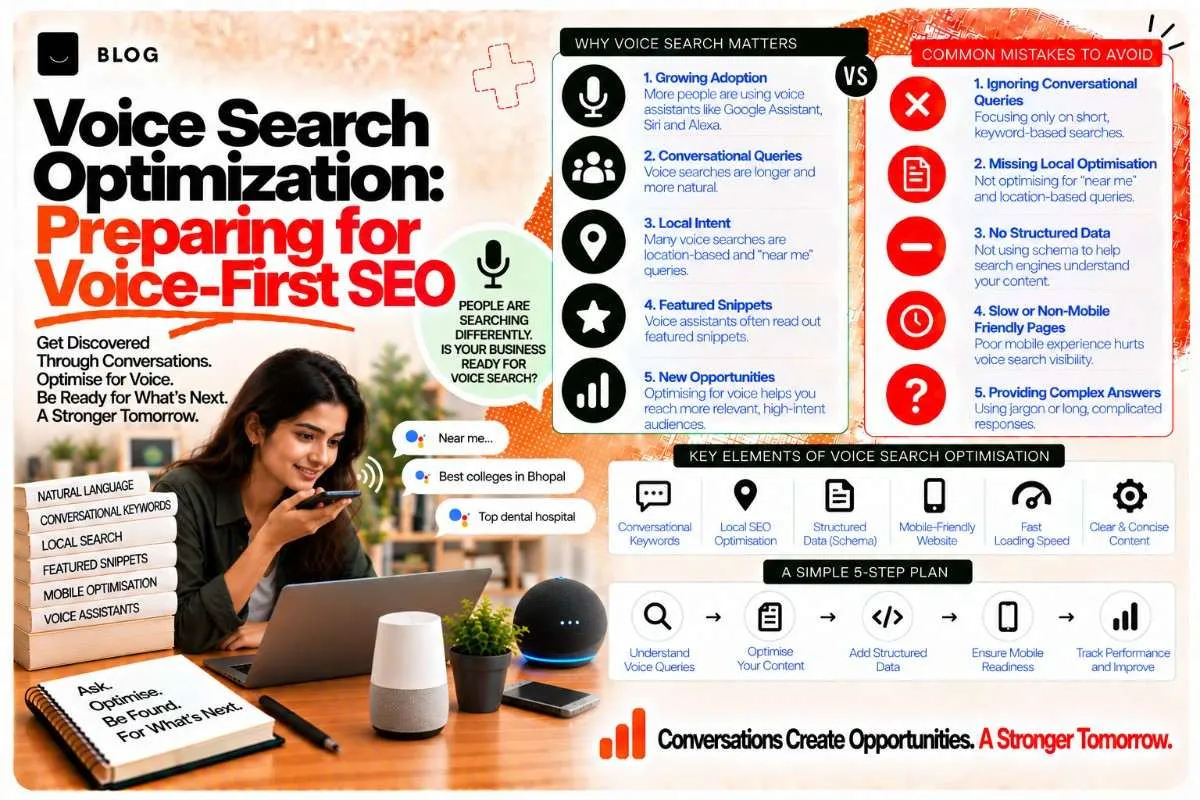
Voice Search Optimization: Preparing for Voice-First SEO
When someone says "Hey Google, find me a plumber near me," they're not typing. They're using voice. And they're asking a question the way they'd ask a friend, not the way they'd type into Google Search.
Voice search is still a small percentage of total search traffic — somewhere between 10–20% depending on the industry and geography. But it's growing, and more importantly, the way voice search works is fundamentally different from typed search. This means your SEO strategy needs to adapt.
Voice search optimized for conversational queries, natural language, featured snippets, and local intent in ways that traditional keyword optimization doesn't address. Missing voice optimization isn't a critical failure today, but it will be in 2–3 years as voice search adoption continues to grow, especially in markets like India where smart speakers are becoming more common.
This guide covers what's changing in voice search, how to optimize for it, and why it matters now.
How voice search is different from typed search
A typed search query looks like: "plumber near me" or "best plumber bhopal"
A voice search query sounds like: "Hey Google, where can I find a good plumber near me right now?"
The difference matters. Voice search queries are:
Longer and more conversational — voice queries average 4–5 words; typed queries average 1–2. Voice queries sound like natural speech, not keyword strings.
Question-based — "What's the best plumber in Bhopal?" instead of "best plumber bhopal." Voice queries often start with who, what, where, when, why, or how.
Local-intent heavy — "near me," "today," "open now" are common voice qualifiers. Voice is primarily used for immediate, local needs.
Imperative-focused — voice queries want an answer NOW. Someone typing might browse results; someone speaking wants the first result to be correct.
Because of these differences, the voice search algorithm and ranking factors are different from typed search. A page that ranks well for "plumber bhopal" in typed search might not appear in voice results for the spoken version of that query.
What voice search platforms exist and who uses them
Google Assistant (Android, Google Home, smart displays) — the largest voice assistant platform globally and in India. Commands: "Hey Google..."
Amazon Alexa (Echo devices, Alexa apps) — strong in US, growing in India. Commands: "Alexa..."
Apple Siri (iPhone, iPad, Apple Watch) — strong in US and developed markets. Commands: "Hey Siri..."
Other platforms — Samsung Bixby, Microsoft Cortana, and various other assistants, but these are much smaller.
For India specifically, Google Assistant and Alexa are the primary platforms. Smart speaker adoption in India is still early compared to the US, but it's accelerating, especially in urban areas.
Usage patterns:
- Smart speakers — mostly for news, weather, music, shopping queries
- Mobile voice search — mostly for navigation, local search, quick answers
- Wearables — mostly for quick info or hands-free control
The common thread: immediate, actionable information. Voice search users want answers, not browsing.
How to optimize for voice search
1. Target question-based keywords and long-tail conversational phrases
Voice queries are question-heavy. Instead of optimizing only for "SEO services bhopal," optimize for "what are the best SEO services in bhopal" and "how much does SEO cost in bhopal."
Optimization tactic:
- Use question-based headings in your content (H2/H3): "What Does SEO Cost?" "How Long Does SEO Take?" "Which SEO Services Do I Need?"
- Answer each question in 40–60 words (voice results typically read this length)
- Include natural, conversational keyword phrases throughout
Example:
Instead of: "SEO Consulting Services Bhopal — Expert Optimization"
Try: "Do You Need SEO Consulting in Bhopal? What Our Agency Offers"
2. Optimize for featured snippets (they're the primary voice answer source)
When you ask a voice assistant a question, it often reads the featured snippet from Google Search (the box at the top of search results). If you own the featured snippet, you own the voice answer.
Optimization tactic:
- Target questions that have featured snippets in current search results
- Format answers as: short answer (1–2 sentences) + list or table
- Keep the answer concise (40–60 words ideal)
- Include the question as a heading
Example featured snippet-friendly structure:
How much does SEO cost?
SEO costs typically range from ₹5,000–₹50,000+ per month, depending on your goals and competition. Most small businesses invest ₹10,000–₹25,000 monthly for comprehensive SEO services.
3. Improve your Google Business Profile for local voice queries
Voice search is heavily local. When someone says "find me a plumber near me," the voice assistant pulls from local results, GBP, Google Maps, and reviews.
Optimization tactic:
- Ensure your GBP is complete (business name, address, phone, hours, photos, attributes)
- Keep your hours current (out-of-date hours hurt voice results badly)
- Encourage reviews (voice results often cite review counts and ratings)
- Answer common voice questions in your GBP description or FAQ section
4. Use schema markup for better voice recognition
Voice assistants use schema markup to understand your content structure. VideoObject schema, FAQPage schema, LocalBusiness schema, and Organization schema all help voice systems understand your page.
Optimization tactic:
{ "@context": "https://schema.org", "@type": "LocalBusiness", "name": "Your Business Name", "address": { "@type": "PostalAddress", "streetAddress": "123 Main Street", "addressLocality": "Bhopal", "postalCode": "462001" }, "telephone": "+91-755-123-4567", "url": "https://yoursite.com", "hoursOfOperation": [ { "@type": "OpeningHoursSpecification", "dayOfWeek": "Monday", "opens": "09:00", "closes": "18:00" } ] }
This helps voice assistants understand your business, hours, and contact info.
5. Write naturally and conversationally
Voice optimization means writing for human speech, not search robots. Use:
- Shorter sentences (10–15 words average)
- Active voice ("We help businesses rank higher" vs. "Ranking improvements are provided by our team")
- Contractions ("We're", "It's") — people speak with contractions
- Natural transitions ("First," "Next," "Finally" instead of keyword-heavy connectors)
6. Focus on local and immediate intent
Voice queries often have local and time-based modifiers: "near me," "today," "open now," "in bhopal."
Optimization tactic:
- Include your city/neighborhood in your content naturally
- Address "open now" intent (make sure your hours are accurate)
- Include "near me" language where relevant
- Create location-specific content (not just generic service pages)
7. Mobile optimization is voice optimization
Most voice searches happen on mobile devices. A mobile-optimized site is a prerequisite for voice search visibility.
Optimization tactic:
- Test your site on mobile (run through Google's Mobile-Friendly Test)
- Ensure pages load fast (voice users want instant answers)
- Make CTAs clear and mobile-friendly
- Avoid pop-ups and intrusive ads
Voice search measurement and tracking
Voice search is harder to measure than typed search because voice queries don't always show up in Google Search Console the way typed queries do. But you can track:
1. Featured snippet ownership — if you own snippets for question-based keywords, you're likely showing in voice results
2. GBP traffic and actions — track calls, directions, and web visits from your GBP in the GBP dashboard; these often come from voice
3. Branded voice queries — set up branded search alerts (Google Alerts, Mention) to monitor when your brand is cited in voice searches
4. Voice assistant testing — manually ask voice assistants questions and see if you appear; note which questions trigger your results
5. Mobile voice traffic — in GA4, segment for mobile traffic and identify conversational query patterns in your Search Console
Common voice search mistakes to avoid
Don't over-optimize for voice at the expense of typed search.
Voice is still ~15–20% of search. Type optimization still matters more, but voice is complementary, not a replacement.
Don't ignore local signals.
Voice + local is a powerful combo. If your GBP or local citations are weak, voice optimization won't help.
Don't forget mobile speed.
Voice users want instant answers. A slow mobile site kills voice visibility.
Don't write only for voice; write naturally.
People read your content on desktop and mobile too. Natural, conversational writing works for all channels.
Don't neglect featured snippets.
If you're not targeting featured snippets, you're missing most voice search opportunity.
Frequently asked questions
Less immediately than B2C. Voice search is strongest for local services, product searches, and quick-answer queries. B2B search is often more complex and research-heavy, so typed search still dominates. But voice is growing for B2B too (e.g., "best email marketing software").
Featured snippets are the content; voice search is how that content is delivered. Voice assistants often read featured snippets aloud. Optimizing for one helps the other, but featured snippets also show on desktop.
Not directly. Voice optimization (featured snippets, natural language, local signals) often helps both voice and typed search, but they're not the same ranking factor.
No. Write naturally and conversationally for your main pages. One well-written page works for both voice and typed search.
For local service businesses: 1–2 years. For e-commerce or B2B: 2–4 years. But starting now puts you ahead of competitors who wait.
Ready to build what's next?
Tell us where you're headed. We'll come back with a plan to get there.
Book an intro call