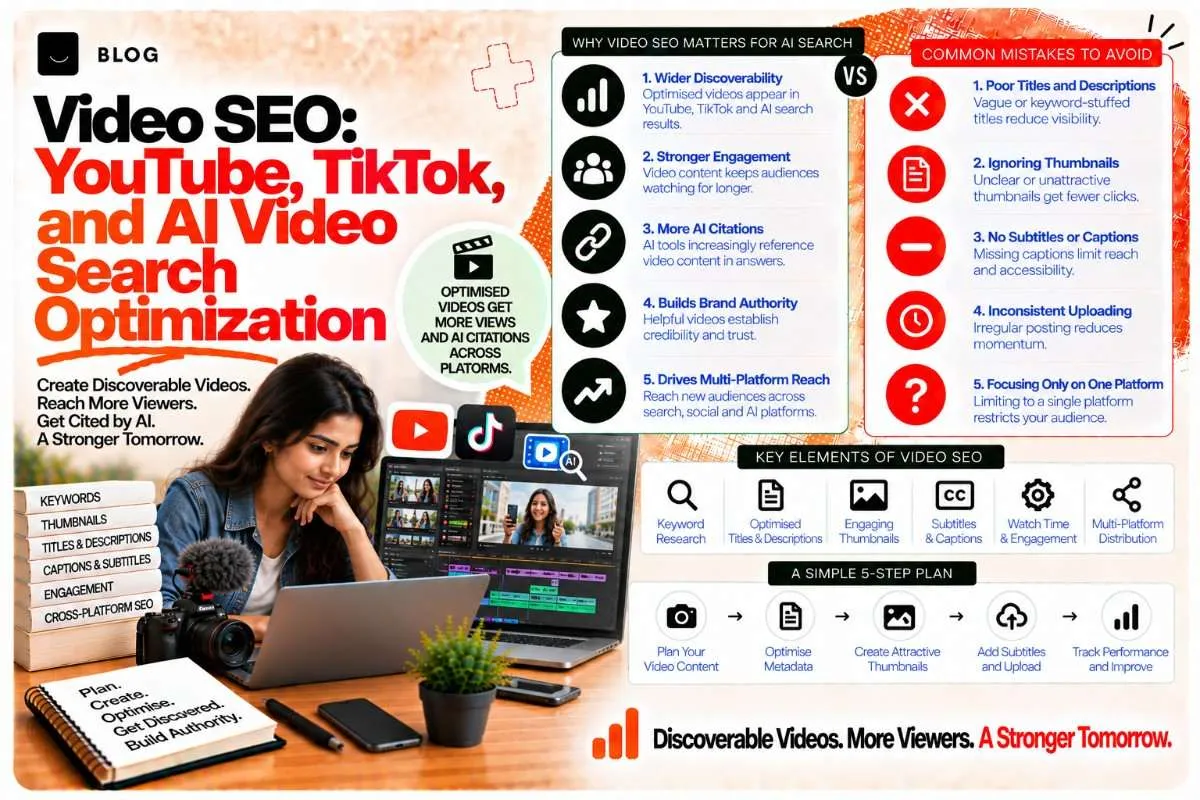
Video SEO: YouTube, TikTok, and AI Video Search Optimization
Video is no longer a "nice to have" for SEO. It's a direct ranking and citation signal across Google Search, YouTube, TikTok, and AI-powered video discovery systems. A blog post optimized for text ranking might not be found by anyone. A video optimized for platform-specific signals and AI discovery can drive thousands of views and, increasingly, direct citations in AI-generated answers.
The challenge: video SEO isn't one thing. YouTube has its own ranking algorithm. TikTok's algorithm is entirely different. Google's AI systems are beginning to index and cite video content alongside text. Each platform rewards different signals, and a video strategy that works on one platform may not work on another.
This guide covers what to actually optimize across platforms, how AI systems cite video, and the schema markup that helps.
How AI systems cite video differently than traditional Google ranking
Traditional YouTube ranking prioritizes: watch time, click-through rate (CTR), engagement (likes, comments, shares), channel authority, and recency. These signals tell YouTube whether a video is worth recommending to other viewers.
AI systems use video differently. When ChatGPT, Perplexity, or Google's AI is answering a question that benefits from a visual demonstration or example, it pulls video recommendations from:
- Video title and description — does it directly answer the question?
- Transcript or closed captions — what is actually being said?
- Schema markup (VideoObject, ClipRange, etc.) — what is this video about and when does the relevant segment start?
- Platform authority — is this from a credible channel?
- Recency — was this updated recently?
This is different from YouTube's ranking algorithm. A video can rank well on YouTube but not be cited by AI systems. And vice versa: a lesser-known video with a crystal-clear transcript and VideoObject schema might be cited more often by AI than a viral video with poor metadata.
Platform-specific video SEO: YouTube, TikTok, and short-form
YouTube optimization: the full-funnel platform
YouTube is the primary platform for long-form video discovery and the most mature platform for AI citation.
What to optimize:
1. Video title (60 characters, primary keyword natural)
- Lead with your primary keyword or value proposition
- Example: "How to Implement Entity SEO: Step-by-Step Guide (2026)" (not just "Entity SEO")
- YouTube shows ~60 characters on desktop before truncation
2. Video description (150–250 characters for the summary, full description below)
- First 2–3 sentences summarize the entire video
- Include your primary keyword once naturally
- Add a full description below with timestamps, links, and context
- AI systems read the full description; the summary determines CTR
3. Timestamps (H2 or H3 headers in description)
- Break the video into logical sections with timestamps
- AI systems use timestamps to reference specific segments
- Example: "0:00 Introduction | 2:15 Entity SEO Basics | 5:30 Implementation Steps | 10:00 Schema Markup"
4. Closed captions (auto-generated or manual)
- AI systems read captions to understand video content
- Manual captions are more accurate and boost watch time
- Include your key terms in captions (naturally, not keyword-stuffed)
5. Transcript (upload or generate)
- YouTube auto-generates transcripts; manual transcripts are more accurate
- A full transcript helps AI systems understand every detail
- Upload as a separate file if your video has poor audio or accents
6. VideoObject schema markup
- Add to any page that embeds or links to the video
- Includes title, description, thumbnail, duration, upload date, and transcript URL
- Helps Google and AI systems index and cite the video properly
7. Thumbnail (custom, clear, relevant)
- Click-through rate (CTR) is a ranking signal
- Custom thumbnails outperform auto-generated ones
- Test different designs and measure CTR in YouTube Analytics
8. Channel optimization
- Channel name consistency (matches your business name)
- Channel description with keywords and links
- Verified badge or custom URL (builds authority)
9. Playlist organization
- Group related videos into playlists
- Playlists keep viewers watching longer and signal content relationships
- Name playlists for your topic clusters (e.g., "Entity SEO Mastery")
10. Update frequency (repost/update strategy)
- Repost or update older videos with fresh information
- A video updated in 2026 signals freshness; a video from 2023 signals stale
- Use YouTube's "Update" feature or re-upload with new metadata
TikTok and short-form: platform-specific optimization
TikTok's algorithm is opaque, but it's not opaque for the reasons YouTube is. TikTok optimizes for watch-time-per-second (not total watch time) and engagement speed.
What to optimize:
1. Hook (first 0.5 seconds)
- Hook the viewer immediately; TikTok punishes drop-off
- Text overlay, pattern interrupt, or promise of value
- Example: "3 things your SEO agency won't tell you about Entity SEO"
2. Caption and hashtags
- Caption: lead with value, then call-to-action
- Hashtags: mix popular (#SEO, 50M+ views) with niche (#EntitySEO, 1M views)
- AI systems don't heavily weight TikTok captions for citation, but they help discoverability
3. Trending sounds and effects (if authentic)
- TikTok's algorithm boosts videos using trending sounds
- Only use if they fit your content; forced trends backfire
4. Engagement bait (use sparingly)
- "Follow for more" or "Save this" CTAs increase engagement signals
- Overuse feels cheap, but strategic use (end of video, soft CTA) works
Shorts and reels: the middle ground
YouTube Shorts, Instagram Reels, and TikTok are all short-form platforms optimized for vertical video. Optimization is similar across all three:
- Hook in the first frame
- Use captions and text overlays (no sound guaranteed)
- Keep it fast-paced (cuts every 1–2 seconds)
- End with a CTA (link, follow, watch full video)
Schema markup for video: VideoObject and beyond
VideoObject schema is the most important markup for video SEO. Add it to any page that hosts or embeds a video.
{ "@context": "https://schema.org", "@type": "VideoObject", "name": "How to Implement Entity SEO: Step-by-Step Guide", "description": "Complete guide to building entity clarity for your business website. Learn how to implement NAP consistency, schema markup, and author credentials to improve AI search visibility.", "thumbnailUrl": "https://example.com/video-thumbnail.jpg", "uploadDate": "2026-10-09T10:00:00Z", "duration": "PT12M30S", "contentUrl": "https://www.youtube.com/watch?v=dQw4w9WgXcQ", "embedUrl": "https://www.youtube.com/embed/dQw4w9WgXcQ", "author": { "@type": "Person", "name": "Abhishek Raikwar" }, "transcript": "https://example.com/video-transcript.txt", "hasPart": [ { "@type": "Clip", "name": "Entity SEO Basics", "startOffset": 135, "endOffset": 330, "url": "https://www.youtube.com/watch?v=dQw4w9WgXcQ&t=135s" } ] }
Key fields:
- name — video title (use your primary keyword naturally)
- description — the summary from your video description
- uploadDate — when the video was published (ISO 8601 format)
- duration — in ISO 8601 format (PT = period of time, M = minutes, S = seconds)
- thumbnailUrl — the custom thumbnail
- author — the creator's name (supports entity clarity)
- transcript — link to a transcript file or page
- hasPart — clips within the video (optional but helpful for AI citation)
Add this to your blog post or video embed page. Google and AI systems use it to index and cite the video properly.
The video content strategy: what to film, where to publish
Content types that drive AI citations:
- Tutorials and how-tos (step-by-step instructions)
- Case studies with before/after visuals
- Expert interviews and insights
- Tools and software demos
- Explainers for complex concepts
- Q&A addressing common questions
Publishing strategy:
- Repurpose, don't duplicate — film one in-depth video, then extract clips for TikTok/Reels/Shorts
- Link between platforms — embed YouTube videos on your blog, link to YouTube from TikTok bio, reference blog posts in YouTube descriptions
- Update on schedule — re-upload or update older videos with fresh information (once per quarter minimum)
- Measure AI citations — track which videos show up in ChatGPT, Perplexity, Google AI answers; adjust strategy accordingly
Video SEO audit checklist
For your existing videos:
1. YouTube: Review top 10 videos. Do they have:
- Clear title with primary keyword
- Full description with timestamps
- Manual captions or transcript
- Custom thumbnail
- VideoObject schema on embedding page
2. TikTok/Reels: Review top 5 videos. Do they have:
- Strong hook (first frame)
- Clear caption with call-to-action
- Relevant hashtags (popular + niche mix)
- Consistent posting schedule
3. Transcripts: Do you have transcripts for your most important videos? If not, generate them (YouTube auto-generates; pay for manual if auto-generated is low-quality).
4. Schema markup: Are your video pages using VideoObject schema? If not, add it.
5. Freshness: Which videos are over 1 year old? Schedule updates or re-uploads for the top performers.
Frequently asked questions
Indirectly. A high-ranking YouTube video can drive traffic to your website if you link to it from your site. The video itself doesn't directly rank in Google Search, but it helps your site's overall authority and user engagement.
Both, but it's still emerging. ChatGPT and Perplexity increasingly recommend YouTube videos alongside text. Google's AI Overview system also pulls from video. Expect this to grow significantly over the next 2 years.
YouTube SEO focuses on ranking within YouTube's platform. Video SEO is broader: optimizing for YouTube, TikTok, Google Search, and AI discovery. Some tactics overlap; some are platform-specific.
Start with yourself or simple tools (CapCut, DaVinci Resolve free version). As your channel grows, hire an editor to handle the operational burden. Quality matters less than consistency and optimization.
YouTube long-form: 8–15 minutes optimal (enough for depth, not so long viewers abandon) Shorts/TikTok/Reels: 15–60 seconds (shorter usually performs better) Clips from long-form: 30–90 seconds (extracted segments)
Yes, but consistency matters more than frequency. Posting weekly is better than posting daily for a month then disappearing. YouTube's algorithm rewards active channels; a predictable schedule signals activity.
Ready to build what's next?
Tell us where you're headed. We'll come back with a plan to get there.
Book an intro call