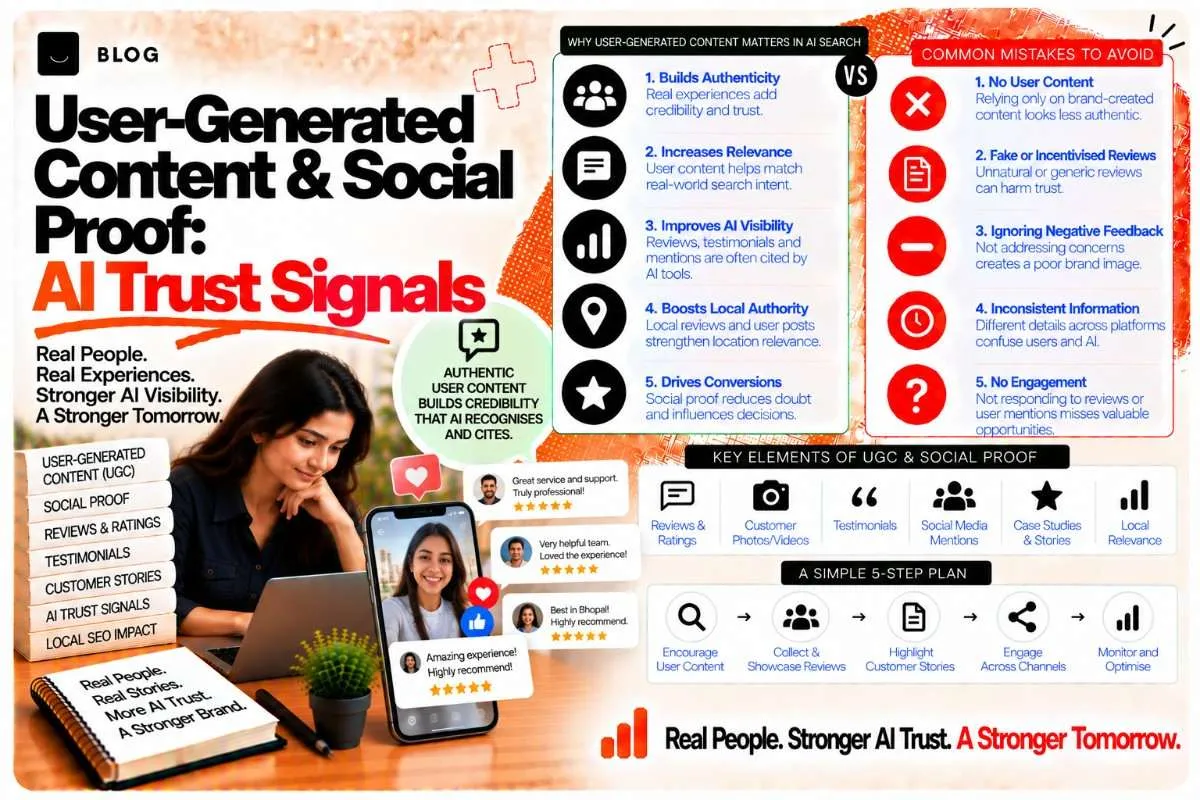
User-Generated Content & Social Proof: AI Trust Signals
AI systems are designed to be skeptical. When ChatGPT, Perplexity, or Google's AI encounters a claim, it asks: "Is this trustworthy? Who's saying this? Can I verify it?"
One of the strongest ways to build trust is social proof: showing that other people agree, trust, and endorse you.
User-generated content — testimonials, case studies, customer reviews, social media mentions — is one of the most powerful trust signals for AI systems. A site with hundreds of positive testimonials is perceived as more trustworthy than a site with polished corporate copy and no social proof.
This is because AI systems understand that people are harder to fake than corporate websites. A real customer saying "This service changed my business" carries more weight than a company saying "We're the best."
How AI systems evaluate social proof
AI systems use social proof to assess trustworthiness at two levels:
Level 1: Existence of social proof
Does your site have testimonials, case studies, reviews, or user-generated content?
- Sites with social proof score higher on trustworthiness
- Sites with none score lower
Level 2: Quality and authenticity of social proof
- Real testimonials (with customer names, photos, details) > anonymous testimonials
- Verified reviews (on third-party platforms) > testimonials only on your site
- Case studies with results (quantifiable outcomes) > generic praise
- Multiple sources (your site + social media + review platforms) > only one source
AI systems evaluate authenticity by looking for patterns:
- Do testimonials sound natural or scripted?
- Are they dated (recent vs. old)?
- Do they include specific details (not generic praise)?
- Are they from diverse sources (not all from your site)?
Content sites with abundant, authentic, diverse social proof are cited more often by AI systems than sites with little or no social proof.
Types of user-generated content and social proof
1. Customer testimonials
What: Short quotes from satisfied customers
Best practices:
- Include customer name, title, company
- Include photo (makes it real)
- Specific details about what they loved ("reduced my ad spend by 40%")
- Recent dates (update quarterly)
- 2–3 sentences max
Example:
"We increased our local visibility in 6 months using Digital4Local's strategy. Our phone calls increased 200%. Highly recommend." — Rajesh Kumar, Operations Manager, Sunsure Energy
2. Case studies
What: Detailed stories of how you helped a client succeed
Best practices:
- Include client name, company, role (with permission)
- Before/after metrics
- Specific challenges and solutions
- Timeline
- Client quote or testimonial
- 500–1,500 words
Why AI systems value them: Case studies show real-world impact. AI systems cite them when answering "how do I implement X?"
3. Video testimonials
What: Customers on camera talking about their experience
Best practices:
- Authentic, unscripted delivery
- 30–90 seconds
- High production quality (good lighting, audio)
- Results-focused
- Posted to YouTube + embedded on your site
Why AI systems value them: Video requires effort and authenticity. It's harder to fake than text.
4. Social media mentions and reviews
What: Testimonials posted on social platforms (LinkedIn, Instagram, Twitter, Facebook, review sites)
Best practices:
- Encourage happy customers to post reviews
- Respond to all reviews (positive and negative)
- Repost positive reviews to your site (with permission)
- Monitor social mentions and compile them
Why AI systems value them: Third-party platforms carry more weight than self-hosted testimonials.
5. Third-party reviews and ratings
What: Reviews on platforms like Trustpilot, Google, Yelp, industry-specific review sites
Best practices:
- Maintain 4.5+ average rating
- Respond to all reviews
- Encourage satisfied customers to leave reviews
- Display reviews on your site with ratings
Why AI systems value them: Third-party verification is stronger than self-reported testimonials.
6. User-generated content on social media
What: Customers sharing their use of your product/service (hashtags, posts, photos)
Best practices:
- Create branded hashtag and encourage use
- Repost user content (with permission/credit)
- Engage with user posts
- Compile into gallery or feature wall
Why AI systems value them: Authentic, organic endorsement from real users
Building a social proof strategy for AI visibility
Step 1: Establish baseline social proof
Audit current:
- Number of testimonials
- Where they're located (your site only? or third-party platforms too?)
- Age and freshness
- Specificity (generic praise vs. detailed results?)
Set targets:
- Testimonials: 10+ on your site + 20+ on third-party platforms (within 12 months)
- Case studies: 3–5 (each 1,000+ words)
- Video testimonials: 3–5
- Review ratings: 4.5+ average on all platforms
- Social mentions: Track and compile monthly
Step 2: Create systems to collect social proof
For testimonials:
- Post-purchase email asking for testimonial
- Simple form: name, company, quote, permission to use
- Offer small incentive (discount on next service, entry into drawing)
For case studies:
- Reach out to top clients
- Offer to document their story
- Share results (traffic, revenue, conversions)
- Get permission and approval before publishing
For reviews:
- Post-service email with review platform links
- Make it easy (direct links, no friction)
- Follow up with non-reviewers
- Respond to all reviews within 48 hours
For video testimonials:
- Reach out to enthusiastic clients
- Offer to film and edit
- Keep it short (30–90 seconds)
- Make the experience easy
For social mentions:
- Monitor hashtags and brand mentions
- Engage with positive posts
- Ask permission to repost
- Compile into monthly highlights
Step 3: Display and organize social proof
On your site:
- Testimonials page or section
- Case studies with metrics
- Video testimonial gallery
- Review rating badge
- Social media feed widget
- Customer logos (if relevant)
Schema markup:
{ "@context": "https://schema.org", "@type": "Review", "reviewRating": { "@type": "Rating", "ratingValue": 5, "bestRating": 5 }, "reviewBody": "Specific details about experience...", "author": { "@type": "Person", "name": "Customer Name" } }
On social platforms:
- Repost customer testimonials and UGC
- Share case study highlights
- Feature customer success stories
- Link back to full case studies
Step 4: Maintain and update social proof
- Review testimonials quarterly (retire old ones, add new ones)
- Update case studies with fresh data
- Respond to all new reviews
- Monitor review platform ratings
- Feature new video testimonials
- Compile monthly social media highlights
Common social proof mistakes to avoid
Don't display generic praise.
"Great service!" with no details doesn't build trust. AI systems prefer specific praise ("Increased my leads by 150%").
Don't use only self-hosted testimonials.
Testimonials only on your site are weaker than third-party reviews. Diversify across platforms.
Don't ignore negative reviews.
A response to a negative review (showing you care about fixing problems) builds more trust than all 5-star reviews with no negatives.
Don't let testimonials go stale.
Old testimonials hurt trust. Update quarterly and remove anything older than 12 months.
Don't force authenticity.
Scripted, corporate-sounding testimonials feel fake. Real language, specific details, and honest opinions are stronger.
Don't show only big brands.
If all your testimonials are from Fortune 500 companies, AI systems notice. Mix large clients with small ones; it signals diversity.
Frequently asked questions
There's no magic number, but 10+ testimonials on your site + 20+ on third-party platforms signals credibility. With less than 5 testimonials, AI systems may deprioritize you.
Both matter, but number matters more. 100 reviews at 4.5 stars is stronger than 5 reviews at 5 stars. Volume signals that many people have used you; rating signals satisfaction.
No. AI systems can detect synthetic testimonials, and if discovered, it destroys trust. Use real customer testimonials only.
No. Authentic testimonials shouldn't be coached. Let customers use their own language. AI systems prefer natural language over optimized testimonials.
Professionally and constructively. Show that you care about fixing problems. Apologize if warranted, offer solutions, follow up. AI systems see this as a trust signal.
Not in ranking, but in AI citation. Video feels more authentic and requires more effort, so AI systems weight it higher for credibility.
Ready to build what's next?
Tell us where you're headed. We'll come back with a plan to get there.
Book an intro call