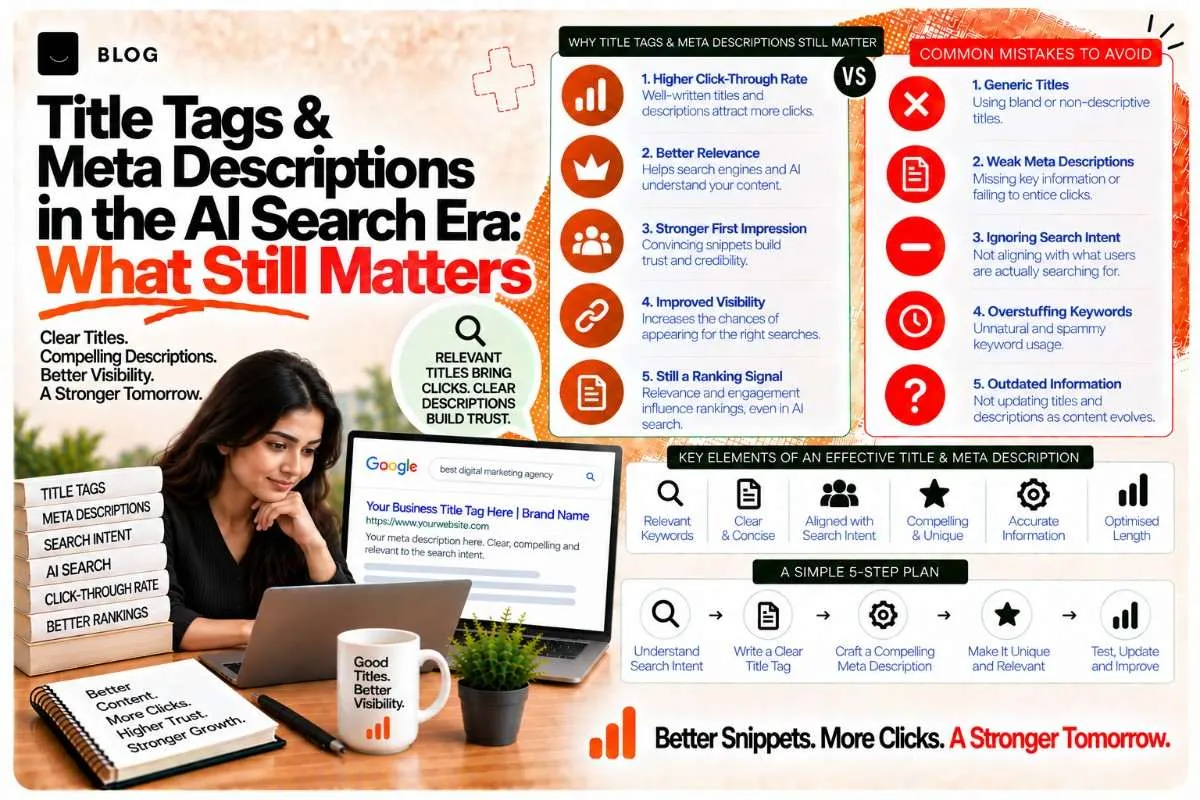
Title Tags & Meta Descriptions in the AI Search Era: What Still Matters
Title tags used to be the clearest signal you could send Google: "This page is about X." Meta descriptions were the ad copy that showed up in search results, a click-bait opportunity. Both were high-stakes, heavily optimized, often over-optimized.
AI search has changed the game, but not how you'd expect. Title tags and meta descriptions aren't less important — they're differently important. They're no longer primarily for Google's ranking algorithm. They're for the humans and AI systems reading your page, and for the specific way AI tools decide whether to cite you at all.
This guide covers what changed, what's the same, what you should actually do, and the checklist that makes sure your on-page fundamentals are AI-search ready.
How title tags and meta descriptions worked in the old SEO model
In traditional SEO (still very much alive, but no longer the whole game), Google used title tags and meta descriptions for three purposes:
- Ranking signal — the words in your title tag helped Google understand topical relevance. A page titled "SEO Services for Bhopal" got a ranking boost for "SEO services Bhopal" queries.
- Click-through rate (CTR) driver — the title and description are what a person sees in search results, and clickable snippets mean more traffic. A compelling, keyword-aligned title/description combo was competitive advantage.
- User signal — when people saw a title tag that matched their query closely, they clicked. When they didn't, they scrolled past. That click-through rate was a signal to Google about relevance.
All three of these still matter somewhat. But AI search introduces a new dimension: AI systems use title tags and meta descriptions not primarily to decide whether to rank you, but to decide whether to cite you as a source.
How AI systems use title tags and meta descriptions differently
When ChatGPT, Perplexity, or Google's AI Overview is building an answer, it's pulling information from your page's content, but it's also reading your metadata (title, description, schema markup) to understand the context and credibility of what it's pulling.
For title tags: An AI system reads your title tag to confirm: "Does this page actually cover what the answer needs?" If your page is titled "The Ultimate Guide to Title Tags," but the AI is answering a question about "how to format JSON-LD schema," the title tag signals that your page is off-topic, and the AI is less likely to cite you — even if your content is good. The title tag is a gate, not a ranking lever.
For meta descriptions: An AI system reads your meta description to quickly understand what the page is about before diving into the full content. A well-written description that accurately summarizes the page increases the probability that the AI pulls the right section for citation. A misleading or vague description makes the AI less confident, which reduces citation likelihood.
Neither directly affects whether you rank in AI search results. Both directly affect whether you get cited.
This is a subtle but important shift: in traditional SEO, a compelling title and description drove clicks. In AI search, an accurate, specific title and description drive citations.
The new rules for title tags in AI search
A title tag in the AI era should do three things:
1. Be specific and directly match the page's primary keyword and intent
Old approach: "Best SEO Services | Bhopal | Digital Marketing Agency"
New approach: "SEO Services in Bhopal | Rank Higher on Google & AI Search"
The new version is more specific (it names the benefit: "rank higher"), clearer about geography, and more directly useful to both a reader and an AI system deciding whether to cite the page.
2. Include the primary keyword but not as a keyword-stuffed phrase
The keyword should appear in the title, but it should read naturally. "Title Tags for SEO" is fine. "Title Tags Title Tags SEO Optimization For Your Title Tags" is not, and AI systems will de-prioritize it for being clearly optimized over useful.
3. Be scannable in one line (under 60 characters for desktop; under 50 for mobile, but you can't control this perfectly)
If your title gets cut off in search results, the first part should be the most important part. Google usually shows 50–60 characters on desktop, so lead with your value proposition or keyword.
Example (59 chars):
Title Tags & Meta Descriptions for AI Search Era — 2025 Guide
This tells you the topic (title tags & meta descriptions), the context (AI search era), and that it's current (2025), all before any text is cut off.
The new rules for meta descriptions in AI search
A meta description should do two things:
1. Accurately summarize what the page covers (not click-bait)
Old approach: "Discover the 7 secrets to SEO success that agencies don't want you to know!"
New approach: "Comprehensive guide to SEO practices for B2B SaaS: technical SEO, content strategy, link-building, and measurement."
The new version tells an AI system exactly what it's getting: a comprehensive guide covering specific subtopics. If the AI is looking for information on "link-building strategies," it now knows this page has that section and is worth citing. The old version is click-bait and vague; an AI system is less likely to trust it.
2. Be between 120–160 characters (more on this below, but aim for the middle of this range)
Reasons for this range:
- Under 100 characters: too vague to help an AI understand the page's scope
- 120–160 characters: sweet spot for human-readable, specific summaries
- Over 160 characters: Google cuts it off in most displays, and the tail end is lost
Example (151 chars):
Expert guide to on-page SEO: title tags, meta descriptions, headers, images, schema markup, and internal linking strategy for ranking in Google & AI search.
This is specific, actionable, covers the page's main topics, and fits the character budget.
What to actually do: the 5-point checklist
1. Title tag: 50–60 characters, primary keyword included naturally, specific benefit or result stated
Example:
- Primary keyword: "SEO services Bhopal"
- Title tag: "SEO Services in Bhopal | Rank on Google & AI Search" (52 chars)
2. Meta description: 120–160 characters, summarizes page scope, no click-bait
Example:
- Page content: comprehensive guide to SEO for local businesses
- Meta description: "Complete SEO guide for local businesses: keyword research, on-page optimization, local signals, and measurement. Rank higher on Google and AI search." (156 chars)
3. H1 tag: matches or mirrors the title tag, single per page
Your H1 should reinforce the title tag, not contradict it. If your title is "SEO Services in Bhopal," your H1 might be "Expert SEO Services for Bhopal Businesses." They're not identical, but they're aligned.
4. Schema markup: Organization or product/service schema with description and keywords
Include an Organization schema on your home page. On service/product pages, include LocalBusiness or a service-specific schema that includes the page's primary keyword and a description.
5. First 60 words of body content: reinforce the primary keyword and summarize the page
This is for both humans and AI. An AI system skimming your page should quickly see that the page is about what the title claims. This is also your last chance to clarify context if the title alone isn't enough.
Common mistakes to avoid
Don't write title tags for Google; write them for humans and AI systems
Old thinking: "I need to rank for this keyword, so I need to use it in the title."
New thinking: "I need to serve the searcher/AI with a clear, specific answer, and the keyword should appear naturally."
If your title feels over-optimized (keyword repeating, awkward phrasing), it probably is. Rewrite it to sound like something a human would write.
Don't use generic meta descriptions
"Read our blog post on marketing" is useless to both humans and AI.
Say what the post is actually about:
"Guide to SEO for e-commerce: keyword research, on-page optimization, technical setup, and measurement."
Don't confuse brand benefit with keyword
A title like "The #1 Digital Marketing Agency for Bhopal" might feel like a win, but it doesn't tell an AI (or a searcher) what your page is about.
"Digital Marketing Services in Bhopal | SEO, Web Dev, Paid Ads" is more useful.
Don't assume meta descriptions are just for CTR
Even though fewer people see your meta description in search results now (more mobile snippets, featured results, etc.), AI systems still read it to understand your page's scope. A good meta description is still doing work.
Don't update title/description just for "freshness"
Only update them if the page's content or primary keyword has genuinely changed. Frequent changes can confuse Google and AI systems about what the page is actually about.
The bigger context: title tags and meta descriptions as entity clarity
Title tags and meta descriptions are part of the broader picture of entity clarity. When Google and AI systems see:
- A title tag that clearly states what your page is about
- A meta description that matches the page's actual content
- Schema markup that reinforces the entity and topic
- An H1 that aligns with the title tag
- First 60 words that get specific immediately
...they're building confidence that you're a credible source for that specific topic.
This confidence compounds: a page with strong on-page fundamentals + entity-level consistency + external corroboration becomes very hard for AI systems to ignore.
For more on entity clarity at the business level, see our Entity SEO Playbook.
Frequently asked questions
Aim for 50–60 characters on desktop (which shows roughly 50–60 characters before cutting off). Mobile shows fewer (around 35 characters), but don't optimize specifically for mobile cutoff; just write a strong 50–60 character title.
Include your business name if you're well-known and space permits, but prioritize keyword + benefit over brand. "SEO Services in Bhopal" ranks higher for relevant queries than "Crescent Digital — SEO Services in Bhopal."
Choose one primary topic for the title tag and meta description. If your page genuinely covers 3+ distinct topics, consider splitting it into separate pages, each with its own focused title and description.
Indirectly. Google doesn't use meta descriptions as a direct ranking factor, but they affect click-through rate. In AI search, they affect citation likelihood. Both are good reasons to make them strong.
Title tag: what appears in browser tab and search results. H1: the main heading on the page itself. They should align but don't have to be identical.
Only when the page's content or primary keyword has changed. Avoid frequent updates, as this can confuse Google and AI systems.
Ready to build what's next?
Tell us where you're headed. We'll come back with a plan to get there.
Book an intro call