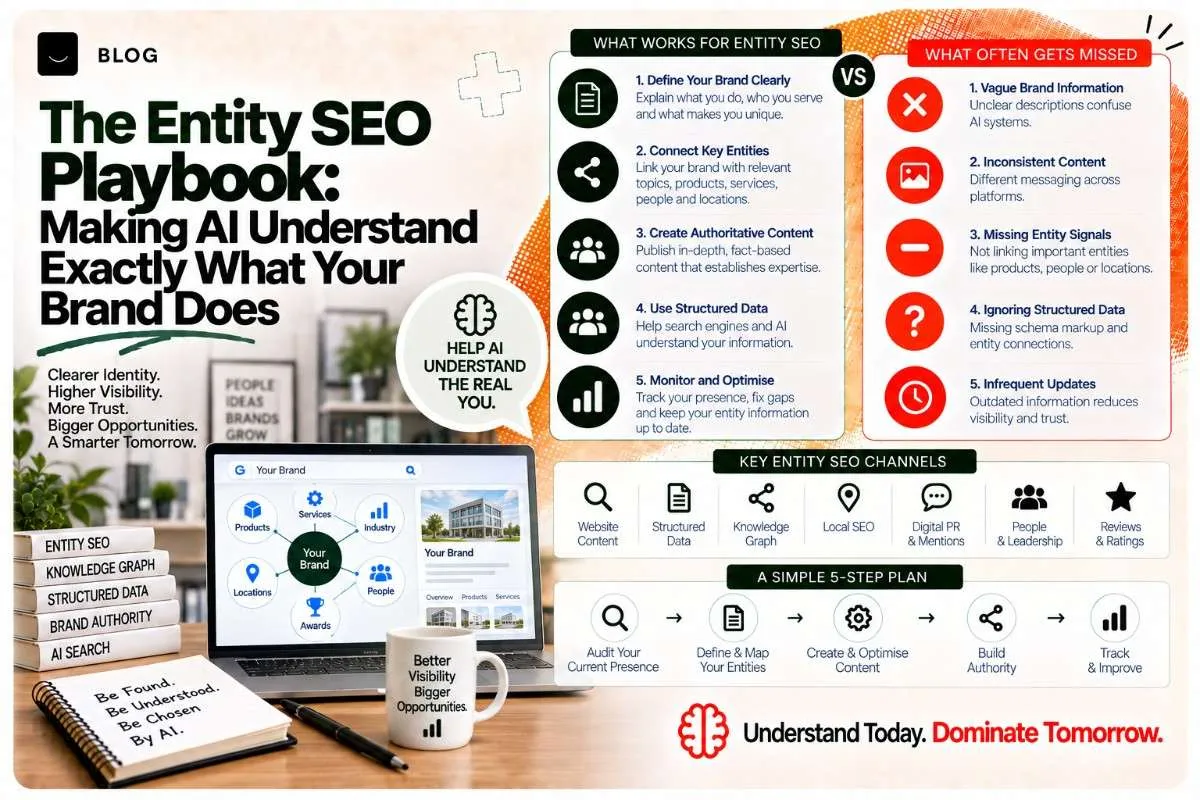
The Entity SEO Playbook: Making AI Understand Exactly What Your Brand Does
An entity, in this context, is a business, person or organisation as a distinct, resolvable thing a search or AI system can confidently identify — as opposed to a scattered set of unconnected mentions that never quite add up to a single, confident understanding. Entity clarity is the foundation underneath nearly every other recommendation in this library: named authors, consistent business data, verified profiles. This post pulls that thread together into one audit, rather than leaving it scattered across a dozen other posts.
What an entity is, in this context
Worth defining precisely, because the term gets used loosely.
A search engine or an AI system does not read your website as a human does, absorbing an overall impression. It attempts to resolve every mention of a business, person or organisation into a single confident record — this name, this website, this address, this set of credentials, this set of verified affiliations — the same way a careful human researcher would cross-reference several sources before concluding they all refer to the same thing.
When that resolution succeeds cleanly, a system can confidently draw on everything it knows about an entity when answering a question about it. When it fails — because the business name is spelled three different ways, the address is inconsistent, or nothing corroborates the business exists beyond its own website — the system either hedges, gets something wrong, or simply does not surface the entity at all.
Why entity clarity underlies everything else in this library
This is worth stating explicitly, because it has been true throughout nearly every post published here without ever being named as a single unifying concept.
- The AI visibility gap post argues that most Indian businesses are weak entities on the open web — that is literally what the problem is.
- The Ask Maps post argues that profile completeness matters because it feeds the record a system builds about this specific business.
- Every post recommending named authors is a recommendation to strengthen a person entity, linked clearly to the organisation entity.
- The GEO pillar's core argument — that AI engines reward clearly stated entities — is this same concept at the foundational level.
Entity clarity is not one more tactic alongside the others. It is closer to the substrate everything else sits on. A business with a confused entity record will underperform on every other recommendation in this library, because each of those recommendations assumes the system already knows which entity it is dealing with.
The seven-point entity audit
1. One stated description, used everywhere
A single sentence describing what the business is and does, used identically — word for word — on the website, the Google Business Profile, every social profile, and any directory listing. Not five variations that each sound slightly different. One sentence, repeated exactly.
This sounds trivial and is the single most commonly failed item on this list. Most businesses describe themselves slightly differently on every platform, without ever noticing, because no one sentence was ever designated as the description.
2. NAP consistency, checked, not assumed
Name, address, phone — identical across every platform where the business appears. This has been recommended throughout this library, and it belongs here as the foundational entity signal it actually is: a system resolving "is this the same business" leans heavily on whether these three facts match everywhere.
Checked, not assumed, because most businesses believe their NAP is consistent and have never actually audited it against every platform where they appear.
3. Verified social profiles, linked with sameAs
Every genuine, actively maintained social profile, linked from the website's Organization schema using the sameAs property. This is the structured, machine-readable version of "here is corroborating evidence that this website and this social profile refer to the same entity" — and it is frequently entirely absent, even on otherwise well-built sites.
4. Named people, consistently identified
Every named author, founder or credentialed team member identified the same way everywhere — same name spelling, same title, same credentials stated identically on the website, LinkedIn, and any bylined content. A person is an entity too, and the same resolution problem applies to individuals as to organisations.
5. Organization schema, complete
Covered in detail in our dedicated schema guide — the structured, explicit version of everything above, in a format a system can parse without inference.
6. Third-party corroboration
At least some independent source — press coverage, an industry directory, a professional association listing, a genuine review platform — confirming the entity exists and matches the stated facts. Self-reported information alone is a weaker signal than the same information corroborated elsewhere, because self-reported information is, definitionally, unverified.
7. Disambiguation from similarly-named entities
If another business, anywhere, shares a similar name, actively distinguishing your entity from it — through a more specific stated location, a distinct visual identity referenced consistently, or explicit disambiguating detail in the entity description. An unresolved naming collision is one of the more damaging and least obvious entity problems, because a business rarely knows it has one until a mismatch is spotted in the wild.
How to run this audit on your own business
Roughly ninety minutes, done properly:
- List every platform your business appears on — website, Google Business Profile, every social platform, every directory, any marketplace listing.
- Pull the stated business description from each one, side by side. Note every variation.
- Pull the stated name, address and phone from each one, side by side. Note every discrepancy.
- Check that every social profile is linked in your website's Organization schema.
- List every named person referenced on your site or in your content, and check their name, title and credentials are stated identically everywhere they appear.
- Search for your own business name and note whether anything independent — a press mention, a directory, a review platform — corroborates who you are.
- Search for any similarly-named business or professional, and assess whether a system (or a customer) could plausibly confuse the two.
What entity confusion actually costs
Concretely, not abstractly:
- A system hedges or omits rather than confidently naming you, because it cannot resolve the scattered signals into one confident record.
- AI-generated answers about your business may draw on the wrong source — if a similarly-named entity is better resolved, a system may confidently answer with facts about the wrong business.
- Every other GEO recommendation in this library underperforms, because they all assume a resolved entity to attach their signal to. Named authorship, structured data, freshness — all weaker when the underlying entity itself is ambiguous.
Where this fits against everything else in this library
This post is deliberately a synthesis rather than new territory. Nearly every recommendation here has appeared elsewhere in this library in a specific vertical or specific context — this post is the organising framework connecting them, so a reader can see the whole shape of the work rather than encountering it piecemeal across a dozen separate posts.
If starting from close to nothing, this seven-point audit is arguably the single highest-leverage place to begin, ahead of any content programme — because content published against an unresolved entity does less work than the same content published against a clearly resolved one.
Frequently asked questions
Entity SEO is the work of making a business, person or organisation resolvable by a search or AI system as a single, confident, distinct entity — rather than a scattered set of mentions that never clearly connect to one another. It underlies most other AI search recommendations, since they assume the system already knows which entity it is dealing with.
Because AI systems attempt to resolve every mention of a business into one confident record before drawing on what they know about it. When that resolution fails — due to inconsistent names, addresses or descriptions — a system tends to hedge, answer incorrectly, or simply not surface the entity at all.
Describing the business slightly differently across different platforms — the website, social profiles, directory listings — without anyone having designated one exact sentence as the canonical description. This sounds trivial but is the most commonly failed item in a full entity audit.
Yes. Name, address and phone consistency is a foundational signal any system uses to determine whether different mentions refer to the same business. This matters for AI answer engines resolving an entity just as much as it matters for conventional local search ranking.
sameAs is a property in Organization schema that links a website explicitly to verified social profiles, providing structured, machine-readable corroboration that the website and those profiles refer to the same entity. It is frequently missing even on otherwise well-built websites.
Regular SEO often focuses on ranking specific pages for specific queries. Entity SEO focuses on whether a system can confidently identify the business itself as a distinct, resolvable thing across every place it appears. Entity clarity underlies and strengthens nearly every other SEO and GEO recommendation, since those assume a resolved entity to attach to.
With the seven-point audit in this post: one consistent stated description, checked NAP consistency, verified social profiles linked in schema, consistently identified named people, complete Organization schema, third-party corroboration, and disambiguation from any similarly-named entity. This is arguably higher-leverage than starting a content programme against an unresolved entity.
Ready to build what's next?
Tell us where you're headed. We'll come back with a plan to get there.
Book an intro call