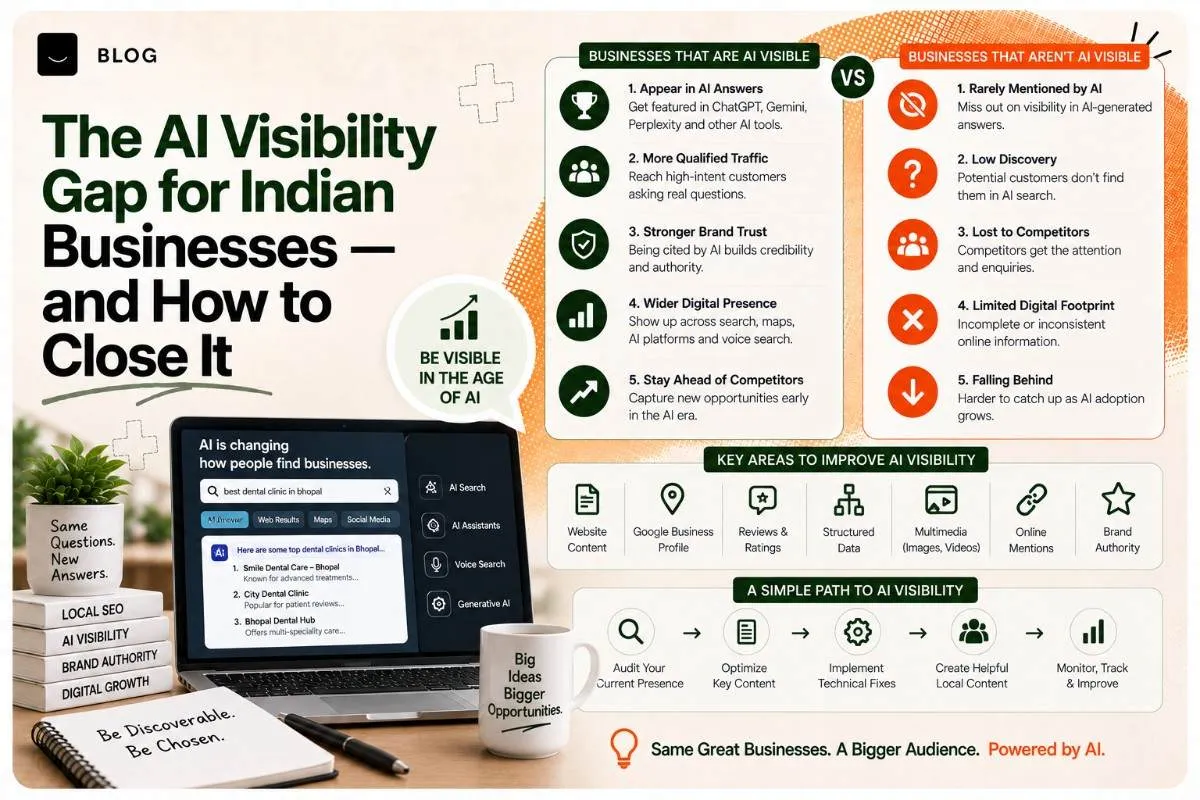
The AI Visibility Gap for Indian Businesses — and How to Close It
Ask an AI assistant to recommend a digital agency, a dermatologist or a boutique hotel in an Indian city and you will often get global brands, large aggregator platforms, or a hedge. Ask the same question about a US or UK city and the answers are specific and local. This is the AI visibility gap, and it is not primarily about model bias. It is about what these systems can find, read and verify — which means most of it is fixable by the businesses themselves.
Test it yourself in five minutes
Before the explanation, get the evidence. This is more convincing than anything below.
Open ChatGPT, Perplexity and Google's AI Mode. Ask each one the question your best customer would ask if they had never heard of you. Not your brand name — the category question. "Which digital marketing agencies in Udaipur handle SEO for hotels?" "Good paediatric dentists in Bhopal?" "Reliable solar installers in Madhya Pradesh who handle the subsidy paperwork?"
Then note three things: whether any specific local business is named, whether the named ones are actual local businesses or directory platforms, and whether the answer hedges rather than recommending.
Run the same shape of question for a comparable Western city. The difference is usually stark, and it is the entire subject of this post.
What causes the gap
Five causes, in roughly descending order of how much they matter and ascending order of how easy they are to fix.
The training data leans Western
Language models are trained on the open web, and the open web over-represents English-language, Western content. Indian businesses, Indian publications and Indian professional discussion are present but proportionally thinner than the country's economic activity would suggest.
This is the cause most often cited and the one you can do least about. It is also, in our reading, not the largest cause — because the systems doing the answering increasingly search rather than relying on training memory alone. Retrieval is where the gap gets closed, and retrieval works on what is currently published.
VERIFY: Do not attach a percentage to this claim. Figures circulate about the Western share of training corpora; most are estimates from partial datasets. The directional point stands without one.
Indian businesses are weak entities on the open web
This is the big one, and it is entirely fixable.
An AI system that recommends a business is making a small bet on its own reliability. It needs to know the business exists, what it does, where it operates, and that something independent corroborates all three. For a large share of Indian businesses, that corroboration does not exist anywhere a model can reach.
Typical picture: a website with no named people on it, no About page detail, no consistent description of the organisation, no social profiles linked in schema, no press coverage, and no third-party mention beyond a directory listing. From a model's point of view that is not a business with weak signals. It is close to no signal at all.
The information lives in places models cannot read
An enormous amount of genuine Indian business information exists — in WhatsApp groups, on Instagram, in phone calls, in PDFs, in images of price lists, in regional-language conversation on platforms that are not openly crawlable.
That is not a criticism of how Indian businesses operate; those channels work. But an AI answer engine reads the open, crawlable web. Information held in a WhatsApp broadcast or a JPEG price list is, for this purpose, unpublished.
Directories and aggregators absorb the citation
When an assistant does find Indian local information, it frequently comes from an aggregator — a directory, a listings platform, a marketplace. Those platforms have the domain authority, the structured data and the volume. So the answer names the platform rather than the business.
This is why a clinic can be well-reviewed on a healthcare platform and still be absent from an AI answer about clinics in its city. The platform got the citation.
Language and script fragment the signal
A business referred to in English, in Hindi, and in transliterated Hinglish, with two spellings of its name and three different addresses, is harder for a system to resolve into one confident entity than a business with one consistent representation everywhere.
Why this gap is an opportunity rather than a complaint
Here is the part worth internalising.
In a mature, competitive channel, closing a visibility gap means outspending or outlasting entrenched competitors. That is not the situation here. In most Indian categories and most Indian cities, almost nobody has done this work. The competition for AI visibility is not fierce; it is largely absent.
That means the cost of establishing visibility now is low compared to what it will be once the category matures. It also means the work is unusually achievable for a small business, because the things that matter — a clearly stated entity, named people, complete information, consistent data, honest content — are not budget-gated. They are attention-gated.
This is the same argument Crescent makes on its own service page about GEO being early. The gap is the reason it is early.
Closing it — in the order that actually works
Order matters here more than in most SEO work, because several steps depend on earlier ones.
1. Make yourself crawlable. If a crawler cannot reach, render and index your pages, nothing else on this list can help. Check indexation in Search Console before anything else.
2. State your entity, once, and repeat it identically. One sentence describing what your organisation is, used verbatim on your website, your Google Business Profile, your social profiles and your directory listings. Not five variations — one. Inconsistency is what stops a system resolving you into a confident entity.
3. Name real people. Founders, doctors, engineers, strategists — with roles, credentials and photographs. Add Person schema. For an Indian business, this is frequently the single largest missing signal, and it is a decision rather than a project.
4. Fix your NAP everywhere. One name spelling, one address format, one phone number, across every platform. Audit it; most businesses discover at least one inconsistency they did not know about.
5. Publish what currently exists only in conversation. The pricing structure you explain on every call. The process you describe to every new client. The questions your front desk answers daily. These are already articulated — they are just not written down anywhere crawlable.
6. Add real structured data. Organization schema with sameAs links to your verified profiles, LocalBusiness where relevant, FAQPage on your question content, Article with named authors on your posts.
7. Get corroborated elsewhere. Local press, trade publications, industry associations, chambers of commerce, podcasts. One credible independent mention does more for entity confidence than ten directory listings.
8. Publish in the languages your customers use. If a meaningful share of your audience searches in Hindi, Tamil or Marathi, content in those languages is close to uncontested and directly addresses the fragmentation problem.
9. Then measure. Re-run the five-minute test monthly, record the results, and watch the direction over months rather than weeks.
What this looks like for three kinds of business
A local service business (clinic, salon, installer, restaurant): steps 1, 2, 3, 4 and 6 are the entire programme for the first quarter. Google Business Profile completeness plus a website that names real people and states the same facts consistently will move you further than any content investment.
A B2B or professional services firm: steps 3, 5 and 7 matter most. Your expertise is genuinely differentiated and almost certainly undocumented. Named experts publishing specific, technical content is the fastest route, because there is very little competing material.
A multi-location or multi-city business: step 4 becomes the hard one. Every location needs consistent, distinct, complete data, and location pages that actually differ from one another rather than being the same page with the city name swapped.
How long it takes, honestly
Nobody can give you a reliable timeline, and any agency that does is guessing. What can be said about the shape of it:
- Weeks: profile completeness and NAP consistency can affect what a system says about you fairly quickly, because that data is retrieved rather than learned.
- Months: entity signals from named authors, structured data and published content accumulate gradually.
- Longer and less predictable: third-party corroboration, which depends on other people publishing.
The measurement is manual and imprecise — a fixed prompt set, run monthly, recorded in a spreadsheet. That is the honest state of the tooling. Anyone selling you a precise AI visibility score should be asked exactly where the number comes from.
What will not close the gap
- Publishing volume for its own sake. Thirty thin posts do not establish an entity. Five substantial ones by a named expert do more.
- Directory listings at scale. A handful of relevant, accurate listings help with consistency. Bulk submission does not, and inconsistent bulk listings actively hurt.
- AI-specific files. Publishing an llms.txt or similar has no demonstrated effect on citation. The evidence is covered separately in our post on that subject.
- Keyword stuffing for AI. These systems are not matching keywords. Writing "best digital marketing agency in Udaipur" fourteen times does nothing except make the page worse.
- Waiting for the models to improve. They may well get better at Indian coverage. That does not help if there is nothing about your business to find.
Frequently asked questions
Several causes compound: training data over-represents Western English-language content, most Indian businesses are weak entities on the open web with no named people or consistent descriptions, much genuine information lives in WhatsApp, images and PDFs that models cannot read, aggregator platforms absorb the citation, and name and address inconsistencies fragment the signal. Most of these are fixable by the business.
Training data does skew Western, but that is not the largest practical cause. Modern assistants increasingly search rather than answering from memory alone, which means retrieval works on what is currently published. Most Indian businesses are missing from AI answers because there is little about them on the crawlable web, not primarily because a model is biased against them.
In order: confirm the site is crawlable and indexed, state one consistent description of the organisation everywhere, name real people with roles and credentials, fix name-address-phone consistency across all platforms, publish information that currently only exists in conversation, add structured data, and seek independent mentions. None of this requires a large budget.
Aggregator platforms have the domain authority, structured data and content volume that individual business sites usually lack, so they become the citable source for local information. A well-reviewed business can therefore be invisible in an AI answer while the platform listing it gets named.
Yes, particularly because it is close to uncontested. Very few businesses publish substantive regional-language content, and it also addresses the fragmentation problem created when a business is referred to inconsistently across languages and scripts. Have a fluent speaker write or review it rather than relying on machine translation.
There is no reliable timeline. Profile completeness and data consistency can affect answers within weeks because that information is retrieved rather than learned. Entity signals from named authors and published content accumulate over months. Third-party corroboration is slowest and least predictable because it depends on others publishing.
Manually, with a fixed set of ten to twenty questions a real customer would ask, run monthly across ChatGPT, Perplexity and Google's AI surfaces, with results recorded in a spreadsheet. The tooling for this is immature. Treat any product offering a precise AI visibility score with scepticism until it explains its methodology.
Ready to build what's next?
Tell us where you're headed. We'll come back with a plan to get there.
Book an intro call