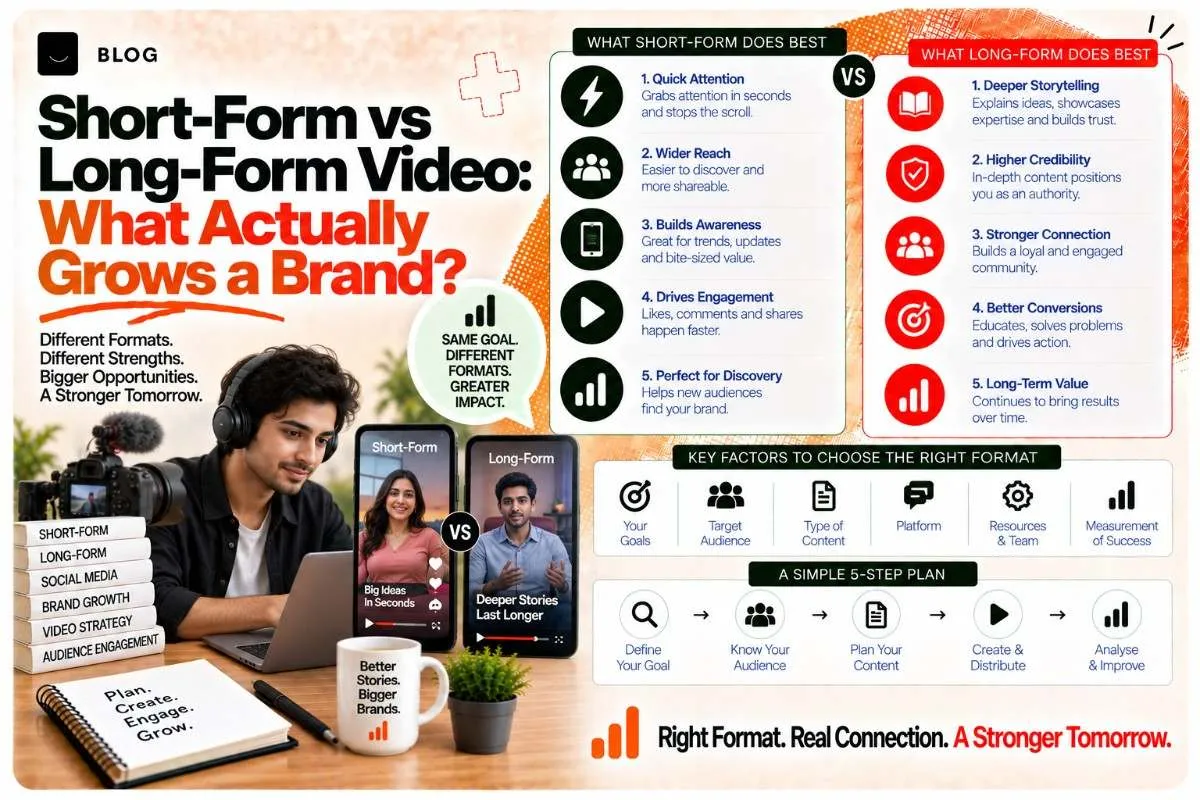
Short-Form vs Long-Form Video: What Actually Grows a Brand?
Short-form video won the discoverability battle over the last several years — it is cheap to produce, algorithmically favoured for reach, and remains the fastest way to get in front of people who have never heard of a brand. Long-form video is having a quieter but genuine resurgence, driven by a different job: depth, trust, and — increasingly — the transcript-based content that feeds AI search visibility. Most brands need both, doing different jobs, not one replacing the other.
The debate, stated fairly
The "long-form is back" narrative gets overstated by publishers with an interest in the story being dramatic. The honest version: short-form has not declined, and long-form has not overtaken it. What has changed is that long-form has found renewed purpose for specific goals short-form structurally cannot serve.
What short-form does well
Reach and discovery among people with no prior relationship to the brand, low production cost enabling high volume and iteration, and strong performance in algorithmic feeds specifically built to reward it. For pure top-of-funnel awareness, nothing currently matches short-form's cost-per-impression.
What long-form is quietly doing better
Building genuine trust and demonstrating real expertise — a ten-minute walkthrough or explainer says something about depth a fifteen-second clip cannot. Producing content that converts into other formats efficiently, since a long-form recording yields a transcript, a written article, and several short clips from one shoot. And, covered in detail in our post on video and AI search visibility, long-form content paired with a genuine transcript is what actually feeds AI answer engines — short-form's minimal spoken content gives those systems very little to extract.
The AI-search dimension neither format alone solves
This is the part most of the short-form-vs-long-form debate misses entirely. AI answer engines work from text, not footage, regardless of format. A short-form video with no caption text contributes nothing to AI visibility. A long-form video without a published transcript contributes almost as little. The dimension that actually matters is not short versus long — it is transcribed and published as text versus not, which is a production discipline that applies to both formats and is covered fully in our dedicated video and AI search post.
A practical allocation, not a winner
For a brand starting from nothing: short-form first, for reach, cheaply and quickly. As the channel matures, add long-form specifically for the topics where genuine depth and expertise-demonstration matter — the same content that can then be cut into short clips, transcribed into a written article, and published on a page a search or AI system can actually read. The two are not competing for the same budget line so much as serving two different, sequential stages of the same growth path.
Frequently asked questions
They serve different stages. Short-form is more cost-effective for reach and discovery among people unfamiliar with the brand. Long-form builds deeper trust and expertise demonstration, and produces more reusable content — transcripts, articles, clips — from a single production effort.
It has found renewed purpose for specific goals rather than displacing short-form. Long-form suits depth, trust-building and content that converts efficiently into other formats, while short-form remains stronger for pure reach and discovery.
Less than whether the video is transcribed and published as text. AI answer engines work from text, not footage, so a short-form video with no captions and a long-form video with no published transcript both contribute little to AI visibility regardless of format.
Usually after establishing reach through short-form first. Long-form works well for topics needing genuine depth and expertise demonstration, and one long-form recording can be repurposed into short clips and a written transcript-based article, extending its value beyond the original video.
Ready to build what's next?
Tell us where you're headed. We'll come back with a plan to get there.
Book an intro call