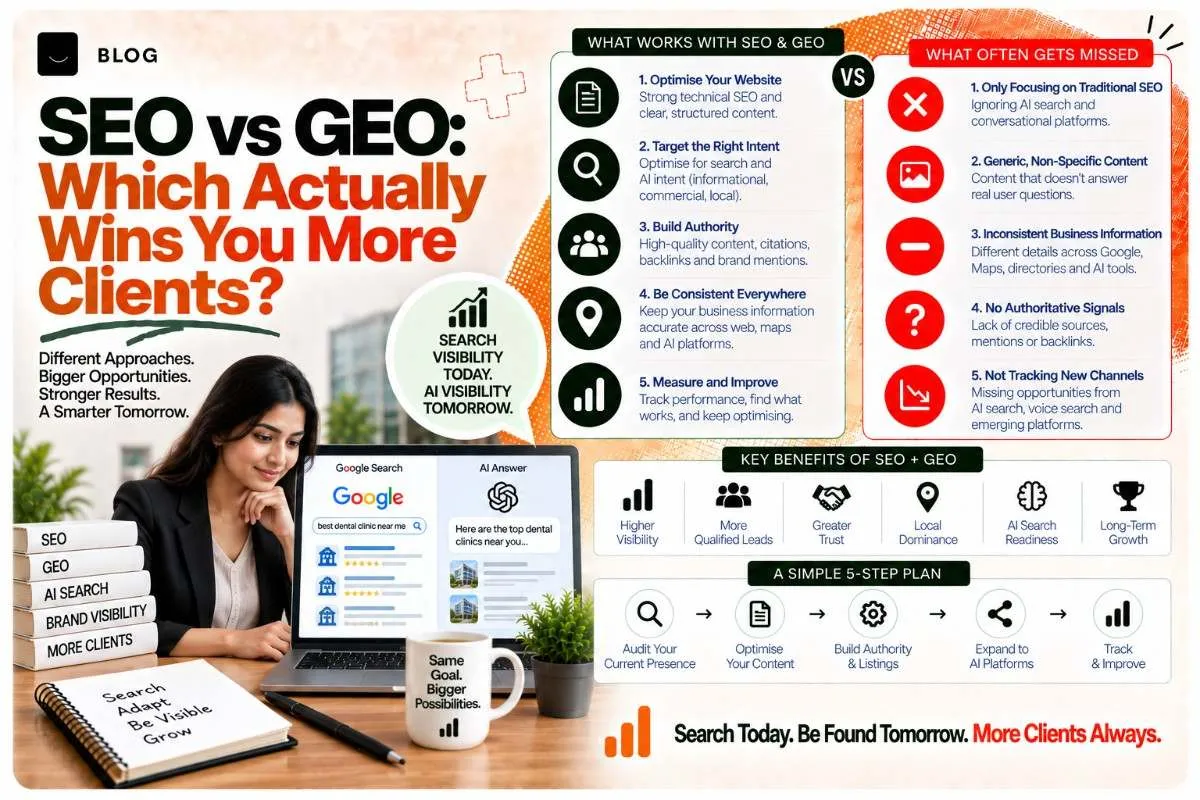
SEO vs GEO: Which Actually Wins You More Clients?
The honest answer is that this is the wrong framing for most businesses, and the right answer depends entirely on where your buyers already are. SEO and GEO overlap on the large majority of the underlying work — crawlability, content depth, structured data — and diverge on a smaller set of specifics that matter more for some categories than others. This post gives the decision framework instead of a universal verdict, because a universal verdict would be dishonest.
Are SEO and GEO actually different?
Not as different as the debate suggests. SEO is optimising to rank in a search engine's organic results. GEO is optimising to be cited inside an AI-generated answer. Both reward crawlable, well-structured, genuinely useful content with clear authorship. A site with broken technical SEO cannot be cited by an AI engine either, because most AI engines still substantially read the open web through the same crawling infrastructure.
The overlap is large enough that "is GEO just SEO with a new name" is a fair question, and the honest answer is: mostly, yes — with a meaningful minority of practice that is genuinely distinct.
What each one optimises for, concretely
SEO rewards backlink authority, keyword-to-page relevance, technical crawlability and Core Web Vitals, and has a mature, well-understood ranking mechanism refined over two decades.
GEO rewards entity clarity, credentialed authorship, specific extractable facts, external citations, and content that fully answers a question rather than teasing a click — and the mechanism is comparatively new, less mapped, and measured with far blunter tools.
Where they overlap almost completely
Technical crawlability, content depth and genuine usefulness, clear site structure, and consistent business information all serve both equally. Nothing here is SEO-only or GEO-only — it is foundational work either discipline depends on.
Where they genuinely diverge
SEO still rewards backlink volume and domain authority more heavily than GEO does — a well-linked but shallow page can still rank. GEO rewards named, credentialed authorship and external citation more heavily than conventional SEO ranking does — an unlinked but deeply authoritative, well-sourced page can still get cited. SEO has mature rank tracking; GEO measurement is still manual and directional, covered in detail elsewhere in this library.
A decision framework, not a verdict
Weight toward SEO first when: the category has established, high-volume search terms; competitors are winning primarily through domain authority; the business needs measurable, trackable results quickly.
Weight toward GEO first when: buyers are asking detailed, conversational questions an AI assistant is well-placed to answer; the category is one where AI answer engines are already visibly citing sources; the business has genuine expertise and named experts but weak backlink profile.
Do both, always, eventually — the foundational work is shared, and one without the other leaves real visibility on the table.
Three worked scenarios
A solar installer competing on "solar installer near me": SEO-first, because this is a high-volume local query with established ranking mechanics, then layer GEO once local pages are built.
A B2B manufacturer answering detailed procurement questions: GEO-first, because backlink-building in a niche B2B category is slow and the actual buyer question is exactly the kind an AI assistant fields directly.
A hospital chain: both simultaneously and inseparably, because YMYL content faces the same E-E-A-T bar from both systems.
Frequently asked questions
Mostly overlapping, not identical. Both reward crawlable, well-structured, genuinely useful content. GEO weights entity clarity, credentialed authorship and citability more heavily; SEO weights backlink authority and established ranking mechanics more heavily. Foundational technical work serves both.
Depends on where buyers currently search. High-volume, established local or category terms favour SEO first. Detailed, conversational buyer questions in a niche or expertise-driven category favour GEO first. Most businesses eventually need both, since the underlying foundation is shared.
No. AI answer engines weigh entity clarity, credentialed authorship and specific extractable facts differently than conventional ranking does. A page can rank well and still be passed over for citation if it lacks a named author or fails to state facts explicitly.
Not yet to the same standard. SEO has mature rank-tracking tools; GEO measurement currently relies on manual prompt testing across AI platforms alongside proxy signals like branded search lift, covered in more depth elsewhere in this library.
Ready to build what's next?
Tell us where you're headed. We'll come back with a plan to get there.
Book an intro call