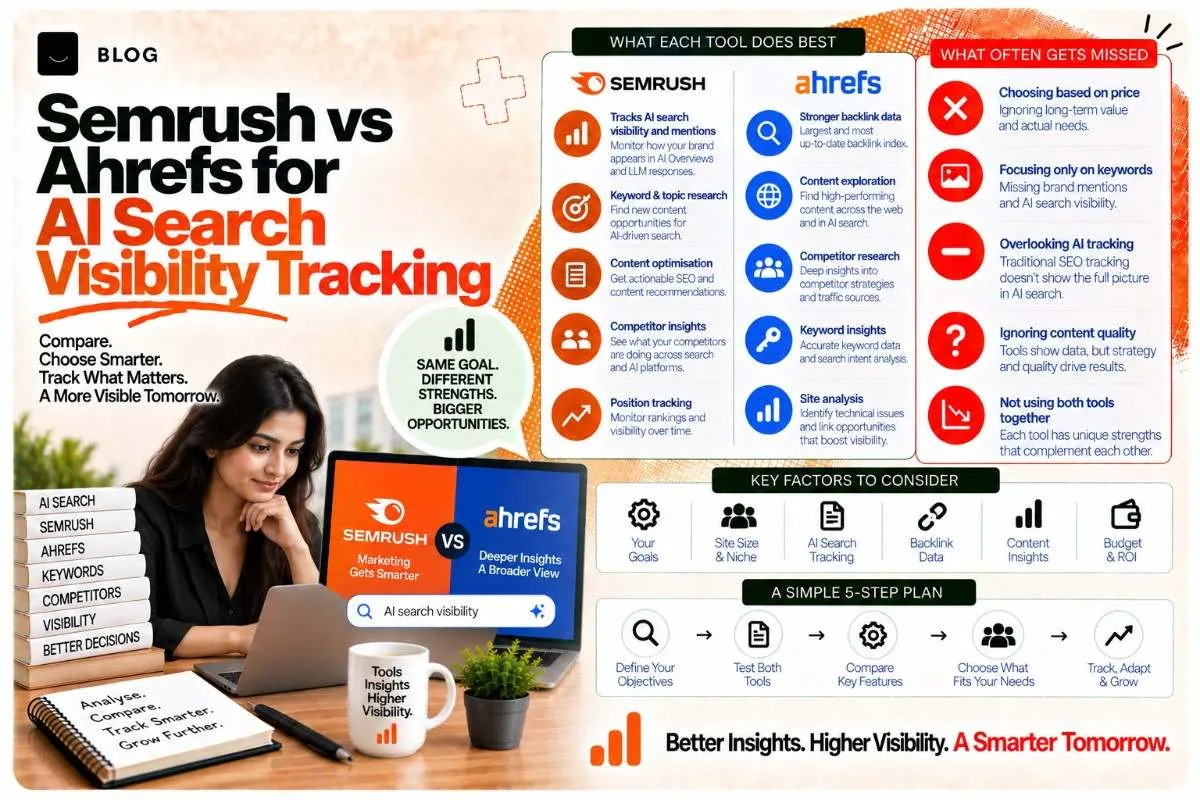
Semrush vs Ahrefs for AI Search Visibility Tracking
Both major SEO platforms have added features tracking how often a brand is mentioned or cited in AI-generated answers, moving beyond their traditional rank-tracking core. Neither replaces the manual prompt-testing layer described elsewhere in this library, and neither should be chosen on brand loyalty alone — the right pick depends on which platform a team already lives in daily, since the AI visibility feature set is currently secondary to each tool's core strength rather than a standalone reason to switch.
A note on verifying what follows
VERIFY: Feature names, scope and pricing for both platforms' AI visibility tools change frequently, and this is an actively developing product category for both companies. Confirm current feature names, what each actually measures, and current pricing tiers against each platform's own documentation before publishing. Do not publish a specific feature name, capability claim or price point that has not been checked on the day of publishing — this category moves faster than almost anything else in this library.
Why this comparison exists now
As AI answer engines became a meaningful discovery channel, both major SEO platforms responded by extending their existing tracking infrastructure — built originally for rankings and backlinks — to also monitor brand mentions across AI-generated answers. This is a genuinely useful addition for any team already paying for one of these platforms, and a genuinely confusing one for a team trying to decide whether the AI feature alone justifies a subscription or a switch.
The honest framing: neither platform built its AI tracking feature from scratch as a standalone product. Both extended an existing toolset. That matters for what to expect — depth and precision here currently trail what either platform offers for traditional rank tracking, a mature category refined over many years.
What each platform's AI visibility feature actually measures
Semrush's approach
VERIFY: Confirm the current feature name and scope before publishing. In general terms, pending verification: Semrush's AI visibility tooling tracks brand and competitor mentions across major AI platforms, generally integrated into the same dashboard as its existing rank tracking and content tools, which is its main practical advantage — a team already living in Semrush sees AI visibility alongside familiar traditional metrics rather than in a separate tool.
Ahrefs' approach
VERIFY: Confirm the current feature name and scope before publishing. In general terms, pending verification: Ahrefs has extended its tracking capability similarly, drawing on its existing strength in backlink and keyword data to contextualise AI citation alongside those established metrics.
Where the two genuinely differ
Beyond the specific feature names, which need verification before publishing, the more durable differences between the platforms are their traditional core strengths: Ahrefs has historically been regarded as stronger for backlink data depth; Semrush has historically been regarded as stronger for broader marketing toolset breadth, including content and PPC tools alongside SEO. Since AI visibility tracking in both platforms is currently a layer added on top of that existing core, the underlying platform strength a team already relies on is a more durable decision factor than the AI feature specifics, which are likely to keep changing on both sides.
What neither tool does
Neither platform, as far as can be confirmed, replaces the manual prompt-testing method described in detail in our post on setting up AI citation tracking with Search Console and GA4. Both platforms' AI tracking tends to sample a defined set of queries or topics rather than testing the specific, granular buyer-intent prompts a business actually cares about. Both are also, like the free-tier tools, working with a genuinely new and less mature measurement problem than traditional rank tracking — meaning results from either should be treated as directional, not as precise as the rank data both platforms are known for.
VERIFY: Do not publish any specific accuracy or coverage claim about either platform's AI tracking without a named, current, verified source.
A decision framework, not a verdict
Already using one of these platforms for SEO? The AI visibility feature is very likely worth turning on and monitoring alongside existing metrics, rather than a reason to switch platforms. Switching platforms for an AI feature currently secondary to both tools' core function rarely justifies the disruption.
Choosing between the two from scratch? Decide based on the core rank-tracking, backlink and content tooling each platform offers — the traditional strengths that remain well-established — and treat the AI visibility feature as a genuinely useful bonus rather than the deciding factor, given how quickly this specific feature set is still evolving on both sides.
Either way: pair whichever platform's AI feature with the manual prompt-testing method covered in our GSC/GA4 citation tracking guide. That manual layer remains, at the time of writing, the only way to test the specific granular prompts a particular business's actual customers ask.
What this replaces, and what it does not
These tools replace the need to build a custom AI-mention tracking system from scratch, and they provide a useful dashboard view alongside metrics a team already monitors daily. They do not replace the discipline of testing specific, real buyer-intent prompts by hand, because neither platform's sampling approach can be assumed to match the exact questions a specific business's own customers actually ask an AI assistant.
Frequently asked questions
Both platforms have extended their existing SEO tooling to track brand and competitor mentions across AI-generated answers, integrated alongside their traditional rank-tracking and content features. Specific feature names and scope should be verified against each platform's current documentation, since this is an actively developing product category for both.
Generally not recommended. The AI visibility feature is currently secondary to each platform's core rank-tracking, backlink or content tooling, which remains the more durable basis for a platform decision. If already using one platform, turning on its AI tracking feature is usually more sensible than switching for that feature alone.
No. Both platforms' AI tracking appears to sample a defined set of queries or topics rather than testing the specific granular prompts a particular business's actual customers ask. Manual prompt testing across AI platforms remains the more precise method for a specific business's own priority questions.
This depends on features and pricing that change frequently for both platforms and should be verified directly before deciding. The more durable factor is each platform's traditional core strength — Ahrefs for backlink data depth, Semrush for broader marketing toolset breadth — since the AI tracking layer is currently secondary to that core on both sides.
Neither platform's AI tracking has a long track record compared to their mature rank-tracking features, and no verified accuracy or coverage claim should be assumed without checking each platform's current documentation. Results from either are best treated as directional rather than precise.
Set up the free-tier method covered in our dedicated guide — segmenting AI referral traffic in GA4, tracking branded search lift in Search Console, and running manual prompt tests across AI platforms by hand. This produces genuinely useful directional data without either platform's subscription cost.
Ready to build what's next?
Tell us where you're headed. We'll come back with a plan to get there.
Book an intro call