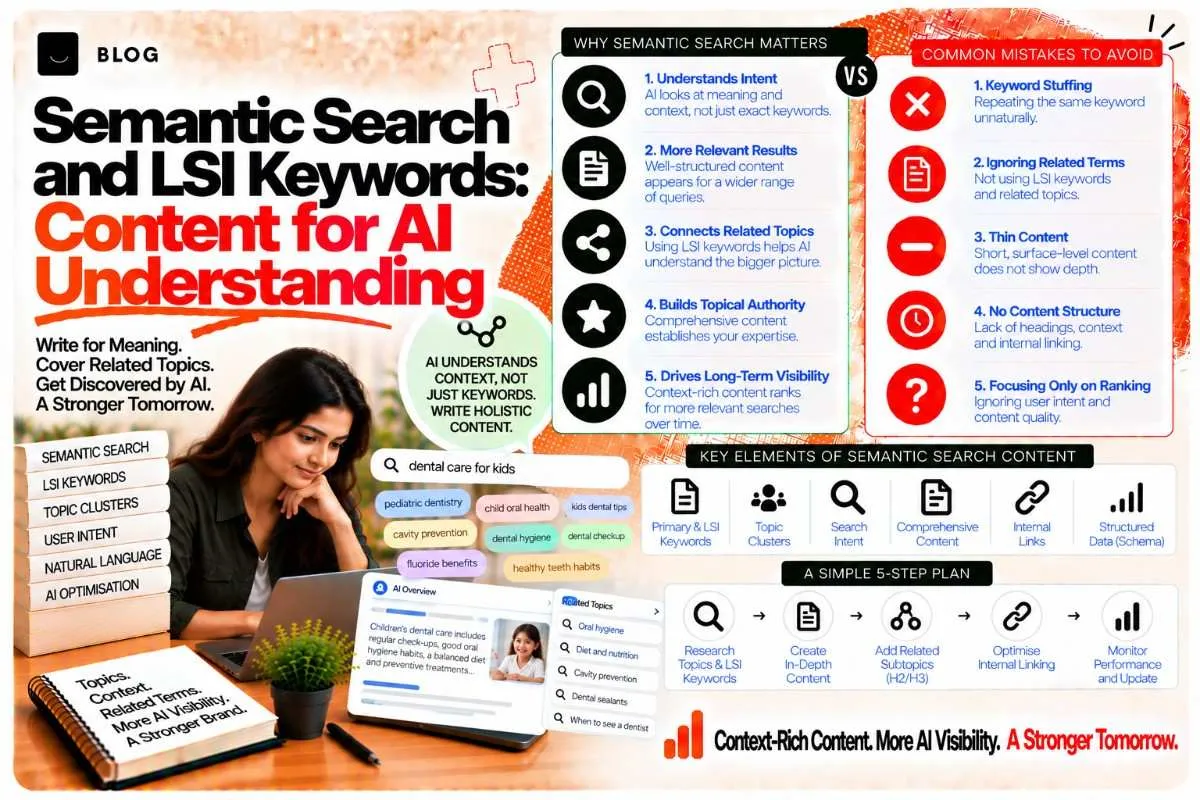
Semantic Search and LSI Keywords: Content for AI Understanding
Traditional SEO was about keywords: get the keyword in the title, use it 10–15 times in the body, and you rank.
Modern SEO — especially for AI systems — is about semantics: the relationships between concepts, the depth of your coverage, and whether you're addressing the topic comprehensively.
When you write about "SEO strategy," you're not just using that exact phrase. You're discussing keywords, content planning, technical optimization, link building, measurement. An AI system reading your content looks at all those related concepts and concludes: "This content covers SEO strategy comprehensively."
If you write about only keywords without mentioning measurement or reporting, an AI system concludes: "This covers a piece of SEO strategy, not the full picture."
This is semantic search, and it's critical for both Google ranking and AI citation.
What is semantic search and why it matters for AI
Semantic search means understanding the meaning and relationships between words, rather than just matching keywords.
Traditional keyword matching:
- User searches "SEO strategy"
- Google finds pages with the exact phrase "SEO strategy"
- Ranks them by authority
Semantic search:
- User searches "SEO strategy"
- Google understands the concepts related to SEO strategy (keywords, content, technical, links, measurement)
- Ranks pages that comprehensively cover these related concepts
- Considers whether the page addresses the full topic or just a part of it
Why AI systems rely on semantics:
AI systems don't think in keywords. They think in concepts and relationships. When ChatGPT reads your content, it's mapping:
- What is this content about? (Main topic)
- What related concepts does it cover? (Subtopics)
- How comprehensive is the coverage? (Depth)
- How does this relate to other content on the topic? (Context)
Content that covers a topic semantically — touching all related concepts — is understood as authoritative. Content that covers only one aspect is understood as partial.
LSI keywords: what they are and how they work
LSI stands for Latent Semantic Indexing. It's a method for identifying the semantic relationships between words and concepts.
LSI keywords are simply words and phrases semantically related to your main keyword.
Example: Main keyword "content marketing strategy"
LSI keywords might include:
- "content planning"
- "content calendar"
- "audience targeting"
- "distribution strategy"
- "engagement metrics"
- "content ROI"
- "brand storytelling"
These aren't keyword variations; they're semantic companions. They belong in content about content marketing strategy because they're part of the topic.
Why LSI keywords matter:
When you naturally include LSI keywords, you're signaling to Google and AI systems: "This content covers the full topic, not just one angle."
How to identify and use LSI keywords
Method 1: Google's search suggestions and People Also Ask
Step 1: Search your main keyword
Step 2: Look at Google's suggestions (type your keyword and scroll through suggestions)
Step 3: Look at the "People Also Ask" section
Step 4: These are all LSI keywords — questions and phrases semantically related to your main keyword
Example: Search "SEO strategy"
- Google suggests: "SEO strategy for small business," "SEO strategy 2026," "SEO strategy for beginners"
- People also ask: "What does an SEO strategy include?", "How do I create an SEO strategy?", "What are the main components of SEO?"
These are your LSI keywords.
Method 2: Analyzing competitor content
Look at the top-ranking pages for your keyword. What words and phrases appear frequently in their content?
Tools like SEMrush, Ahrefs, and Moz show "related keywords" — these are LSI keywords competitor content targets.
Method 3: Semantic keyword research tools
- Google Keyword Planner — shows related keywords
- SEMrush — "Keyword Magic Tool" shows related keywords and their relationships
- Ahrefs Keywords Explorer — shows keyword variations and related keywords
- LSI Graph — dedicated LSI keyword generator
Step 4: Naturally incorporate LSI keywords into your content
Don't force them. LSI keywords should appear naturally because they're part of the topic.
Good approach:
"An effective SEO strategy includes keyword research, on-page optimization, technical SEO, link building, and ongoing measurement. Your content strategy should align with your SEO goals..."
(Naturally includes LSI keywords: keyword research, on-page optimization, technical SEO, link building, measurement, content strategy, goals)
Bad approach:
"SEO strategy. Our SEO strategy includes SEO strategy components: keyword strategy, technical strategy, link strategy, measurement strategy."
(Forced repetition; sounds unnatural)
Concept clustering and topic depth for AI systems
Beyond individual LSI keywords, AI systems evaluate concept clustering: how well different ideas are organized and connected.
High-quality semantic content shows:
- Central concept — clearly identifies the main topic
- Subtopic organization — groups related concepts into sections
- Concept relationships — shows how subtopics relate to each other
- Depth — explores each subtopic thoroughly
- Integration — ties everything back to the central concept
Example structure for "Entity SEO Playbook":
Central concept: Entity SEO Subtopic 1: What is Entity SEO? - Entity definition - Entity signals - Why entities matter for AI Subtopic 2: Building your entity - Name consistency - Address consistency - Phone number consistency - Logo and visual identity Subtopic 3: Entity schema and markup - Author schema - Organization schema - Local business schema Subtopic 4: Entity authority signals - Wikipedia mentions - News coverage - Backlinks to entity Integration: How these subtopics create entity authority
Each subtopic is semantically related to the central concept (Entity SEO). The organization shows that you understand how these concepts connect.
AI systems reading this structure conclude: "This content systematically covers Entity SEO from multiple angles."
Common semantic optimization mistakes to avoid
Don't stuff keywords without semantic meaning.
Adding "SEO strategy," "keyword strategy," "content strategy," "link strategy" without explaining what they mean is keyword stuffing, not semantic depth.
Don't cover unrelated topics in one post.
Semantic depth is about covering your main topic thoroughly, not covering multiple unrelated topics. A post on "SEO Strategy and Paid Advertising" isn't semantically deep; it's unfocused.
Don't ignore subtopics and related concepts.
If your main keyword is "social media strategy" but you never mention "content creation," "audience engagement," or "analytics," your coverage is shallow.
Don't assume exact keyword match is required.
Use variations, synonyms, and related concepts. "SEO strategy," "SEO plan," "search optimization approach" all convey the same meaning. Variety is good.
Don't neglect the relationships between concepts.
Simply listing LSI keywords doesn't create semantic depth. Show how they connect. "Content strategy drives keyword opportunities, which then inform your technical optimization."
Measuring semantic depth
How do you know if your content has sufficient semantic depth for AI systems?
Checklist:
- ✓ Does your content have a clear central topic (H1)?
- ✓ Does it address 5+ major subtopics (H2s)?
- ✓ Does each subtopic explore a related concept (not just restate the main topic)?
- ✓ Does your content mention 15+ LSI keywords naturally (not forced)?
- ✓ Does your content explain relationships between concepts?
- ✓ Would a reader understand the full topic after reading this post?
If you answer yes to all six, your content has good semantic depth.
Frequently asked questions
Not directly as a ranking factor, but indirectly: using LSI keywords naturally signals comprehensive topic coverage, which does affect ranking. Google prioritizes content that comprehensively covers a topic.
There's no magic number. Use them naturally. If your content is 2,000 words on "SEO strategy," you might naturally include 20–30 LSI keywords. The goal is natural coverage, not a target count.
Related but different. Semantic search is about relationships between concepts. Entity-based search is about understanding things (people, places, organizations). Both matter for AI systems.
The core logic is similar across AI systems: they evaluate how comprehensively content covers a topic. But weighting might differ. One AI might value depth more; another might value clarity more.
Yes, if it's a key page. If an old post covers only one aspect of a topic, expanding it to cover related subtopics improves ranking and AI citation.
Traditional SEO: target specific keywords, optimize for keyword density, build links. Semantic SEO: target topics, cover comprehensively, build topical authority through related content.
Ready to build what's next?
Tell us where you're headed. We'll come back with a plan to get there.
Book an intro call