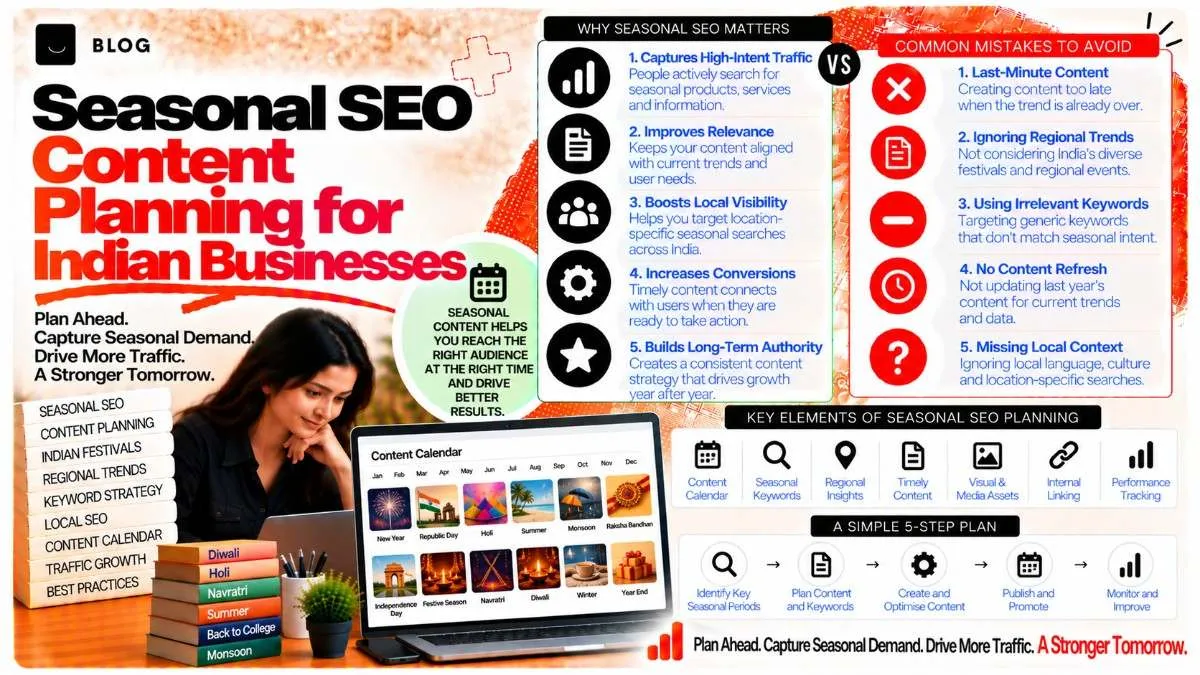
Seasonal SEO Content Planning for Indian Businesses
Demand for most services does not stay flat through the year. A tuition centre sees searches surge before board exams. A furniture retailer sees interest rise before Diwali. A roofing contractor in a monsoon-heavy city sees a spike in leak-repair queries when the rains begin. Businesses that publish their content in the same month that demand peaks often arrive too late, because the pages need time to be crawled, indexed and trusted before they can rank.
Seasonal planning is the discipline of working out when demand rises, when content needs to be live, and which pages should carry the seasonal traffic. It turns a reactive calendar into a schedule built on evidence rather than guesswork.
This guide covers how to map demand across the year, how to time publishing, and how to decide which seasonal content should be kept permanently and which should be retired.
What seasonal planning can and cannot do
Seasonal planning helps you publish at the right time and choose the right topics. It can reduce the gap between when demand arrives and when your content is ready. It cannot create demand that does not exist, and it cannot replace the quality and authority a page needs to rank. A late, thin article about a festival will not outrank a well-established guide, however well it is timed.
It also works best for businesses whose demand genuinely varies. A service with steady year-round demand gains less from a seasonal calendar than one with clear peaks.
Step 1: Map demand with your own data first
Start with what you already know. Your own history is more reliable than general advice about festivals.
In Search Console, export at least 16 months of query data for your core services, grouped by month. Look for:
- Queries that rise and fall in a predictable pattern each year
- Pages that gain clicks in particular months
- Impressions that rise before clicks, which often signals growing interest ahead of a peak
In GA4, check when enquiries and conversions rise for the same services. Demand that produces sales matters more than demand that produces visits.
If you have less than a year of data, note that the calendar is provisional, and review it after the first full cycle.
Step 2: Validate the pattern with Google Trends
Google Trends shows relative search interest over time for a term, by country or region. It is useful for testing whether a seasonal pattern is real and for comparing terms.
Use it to:
- Compare the timing of related terms, such as "board exam results" and "exam preparation tips", to see which leads
- Check regional differences, since monsoon-related demand peaks in different months across India
- Confirm the pattern across several years, rather than relying on a single unusual season
Trends gives relative figures, not absolute search volumes. Use it to judge timing and direction, not to set exact targets.
Step 3: Build a demand calendar
Turn the findings into a calendar with one row per month and a clear set of columns: the season or event, the services it affects, the target queries, the content needed, the publish date, and the review date.
For a typical Indian service business, the calendar might include:
- Festival periods, such as Diwali, Eid, Onam, Pongal, Durga Puja and Christmas, where gifting, decor, travel, finance or home services can spike
- Academic and exam cycles, including board results, entrance exam registration windows and admission periods
- Monsoon and summer, which affect roofing, pest control, cooling, water, transport and health services
- Financial year and tax deadlines, relevant to accounting, tax and investment services
- Industry events, such as trade fairs, product launches and sector-specific deadlines
Mark each event as fixed or moving. Festival dates change each year according to the calendar used, so check the date every year rather than copying last year's plan.
Step 4: Time the publishing, not just the topic
The most common mistake in seasonal content is publishing on the peak day. Pages need time to be crawled, indexed and seen as relevant. For most seasonal topics, plan to publish several weeks before demand rises, and update the page as the season approaches.
A working rule:
- Publish four to eight weeks ahead for steady seasonal demand that builds gradually
- Publish two to four weeks ahead for shorter peaks where the pattern is well established
- Update, rather than replace, the page in the following year, so its history and links carry forward
Adjust these windows using your own data. If a page's impressions begin rising five weeks before a peak, that is your evidence for the lead time.
Step 5: Decide what stays evergreen
Not every seasonal page should be deleted after its peak. Many can become evergreen with the right structure.
Keep a seasonal page permanently when:
- The underlying need recurs every year, such as exam preparation or monsoon waterproofing
- The page has earned links or traffic in previous seasons
- The core content can be updated each year without rewriting it
Retire or consolidate a page when:
- The event is one-off, with no recurring demand
- It duplicates another page covering the same need
- It has no traffic or links after two cycles
The content pruning post covers how to decide which pages to keep, merge or remove. The same logic applies here, applied to seasonal content.
Step 6: Structure seasonal pages to be reused
A seasonal page that is rebuilt each year loses its history. Build the page so that the annual update is a series of small changes.
- Use a stable URL that does not include the year, where possible, such as /diwali-home-cleaning-services/ rather than a dated address
- Put the year and dates in a clearly marked section that can be updated annually
- Keep the core guide on the topic intact, so it remains useful outside the peak
- Link the page from the main category or service page, so it keeps internal support
Where a dated URL is necessary, such as a specific exam notification, decide early how that page will be redirected or retired once the event has passed.
Step 7: Match the format to the query
Seasonal searches often ask different questions at different stages. Someone searching for exam dates needs a schedule. Someone searching for festival gift ideas needs a list. Someone searching for monsoon leak repair needs a process and a contact route.
Match the page's structure to the intent, which the search intent mapping post covers in detail. For queries that ask a direct question, such as "when is the exam registration deadline", a short, clearly marked answer near the top of the page can also support featured snippets, covered in the featured snippets post.
Step 8: Review the calendar after each cycle
A seasonal calendar is a hypothesis until it has been tested. After each peak, review:
- Did the content go live in time? Check the first impressions against the publishing date.
- Did impressions rise before the peak? This tells you whether the lead time was right.
- Which pages earned clicks and conversions? Use these to decide what to expand next year.
- What did competitors publish? Note which topics they covered and when.
Adjust the calendar each year. Keep a log of what was published, when, and what happened, so the next plan starts from evidence.
What seasonal planning cannot do
It cannot guarantee that a seasonal peak will produce traffic. A market can shift, competition can rise, or an event can be cancelled or rescheduled. It also cannot replace a strong year-round foundation. Businesses that depend entirely on a few peak weeks are exposed when those weeks are weaker than expected.
Seasonal planning works best alongside a steady base of evergreen content that earns traffic in every month.
Common seasonal planning mistakes to avoid
Publishing on the peak day. Pages need time to be crawled and trusted.
Copying last year's dates without checking. Moving festival and exam dates change each year.
Creating a new URL every year. This loses the history and links the page had built.
Covering every event. Focus on the seasons that genuinely drive your business.
Ignoring the review step. Without a review, the calendar never improves.
Building the whole plan around one peak. A steady base matters more than a single spike.
Frequently asked questions
It depends on how quickly the demand builds. Four to eight weeks is a common starting point for gradual peaks, and two to four weeks for shorter ones. Use your own impression data to refine the window.
Not usually. Where the need recurs, update a stable page with the year's details. Create a new page only where the event or the search intent is genuinely different.
Start with Search Console history and GA4 conversion data for your own services. Google Trends helps validate the pattern and compare timing across terms.
Yes. Services such as accounting, roofing, education, healthcare, travel and home maintenance often have clear seasonal demand. The principles are the same, even when the events differ.
Then a seasonal calendar adds less value. Focus on evergreen content and occasional campaigns tied to genuine events.
Check the dates annually, and build the publishing schedule from the confirmed dates rather than last year's calendar. Mark each event as fixed or moving in the planning sheet.
Ready to build what's next?
Tell us where you're headed. We'll come back with a plan to get there.
Book an intro call