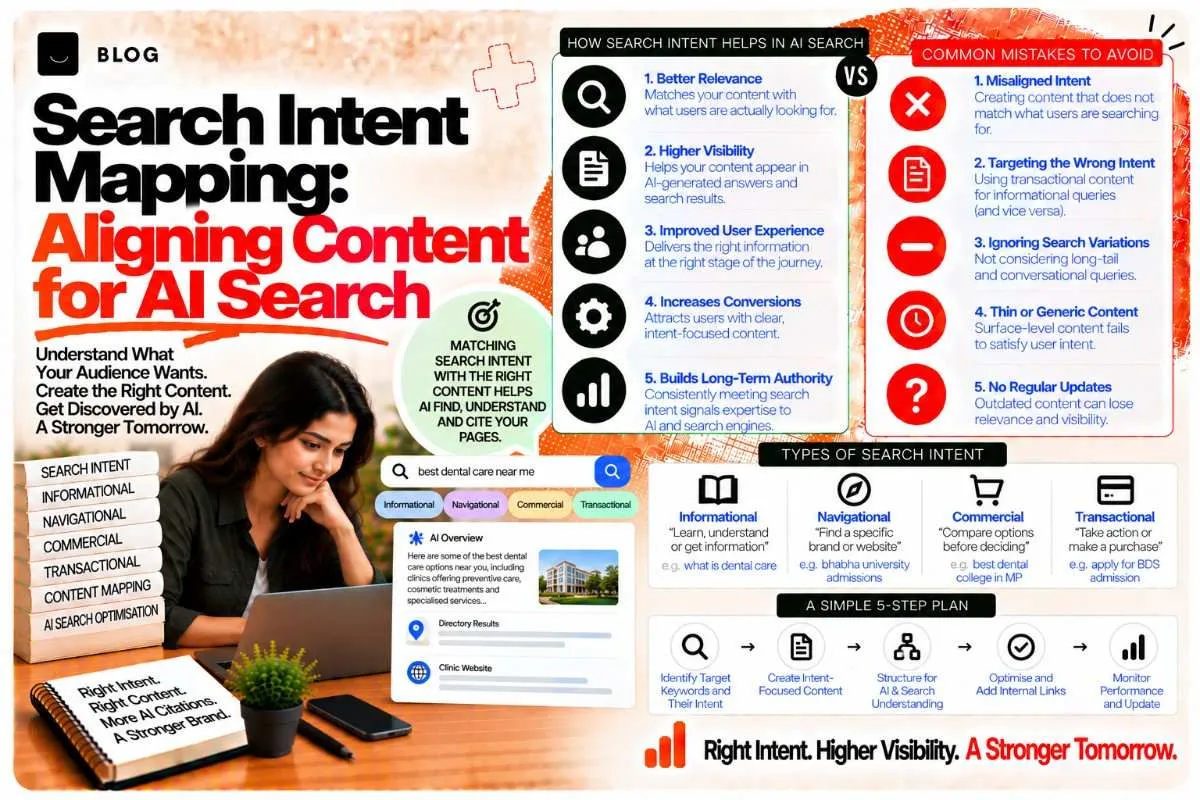
Search Intent Mapping: Aligning Content for AI Search
You have the perfect keyword. It gets 5,000 searches a month. You publish a comprehensive 3,000-word guide optimized for that keyword.
But your content doesn't rank. Or it ranks, but doesn't convert.
The problem: you optimized for the keyword, but not for the intent behind it.
Search intent is what the user actually wants when they search. A keyword can have multiple intents, and if your content doesn't match the user's intent, neither Google nor AI systems will recommend it.
For AI systems, intent alignment is even more critical. When ChatGPT, Perplexity, or Google's AI is deciding which content to cite, it's asking: "Does this content actually answer what the user is looking for?" Content that matches intent gets cited; content that misses intent gets skipped.
This guide covers how to map search intent, align your content to it, and ensure both Google and AI systems see your content as a relevant answer.
The four types of search intent
Not all searches are the same. Google and AI systems categorize search intent into four main types:
1. Informational intent
What: The user wants information or an answer to a question.
Examples: "How much does SEO cost?", "What is E-E-A-T?", "Why do backlinks matter?"
Content type: Guides, explainers, how-tos, definitions
Length: 1,500–3,000 words (comprehensive but focused)
Format: Blog posts, articles, guides
Why it matters for AI: AI systems cite informational content heavily. A user asking "How does voice search work?" will see AI-cited informational blog posts.
2. Navigational intent
What: The user wants to go to a specific website or page.
Examples: "Google Search Console", "Digital4Local website", "Amazon prime video"
Content type: Brand pages, official resources
Length: Variable (optimized for brand clarity)
Format: Official company pages, branded content
Why it matters for AI: AI systems recognize navigational intent and prioritize official sources. If someone searches "ChatGPT login," they get the official ChatGPT page, not a blog post about ChatGPT.
3. Commercial intent
What: The user is researching products/services before buying.
Examples: "Best SEO tools", "SEO services near me", "cheapest web hosting", "SEO pricing comparison"
Content type: Comparisons, reviews, buying guides
Length: 2,000–4,000 words (detailed evaluation)
Format: Comparison guides, product reviews, roundup posts
Why it matters for AI: AI systems recognize commercial intent and prioritize pages that help with purchasing decisions. High-quality comparisons and reviews get cited.
4. Transactional intent
What: The user is ready to buy or take action.
Examples: "Buy SEO tools online", "Hire an SEO agency", "Sign up for SEO course"
Content type: Product pages, service pages, CTAs
Length: Variable (focused on action)
Format: Product/service pages, sales pages, checkout flows
Why it matters for AI: AI systems recognize transactional intent and prioritize pages that facilitate action. A user searching "buy SEO tools" needs product pages, not blog posts.
How to map search intent for your target keywords
Mapping search intent means understanding what users actually want when they search your target keywords.
Step 1: Search your target keyword
Go to Google and search your target keyword. Look at:
- The SERP layout — what types of results rank?
- The top 5 results — what format are they? (blog posts, product pages, comparisons, etc.)
- The People Also Ask section — what related questions are people asking?
- The answer boxes (featured snippets) — what format does Google extract?
Example: "How much does SEO cost?"
- SERP layout: Mix of blog posts and agency pages
- Top results: Agency service pages, blog guides, pricing breakdown posts
- Intent: Informational (user wants to understand pricing) + Commercial (user considering hiring)
- Content needed: Pricing guide that explains costs and includes agency services
Step 2: Categorize the intent
Assign one primary intent (Informational, Navigational, Commercial, Transactional) and note any secondary intents.
Example keywords and their intents:
- "How to implement Entity SEO" → Informational (primary) + How-to
- "Best SEO tools for startups" → Commercial (primary) + Comparison
- "SEO services near me" → Commercial (primary) + Local + Transactional
- "Google Search Console" → Navigational (primary)
Step 3: Match your content format to the dominant intent
| Intent | Content Format | Word Count | Structure |
|---|---|---|---|
| Informational | Blog post, guide, explainer | 1,500–3,000 | Question-answer, step-by-step |
| Navigational | Official page, branded content | Variable | Direct to resource |
| Commercial | Comparison, review, roundup | 2,000–4,000 | Detailed evaluation with pros/cons |
| Transactional | Product/service page, sales page | 800–1,500 | Action-focused, clear CTA |
Step 4: Evaluate your current content against intent
If your content doesn't match the intent of the keyword you're targeting, update it.
Example mismatch:
- Keyword: "Best SEO tools for startups"
- Your current content: A blog post explaining what SEO tools are
- Problem: The keyword asks for a comparison; your content is informational
- Solution: Rewrite it as a comparison post with pros/cons for each tool
Intent alignment for AI citation
AI systems evaluate intent alignment at two levels:
Level 1: Does the content type match?
- Informational intent → AI cites blog posts, guides, explainers
- Commercial intent → AI cites comparisons, reviews, expert opinions
- Transactional intent → AI cites official product/service pages
Level 2: Does the content depth match?
- Simple questions ("What is SEO?") → AI cites concise definitions (200–300 words)
- Complex questions ("How should I structure my SEO strategy?") → AI cites comprehensive guides (2,000+ words)
- Comparative questions ("Should I hire an agency or do SEO myself?") → AI cites detailed comparisons with pros/cons
Content that matches both levels gets cited.
Common intent mapping mistakes to avoid
Don't target commercial keywords with only informational content.
If your keyword has commercial intent (e.g., "best SEO agencies"), your content should compare agencies, include pricing, and help with buying decisions. A blog post explaining "what an SEO agency is" won't rank or be cited.
Don't publish the wrong format for the intent.
Commercial intent needs comparisons, not how-tos. Informational intent needs explanations, not sales pitches.
Don't ignore secondary intent.
If a keyword has both informational and commercial intent, address both. "How much does SEO cost?" is informational (explain pricing) + commercial (mention your services).
Don't assume all high-volume keywords are right for you.
A keyword with 10,000 searches might have transactional intent (people looking to buy). If you sell SEO services, that's perfect. If you sell SEO courses, it's not aligned.
Don't neglect People Also Ask.
The questions in People Also Ask reveal secondary intents. If people searching "SEO cost" also ask "How long does SEO take?", address that too.
Building an intent-aligned content strategy
- List your target keywords — everything you want to rank for
- Map intent for each — categorize as Informational, Commercial, Transactional, or Navigational
- Identify content gaps — which intents are underserved in your content library?
- Create intent-matched content — publish new content that fills those gaps
- Audit existing content — does it match the intent of the keyword it targets?
- Update misaligned content — rewrite or consolidate to better match intent
Frequently asked questions
Yes, but be careful. A comparison post can serve both informational and commercial intent. But mixing transactional with informational (trying to sell in a how-to guide) confuses users and AI systems.
Ask: "If I search this keyword, would I find this content helpful?" If the answer is no, your content doesn't match intent.
Yes, potentially more. Google prioritizes content that matches user intent. Keyword density is less important than intent match.
Separate posts usually perform better. A comparison post (commercial intent) ranks differently than a how-to post (informational intent). Target one intent per post.
Different AI systems may weight intents differently, but the core logic is the same: match content format to user need. A user asking "best SEO tools" expects a comparison from ChatGPT, Perplexity, and Google's AI.
Ready to build what's next?
Tell us where you're headed. We'll come back with a plan to get there.
Book an intro call