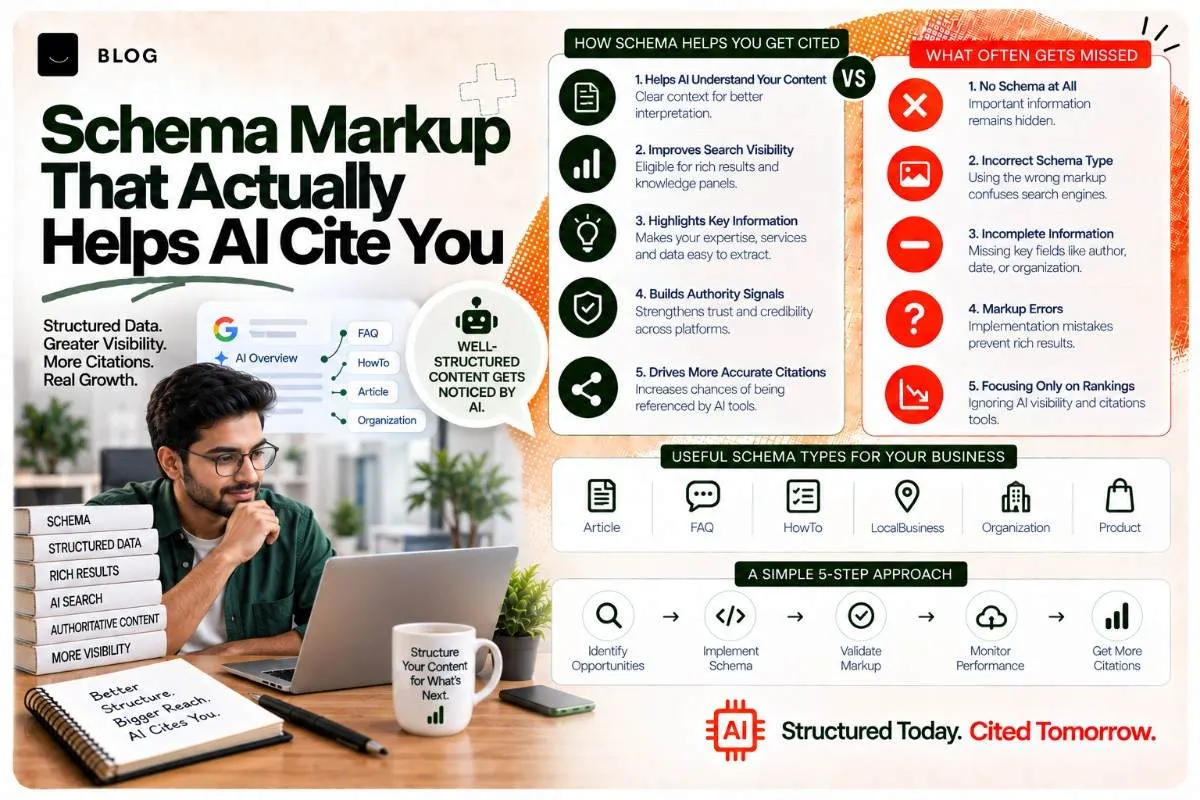
Schema Markup That Actually Helps AI Cite You
Schema markup does one specific job: it makes facts on a page explicit and machine-readable instead of leaving a system to infer them from prose. That makes a real, if modest, difference to whether an AI answer engine can extract and cite your content confidently — but schema is a supporting signal, not a ranking lever, and treating it as a magic switch overstates what it does. This is the priority order that matters, what each type actually accomplishes, and what to expect once it is implemented.
What schema actually does, and what it does not
Worth being precise before the list, because schema is one of the more overclaimed topics in AI search advice.
What it does: structured data states a fact in a standardised format a machine can parse directly, rather than requiring the machine to infer it from surrounding text. Your page might say "written by Dr. Priya Sharma, a dermatologist with 12 years of practice" in prose — a human reads that easily, and a language model can often infer it too, but inference is probabilistic. Schema states the same fact in a format with no ambiguity: this is the author, this is their credential, this is unambiguous.
What it does not do: guarantee inclusion in an AI answer, replace the need for genuinely good content, or act as a ranking factor in the way backlinks or content quality do. Complete, valid schema on a thin, generic page will not make that page authoritative. Schema amplifies what is already there; it does not create substance that is not.
The honest framing: schema reduces ambiguity for machines reading a page that already has real information on it. It is a multiplier on genuine content quality, not a substitute for it.
The schema types worth implementing, in priority order
Ten types, ordered by how much they typically matter for a business site aiming at both search and AI visibility.
1. Organization
The foundational entity signal — name, logo, URL, contact information, and sameAs links to verified social profiles. This is what helps a system resolve "this website" into a confident understanding of "this specific business," which everything else on the site then attaches to. If only one schema type gets implemented, this is the one.
2. Article
For blog posts and long-form content: headline, author (linked to Person schema), datePublished, dateModified, and a description. This is what supports credibility and freshness signals — both repeatedly shown throughout this library to matter for AI citation — in a machine-readable form rather than only as visible text.
3. FAQPage
Marks up genuine question-and-answer content so each question and its answer are explicit, individually addressable units rather than paragraphs a system has to parse out of running prose. This is one of the more directly useful types for AEO specifically, since it mirrors exactly how a snippet or an AI answer extracts a single question-answer pair.
4. Product
For ecommerce: name, brand, SKU, price, availability, and review data. Covered in detail elsewhere in this library as the foundation of AI shopping visibility — genuinely one of the highest-value schema types for any site selling physical products.
5. LocalBusiness
Name, address, phone, hours, and service area for any business with a physical location or defined service area. This is the structured counterpart to the same profile-completeness argument made throughout this library's local SEO content — schema states formally what a Google Business Profile states informally.
6. Person
Author bios, linked from Article schema — name, job title, credentials, and sameAs links to a professional profile. Repeatedly the single largest missing signal across the sites covered in this library. Implementing this properly, for real named people, does more for E-E-A-T than almost any other item on this list.
7. HowTo
For genuine step-by-step content — a process with a defined sequence and, ideally, time estimates per step. Useful specifically for procedural content; markup on content that is not actually procedural adds nothing and can look manipulative to a reviewing system.
8. Review and AggregateRating
Genuine customer review data, marked up accurately. This must reflect real reviews — fabricated or inflated review schema is both a platform violation and a straightforward trust problem once discovered.
9. BreadcrumbList
Site navigation structure, marked up explicitly. Lower individual impact than the items above, but nearly free to implement once a site has consistent navigation, and it clarifies site architecture for any crawling system.
10. VideoObject
For pages with embedded video: title, description, thumbnail, upload date, duration and, where available, a transcript reference. Covered in more depth elsewhere in this library — schema here supports discoverability of the video's existence; it does not substitute for the actual transcript text a system needs to cite the video's content.
The realistic expectation, stated plainly
No study exists demonstrating a precise, isolated effect of schema markup on AI citation rates, and any claim of one should be treated with suspicion. What can be said with more confidence: complete, accurate schema removes ambiguity that would otherwise require a system to infer facts probabilistically, and probabilistic inference is inherently less reliable than an explicit statement.
VERIFY: No specific percentage or citation-lift figure appears in this post for exactly this reason — none is reliably available. If a claimed statistic is added later, it must be sourced to a named primary study, not a vendor blog.
The practical framing: implement schema because it is correct, low-cost, and removes a class of uncertainty for any system reading the page — search engine or AI assistant. Do not implement it expecting a measurable before-and-after citation lift, because that lift, if it exists, cannot currently be isolated from everything else a good page is also doing.
How to implement this without breaking anything
- Validate every implementation with a structured data testing tool before considering it done. Malformed schema is common and worth roughly nothing.
- Match schema to visible content exactly. Schema stating a fact not visible on the page, or contradicting what is visible, is a trust problem for any system that checks.
- Do not mark up content that is not genuinely what the schema claims. FAQPage markup on content that is not actually question-and-answer formatted, or Review schema on fabricated reviews, both risk more than they gain.
- Prioritise by the list above, not by whatever a template happens to include by default. Organization and Person schema, done properly, outweigh a dozen minor types implemented carelessly.
- Re-validate after any site redesign or CMS migration. Schema is one of the most common casualties of a redesign, quietly broken and unnoticed for months.
A ten-minute audit of your own site
- Run your homepage and one blog post through a structured data testing tool. Note what is present, what is valid, and what is missing entirely.
- Check specifically for Person schema on any bylined content. This is the most commonly absent type across the sites covered throughout this library.
- Check that Organization schema includes sameAs links to verified, currently active social profiles — a stale link here is worse than none.
- If the site sells products, check Product schema completeness against the checklist covered in our dedicated guide on this.
- Check one FAQ page, if one exists, for FAQPage markup — this is frequently missing even when the visible content is well-structured.
Frequently asked questions
It helps in a specific, modest way — by stating facts explicitly rather than leaving a system to infer them from prose, which reduces ambiguity. It does not guarantee citation and is not a ranking factor on its own. Schema amplifies genuinely good content; it does not substitute for content that is thin or generic.
Organization schema is the foundational one — it establishes the entity a system is reading about, which everything else attaches to. Person schema for named authors and LocalBusiness schema for physical or service-area businesses are close behind, since both are commonly missing and directly support the credibility signals that matter for AI citation.
No reliable, isolated study demonstrates a specific effect, and any claimed percentage should be treated with scepticism unless sourced to a named primary study. What can be said with confidence is that explicit, structured facts remove a class of inference-based uncertainty that unstructured prose leaves to the reading system.
Yes, if it is invalid, inconsistent with visible content, or applied to content that does not genuinely match what the schema claims — fabricated review data or FAQPage markup on non-question content, for example. Malformed or misleading schema is a trust problem, not a neutral non-event.
After any site redesign or CMS migration, since schema is commonly broken silently during those changes and goes unnoticed for months. Otherwise, whenever the underlying content changes materially — a new author, updated pricing, a changed address — the corresponding schema should be updated at the same time.
Schema markup is one tool that supports Answer Engine Optimization, not the whole of it. AEO more broadly covers question-phrased headings, direct-answer paragraphs, and content structure generally; schema is the machine-readable layer that formalises facts a well-structured page already states in visible text.
Not necessarily all at once, and not types that do not genuinely apply — HowTo schema on content that is not actually procedural, for example, adds nothing. Prioritise by the order in this post: Organization and Person first, since those are most commonly missing and most directly support credibility, then the types relevant to the specific site's content.
Ready to build what's next?
Tell us where you're headed. We'll come back with a plan to get there.
Book an intro call