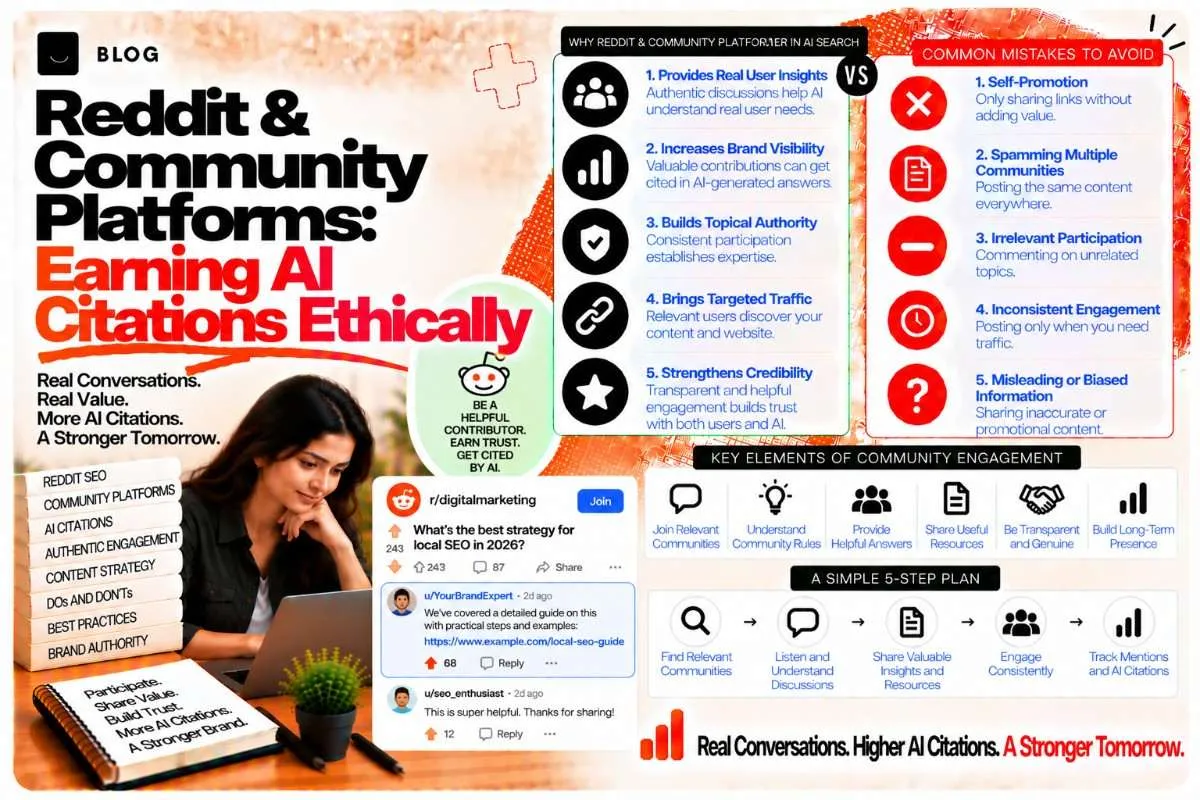
Reddit & Community Platforms: Earning AI Citations Ethically
When someone asks an AI system which tool, service, or approach to choose, the answer often draws on what real people wrote in forum threads. Reddit, Quora, and niche community boards contain exactly the kind of first-hand discussion AI systems look for: specific questions, honest comparisons, and people describing what actually happened.
That creates an opportunity, and a trap. The opportunity is real third-party context about your brand, and genuinely helpful answers that position your expertise where people are already asking. The trap is that brands which post promotional content, create sock-puppet accounts, or ask customers to upvote themselves get removed, banned, and remembered badly. Some of that damage is visible to AI systems too, because the discussions that remain are the ones they cite.
This guide covers how to participate in community platforms in a way that earns citations without breaking the rules that make those platforms useful.
Why community discussions matter to AI systems
AI systems answer questions by synthesising sources. When a question is subjective or experience-based ("is this agency worth it for a small clinic?"), forum threads are often among the most relevant material available, because they contain the kind of direct experience that official pages cannot provide.
Three characteristics make community content valuable as a source:
- Specificity. A thread usually names the tool, the price, the problem, and the outcome.
- Disagreement. Multiple people with different experiences give a range of views rather than one polished position.
- Recency. Active threads keep accumulating new answers, which signals that a topic is current.
The same features make community content hard to manufacture. A brand cannot create a convincing discussion about itself without the discussion looking staged, and staged discussions tend to be detected and removed.
What this approach is not
It helps to be precise about the strategy, because the line between useful participation and spam is where most brands fail.
This is not:
- Posting your own content into threads as if it were an answer. Links to your blog in every reply are promotion, not participation.
- Creating accounts that pretend to be customers or independent experts. Undisclosed affiliation is deception, and platforms ban it.
- Asking customers to upvote or defend you in threads. Coordinated voting is manipulation.
- Buying community engagement from services that deliver upvotes or comments.
What it is: a long-term practice of answering real questions honestly, under your real identity, in communities where your expertise is relevant, and disclosing your connection when it matters.
Step 1: Choose the communities that match your expertise
Not every community is worth joining. Pick two to four where people already ask questions in your field.
Good signals that a community is worth participating in:
- Members ask specific questions about tools, services, or problems you solve.
- Threads get replies from experienced members, not only from people asking for help.
- The community has active moderation and clear rules about self-promotion.
- The subject matter overlaps with the questions your customers ask.
For a local service business, that may be a city subreddit and a niche industry forum. For a software company, it may be a product-specific subreddit and a Q&A site. For an SEO agency, it may be a marketing subreddit, a Q&A site, and a professional community.
Avoid communities that are primarily for complaints, or where your category is generally disliked. Participation in those rarely helps, and the risk of being treated as a salesperson is high.
Step 2: Read the rules before you post
Every community sets its own rules, and most are strict about self-promotion. Read the rulebook, the pinned posts, and the moderator guidance before you write anything.
Common rules to check:
- Self-promotion limits. Some communities allow a fixed share of promotional posts, or require a minimum history before any promotion.
- Affiliation disclosure. Many require you to state that you work for a company when you discuss it.
- Link policies. Some restrict or remove links to commercial sites entirely.
- Account requirements. Minimum account age or karma may be required to post in certain sections.
Breaking these rules gets content removed and accounts restricted. It also trains moderators and members to view your name with suspicion, which is harder to undo than a removed comment.
Step 3: Answer first, then disclose
The pattern that works is simple. Find a question where your experience genuinely helps, answer it fully and honestly, and mention your connection only when it is relevant to the answer.
A weak reply:
"You should check out [brand]. We offer great services for this. Visit our website for more."
A stronger reply:
"Assuming you're trying to fix the slow load on mobile, the first thing I'd check is the largest image above the fold, then whether a third-party script is blocking render. Disclosure: I work at an SEO agency, so I see this problem a lot, but these two checks are free and worth doing before you hire anyone."
The second reply answers the question completely, does not require the reader to click anywhere, and discloses the connection honestly. That is the kind of reply that gets upvoted and, over time, quoted.
Step 4: Link sparingly, and only when it adds value
Most community platforms add the attribute rel="nofollow" to user-posted links, which means those links do not pass ranking signals in the way a normal editorial link does. Reddit applies this to external links in posts and comments. So the direct SEO value of a community link is limited.
The value is elsewhere. A thread that quotes a specific claim from your research, cited by name, can be found by AI systems and by people. Linking to a detailed resource is reasonable when the answer genuinely needs it and the rules allow it. Linking to the same page in every thread is not.
Check current platform documentation on link attributes before assuming any specific treatment, since policies change.
Step 5: Build a track record over months, not weeks
Community credibility is built slowly. A new account that answers one question and then promotes its own website looks like spam. An account with a year of helpful answers across several threads, most of them with no link at all, looks like an expert.
A realistic cadence for a brand or a team member:
- Weeks 1–4: Read the community, learn its norms, and make a handful of helpful replies with no links.
- Months 2–3: Answer several questions per week where you have direct experience. Begin to disclose affiliation when relevant.
- Months 4–6: Start a small number of original posts that share data, a checklist, or a case study, with clear disclosure and in line with the rules.
- Ongoing: Keep answering. The effect compounds as your replies become part of the searchable record.
Assign the activity to specific people who understand the subject. Rotating junior staff through the accounts, or outsourcing replies, usually produces the generic answers that moderators remove.
Step 6: Monitor what is said about you
Community discussions will mention your brand whether or not you take part. Set up monitoring so you know when a thread concerns you.
Practical options:
- Search the platform directly for your brand name, your product names, and common misspellings, weekly.
- Set alerts using a monitoring tool or a saved search, where the platform allows it.
- Track sentiment in threads that mention you, and note recurring complaints.
When a thread contains a factual error about your business, reply once, politely, with the correction and a source, under your real account and with disclosure. Do not argue, do not ask others to downvote the original poster, and do not attempt to remove legitimate criticism through reporting unless it breaks the rules.
For genuine problems, such as a customer who had a bad experience, a public reply that acknowledges the issue and offers a direct route to resolve it is more effective than silence. It also shows other readers how you handle problems, which is part of the trust signal AI systems weigh.
Step 7: Measure results honestly
Community work is hard to attribute. Track what you can, and be cautious about claims that cannot be checked.
Useful measures:
- Referral traffic from community platforms in GA4, to pages that were linked and disclosed.
- Mentions and sentiment over time, from your monitoring.
- AI citation checks, asking AI systems the questions your community answers and noting whether community discussions appear among their sources.
- Branded search in Search Console, which can rise when community discussion builds awareness.
Expect slow, indirect results. The return is usually a combination of brand awareness, better answers to customer questions, and occasional citations, rather than a direct spike in rankings.
Common community SEO mistakes to avoid
Undisclosed affiliation. Posting about your own company without saying so is deceptive, and most communities treat it as a ban offence.
Sock puppets and vote rings. Using extra accounts to upvote yourself or reply to your own posts is manipulation. Platforms detect it, and the damage to your reputation outlasts any short-term gain.
Copying the same reply everywhere. Templated answers look automated and are removed quickly.
Linking to your blog in every thread. This reads as promotion. Answer the question and link only when the link genuinely serves the reader.
Ignoring negative threads. Silence about a real complaint lets the complaint define your reputation.
Hiring a service to do it. Outsourced community work tends to be generic and easy to detect. If you do outsource, the people writing the replies still need subject knowledge and a clear set of rules.
Frequently asked questions
Reddit links are generally nofollow, so they do not pass ranking signals in the way editorial links do. The value is indirect: visibility in discussions that search engines and AI systems read, and the referral traffic and awareness that can follow.
If you participate, use a real account tied to a real person in your company, and disclose your affiliation where relevant. Do not create accounts that hide who you work for.
Asking customers to share their honest experience is different from asking them to post praise. Do not script recommendations or ask people to upvote. Customers who choose to discuss you on their own are the kind of discussion AI systems find credible.
There is no fixed timeline. Expect months rather than weeks, and do not treat any single thread as a guaranteed citation source.
Read the moderator's reason, correct the issue, and do not repost the same content. If the rule is unclear, message the moderators and ask before posting again.
No. Reviews are structured ratings on platforms you do not control in the same way. Community discussion is open-ended conversation. The local review strategy post covers the review side; this post covers conversation.
Ready to build what's next?
Tell us where you're headed. We'll come back with a plan to get there.
Book an intro call