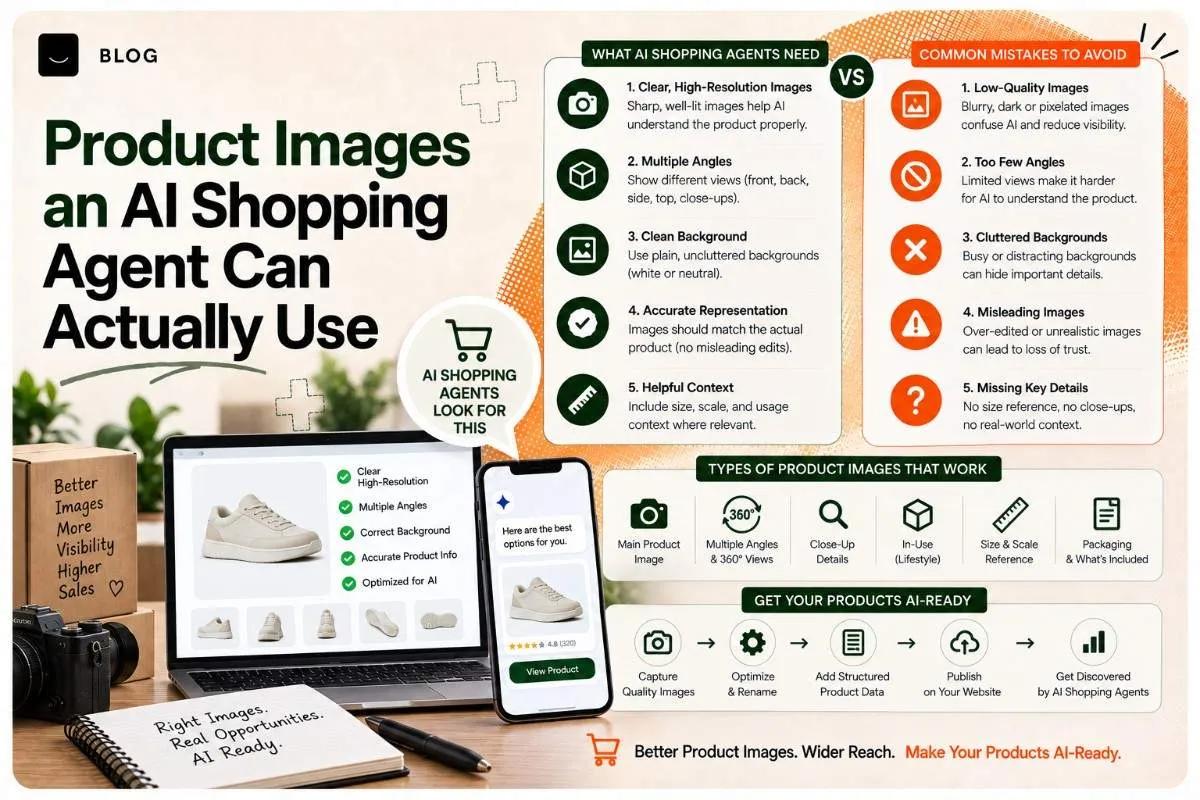
Product Images an AI Shopping Agent Can Actually Use
An AI shopping agent evaluating your product against a customer's requirements reads text, structured data and review content. It does not reliably read the text inside your images. If your size chart, ingredient list or specification table exists only as a JPEG, that information is invisible at exactly the moment a buyer's agent is deciding whether to shortlist you. This is a photography and editing problem as much as a content one, and most Indian D2C catalogues have it.
The problem in one sentence
Your best-designed asset may be your least readable one.
D2C brands invest heavily in product imagery — and correctly, because a human buyer decides largely on how a product looks. But a growing share of purchase research now runs through an assistant that compares products against stated requirements. That system reads your page differently from a person, and the beautifully-set-out spec graphic your designer produced is, to it, a blank rectangle.
What actually happens when an agent reads your product page
Worth being concrete, because "AI can't read images" is both slightly wrong and practically true.
Modern models can process images. Some systems will describe a photograph reasonably well. But in the retrieval pipeline that assembles a shopping answer — where speed, cost and scale all matter — what gets extracted is overwhelmingly text and structured data. Your product title, description, attribute list, Product schema, price, availability, policies and reviews.
So the practical rule is not "images are invisible." It is: do not let an image be the only place a fact exists. Anything a buyer needs in order to choose must also exist as text on the page.
The test is simple. If you disabled every image on your product page, would a stranger still know the size range, the material, the ingredients, the compatibility, and what is in the box? If not, that is precisely what an agent is missing.
The five image mistakes that cost D2C brands recommendations
1. The size chart that is a JPEG
The single most common and most costly one on Indian D2C sites. A customer asks an assistant for a shirt in a specific chest measurement, or shoes in a particular size, and your page carries the answer — inside a graphic. The agent has nothing to match against, and you do not appear in the comparison.
Fix: publish the size chart as a real HTML table. Keep the designed graphic if you like it; both can coexist. Only one of them is readable.
2. The ingredient or spec list baked into a graphic
Same failure, different category. Skincare ingredient lists, supplement panels, electronics specifications, fabric composition — all frequently rendered as designed images because they look tidier that way.
Fix: full list as text. If it is long, put it in a collapsible section that still renders in the HTML rather than loading on click.
3. Alt text written for compliance, not for meaning
Most D2C alt text is either missing, or the filename, or the product name repeated across eleven images. Alt text is one of the few genuinely machine-read pieces of image metadata, and it is being wasted at scale.
Fix: describe what the image shows, specifically and differently for each one. "Navy blue cotton kurta, front view, showing mandarin collar and wooden button placket" rather than "kurta image 3". This also serves visually impaired customers, which is reason enough on its own.
4. Lifestyle images doing the work of product images
A model wearing the garment on a beach communicates mood beautifully and product detail poorly. A page that is entirely lifestyle imagery leaves both a careful human buyer and an agent short of the information needed to decide.
Fix: a clear structure per product — plain-background product shots, detail crops of the things buyers care about, a scale reference, and lifestyle images as context rather than as the whole set.
5. Inconsistent editing across a catalogue
Different backgrounds, colour temperatures and crops across a catalogue make products hard to compare visually. This is a straightforward conversion problem for human buyers, and it is worth naming even though agents are indifferent to it.
Fix: one editing specification applied to the whole catalogue — background, crop ratio, shadow treatment, colour handling. This is unglamorous, repetitive work and it is exactly the kind that benefits from being done consistently by one team.
What images are still genuinely for
It would be a mistake to read the above as "images matter less now." They do not.
- Humans still decide. An agent narrows a shortlist; a person usually makes the final call, and they make it looking at your photographs.
- Accurate imagery reduces returns. A colour that does not match reality is a return, a refund and a negative review — and that review text then becomes source material describing your product.
- Photography carries brand where text cannot. The agentic commerce shift arguably makes visual brand more important at the decision moment, because so much of the comparison stage has been abstracted away into text.
- Marketplaces have their own image requirements. Meeting them properly affects placement independently of anything discussed here.
The argument is not to spend less on imagery. It is to stop asking imagery to carry facts it cannot deliver.
The image brief for a D2C catalogue
A practical specification worth agreeing once and applying everywhere:
Per product, minimum set:
- Primary product shot, plain background, consistent crop
- Two to four detail crops of the features buyers actually ask about
- One scale or fit reference
- One or two lifestyle or in-use images
- Any packaging or in-the-box shot where relevant
Editing specification:
- One background treatment across the catalogue
- Consistent colour handling, checked against the physical product — accuracy beats flattery
- Consistent shadow and crop ratio
- Export at a resolution that supports zoom without wrecking page speed
- Modern formats (WebP or AVIF) with sensible fallbacks
Metadata specification:
- Descriptive, unique alt text per image
- Descriptive filenames rather than IMG_4471.jpg
- Images referenced in Product schema
The text rule, applied without exception:
- Every fact that appears in an image also appears as text on the page
Where editing quality actually matters commercially
Three places, in order of how directly they affect revenue:
Colour accuracy. The highest-return editing decision in D2C, and the one most often sacrificed for a punchier image. Inaccurate colour drives returns, and returns are more expensive than any photography line item.
Consistency across the catalogue. A category page where every product sits on a different background looks like a marketplace of unrelated sellers rather than one brand. This affects trust at the exact moment a buyer is comparing.
Detail legibility. If a texture, finish, stitch or fitting is what a buyer is deciding on, the crop and the retouching determine whether they can see it. Over-smoothing a fabric texture removes the information the buyer came for.
None of this is about making products look better than they are. Over-retouched imagery increases returns and generates the negative review text that later describes you in an AI answer. Accuracy is the commercial position, not just the honest one.
A workable audit of your own catalogue
Thirty minutes, no tools required.
- Pick your five best-selling products.
- Open each page and disable images (any browser's reader mode or developer tools will do). Read what remains.
- Write down what a stranger could not learn from the text alone — sizes, materials, ingredients, dimensions, compatibility, what is included.
- Every item on that list is a gap. Move it into text on the page.
- Check the alt text on every image. Count how many are missing, duplicated, or just the product name.
- Ask an AI assistant to compare your product against two competitors on the criteria a customer would use. See what it gets wrong about yours, and trace each error back to whichever source should have supplied it.
Step six is the one that tends to change minds internally. Seeing an assistant confidently describe your product incorrectly, because the correct information was in a graphic, makes the argument better than any explanation.
What this does not mean
- This is not a reason to reduce photography investment. It is a reason to add a text layer alongside it.
- This is not a claim that AI cannot process images at all. It is a claim that you should not rely on it doing so in a shopping-comparison pipeline.
- There is no verified figure for how much D2C purchase research currently runs through AI agents. Anyone quoting you one is repeating a vendor projection. The work recommended here improves conversion, accessibility and ordinary search performance regardless — which is what makes it a safe investment rather than a bet on a forecast.
Frequently asked questions
Not reliably in the context that matters. Models can process images, but the pipelines assembling shopping comparisons extract overwhelmingly text and structured data for reasons of speed and cost. The practical rule is that no fact should exist only inside an image — anything a buyer needs to choose must also appear as text on the page.
Publishing the size chart, ingredient list or specification table only as an image. A human reads it easily; an AI agent matching a customer's stated requirement finds nothing. The fix is to publish the same information as a real HTML table while keeping the designed graphic if preferred.
Yes. Alt text is one of the few image attributes that is genuinely machine-read, and on most D2C catalogues it is missing, duplicated or set to the filename. Descriptive, unique alt text per image serves both AI systems and visually impaired customers.
Both, with different jobs. Plain-background product shots and detail crops carry the information a buyer needs to evaluate the item; lifestyle images carry context and brand. A page consisting only of lifestyle imagery leaves careful buyers and AI systems without the detail needed to decide.
Yes, in three specific ways: colour accuracy, because inaccurate colour drives returns; consistency across a catalogue, because inconsistent imagery undermines trust during comparison; and detail legibility, because over-smoothing removes the texture or finish a buyer is deciding on. Humans still make the final decision.
Open your top product pages with images disabled and read what remains. Anything a stranger could not learn — sizes, materials, ingredients, dimensions, what is included — is a gap. Then ask an AI assistant to compare your product against two competitors and trace every error it makes back to the source that should have supplied the fact.
Yes. Images should be referenced in Product schema alongside name, description, brand, SKU, price, availability and review data. Complete structured data remains uncommon enough that implementing it properly is a genuine differentiator.
Ready to build what's next?
Tell us where you're headed. We'll come back with a plan to get there.
Book an intro call