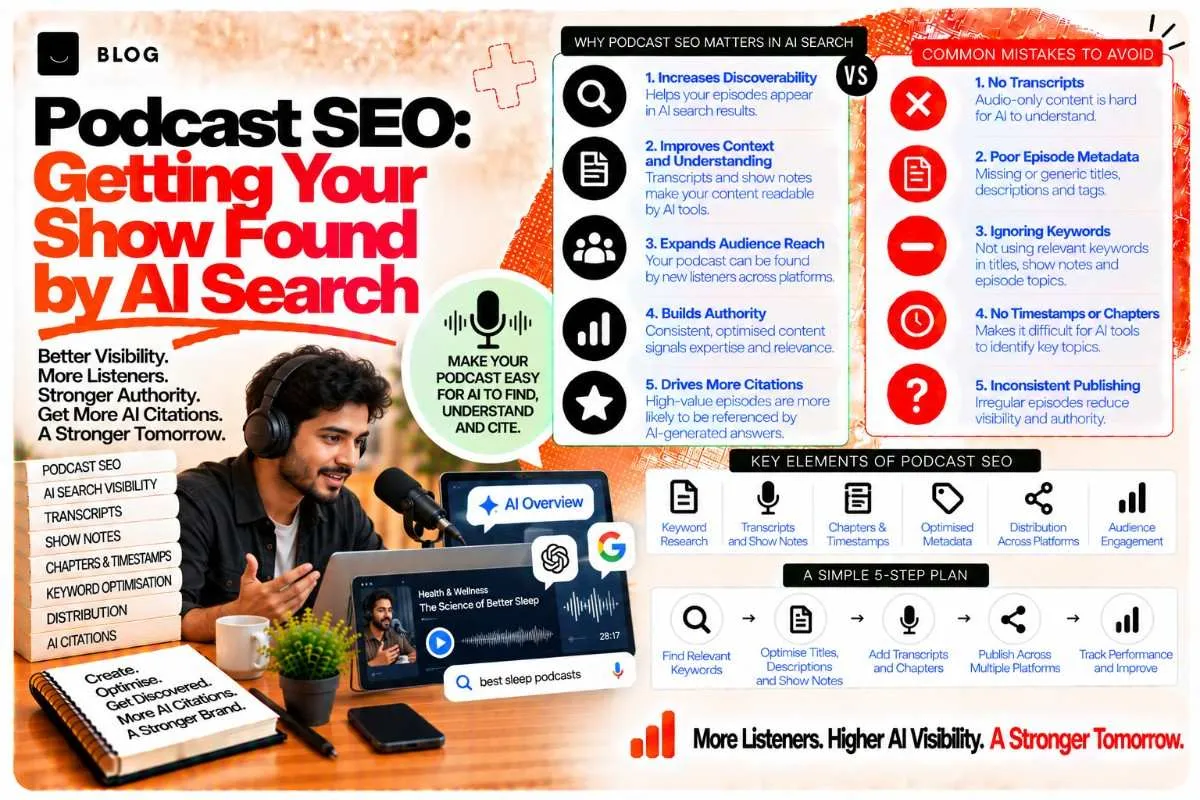
Podcast SEO: Getting Your Show Found by AI Search
A podcast episode is a conversation. For a listener, it lives inside an app. For a search engine or an AI system, it is much harder to find, because most of what makes it discoverable is not the audio itself. It is the text around the audio: the episode title, the description, the transcript, the timestamps, the show name, and the page where the episode is published.
That gap is the opportunity. Most podcasts publish episodes with thin descriptions, no transcript, and no web page of their own. Their best ideas stay inside a directory app that search engines and AI systems barely index. A podcast that publishes a crawlable page for each episode, with a full transcript and clear structure, gives those systems something to read and cite.
This guide covers how to make podcast episodes discoverable on the open web, what AI systems actually use to find audio content, and how to build the workflow so it does not depend on heroic effort every week.
How AI systems find podcast content
AI systems do not listen to audio the way a person does. When they answer a question that could be served by a podcast episode, they rely on text they can read and verify. The usual sources are:
- Episode pages on your own website, with the title, description, transcript, and speaker names in plain HTML.
- Show notes, which describe what is discussed and in what order.
- Transcripts, which contain the actual words spoken and let a system quote or summarise specific claims.
- Directory listings on platforms such as Apple Podcasts and Spotify, which provide the show name, category, and episode descriptions.
- Structured data that identifies the show, the episodes, and the people involved.
If your episodes exist only inside a podcast app, most of these sources are missing. If they exist on a web page with a transcript, an AI system has something it can read, quote, and attribute.
Step 1: Give every episode its own indexable page
The most important podcast SEO decision is whether each episode has a web page. A player embedded on a page is not enough. The page needs real text.
A strong episode page includes:
- An H1 with the episode title, written so the topic is clear without the audio.
- A summary of two to four sentences, stating who the guest is, what the conversation covers, and why it matters.
- An embedded audio player near the top, so the page works for listeners as well as readers.
- The full transcript below the summary, with speaker labels.
- Timestamped chapters, linked to sections of the transcript, so a reader can jump to a specific point.
- Guest bio and links, with the guest's name, role, and organisation in plain text.
- Links to related episodes and relevant articles on your own site.
One page per episode, with a stable URL, is the foundation. Keep the URL structure simple, such as a show path followed by the episode slug, and do not change it after publication.
Step 2: Write episode titles and descriptions for search and for AI
Episode titles on podcast platforms are often clever or vague. A title like "The Quiet Engine" tells a listener nothing about the topic. Search and AI systems need the topic in plain language.
Write titles that name the subject and the guest where it helps:
- Weak: "Episode 47: The Quiet Engine"
- Stronger: "How a Bhopal Dentist Built a Local Patient Pipeline With Google Maps"
Keep the title natural and specific. Avoid stuffing keywords. The aim is for someone who asks an AI system a question to find an episode whose title and summary match the question.
Descriptions do the heavy lifting. Write them as if answering the question the episode addresses. Two to four sentences is enough for the summary on the episode page. The full show notes can run longer, with a short paragraph for each major topic and the timestamp where it starts.
Step 3: Publish a full transcript
A transcript is the single most useful asset for podcast discovery. It turns spoken words into text that search engines and AI systems can index, quote, and verify.
Generate the first draft with an automated tool, then edit it. Automated transcripts often misspell names, product terms, and place names, and they can misattribute speakers. Those errors matter on a page that other systems will read as the source.
Good transcript practice:
- Label each speaker, with the name at the start of each turn.
- Correct names and technical terms before publishing.
- Keep the wording faithful. Do not rewrite the conversation into polished prose. AI systems quote what was said, and a sanitised transcript is less trustworthy.
- Break long transcripts into sections with headings that match the chapter timestamps.
- Place the transcript in the page HTML, not only as a downloadable file. A file a crawler has to fetch separately is less likely to be indexed alongside the episode.
Transcripts also help accessibility, which matters for both users and compliance. They are a case where the SEO benefit and the user benefit point the same way.
Step 4: Use chapters and timestamps that match the transcript
Timestamps let a listener skip to the part of an episode they care about. For search, they do something more useful: they divide the episode into named sections that a system can refer to.
Write chapter titles as topics, not as jokes or teasers. "Why local citations still matter" is more useful than "The boring part."
Link each chapter to its position in the transcript, so the two stay in sync. If a chapter starts at 14:20, the matching transcript section should start at the same point.
Step 5: Add structured data for the show and each episode
Schema markup helps search engines understand the relationships between a show, its episodes, and its people. The most relevant types are PodcastSeries for the show and PodcastEpisode for each episode.
The example below shows the core fields for one episode. Adapt the names and URLs to your own show.
{ "@context": "https://schema.org", "@type": "PodcastEpisode", "name": "How a Bhopal Dentist Built a Local Patient Pipeline With Google Maps", "description": "A conversation about using Google Business Profile to attract local patients, with practical steps for review requests and profile setup.", "url": "https://example.com/podcast/episode-47", "datePublished": "2026-10-15", "duration": "PT42M", "associatedMedia": { "@type": "MediaObject", "contentUrl": "https://example.com/audio/episode-47.mp3", "encodingFormat": "audio/mpeg" }, "partOfSeries": { "@type": "PodcastSeries", "name": "Example Show", "url": "https://example.com/podcast" }, "author": { "@type": "Person", "name": "Host Name" }, "about": { "@type": "Person", "name": "Guest Name", "jobTitle": "Practice Owner" } }
Validate the markup with Google's Rich Results Test or the Schema Markup Validator before publishing. Use datePublished in ISO 8601 format, and keep duration accurate to the actual runtime.
Do not add schema that describes content the page does not contain. If there is no transcript on the page, do not mark it up as if there were.
Step 6: Make the show discoverable in directories
Directory listings on Apple Podcasts, Spotify, and similar platforms feed both user discovery and the broader web. Treat them as part of your SEO footprint.
Check these fields on every platform:
- Show name, identical everywhere and consistent with your website.
- Show description, written as a clear statement of who the show is for and what it covers.
- Category and subcategory, chosen to match what the show actually discusses.
- Artwork, clear at small sizes, with the show name readable.
- Website link, pointing to your podcast landing page, not your homepage.
- Episode descriptions, copied from your episode pages so the wording matches.
Keep the show name consistent with the entity information on your website. Inconsistent naming makes it harder for systems to connect a directory listing to your site, which is the same principle behind citation consistency.
Step 7: Build a show hub that links the episodes together
A podcast with 100 episodes and no hub page is hard to navigate and hard for search engines to understand as a body of work. Create a show landing page that:
- Describes the show, its host, and its audience in a few paragraphs.
- Lists episodes by theme, not only by date, with each theme linking to a short overview.
- Links to the most important episodes first.
- Links out to the articles and resources that the episodes discuss.
This hub is where topical authority builds. A show that consistently covers one subject, with a clear hub and well-linked episodes, gives AI systems a coherent source to cite. A show that covers everything with no hub gives them very little to work with.
Step 8: Build the workflow so it survives a busy week
Podcast SEO fails most often because it is treated as an extra task after recording. The fix is to build it into the production process.
A practical weekly workflow:
- Before recording, write the working title, the planned summary, and a list of likely chapters. This forces a clear topic.
- After recording, generate the transcript, then edit names and terms within 48 hours while the conversation is fresh.
- Write the episode page using the summary and chapters, then publish it with the audio embedded.
- Update directory listings with the same title and description.
- Link the episode from the show hub and from one or two related articles on your site.
Assign ownership. One person should be responsible for the episode page and its transcript, even if the host records the audio.
What to measure
Podcast analytics are weaker than web analytics, so combine sources.
- Episode page traffic and search impressions in Search Console and GA4, to see which episodes are being found through search.
- Directory download and follower numbers, to see listener growth.
- Referral traffic from directories and the show's social channels.
- AI citation checks, by asking AI systems the questions your episodes answer and noting whether your episode pages are referenced.
Expect slower results than with articles. Episodes accumulate search value over months, and a good transcript keeps working long after the initial release.
Common podcast SEO mistakes to avoid
Publishing audio without a web page. If the only place an episode exists is inside a podcast app, search and AI systems have almost nothing to index.
Using automated transcripts unedited. Misspelled names and misattributed speakers damage credibility on the page other systems will read.
Vague titles and teaser descriptions. A clever title that hides the topic is a missed search opportunity.
Changing episode URLs after publication. Broken URLs lose the links and citations the episode has earned. Set the URL once and keep it.
Ignoring the show hub. Without a hub, a large back catalogue reads as scattered.
Marking up content that is not on the page. Schema must describe what the page actually contains.
Frequently asked questions
It can. Episode pages with transcripts and clear titles can appear in search results for the questions they answer. Results vary by topic, competition, and how well each page is built.
Yes. Interviews are often the most citable format, because the guest makes specific claims that a system can attribute. A transcript turns those claims into text.
Host them on your own site, in the episode page HTML. A transcript on your own domain builds the authority of your site, while a transcript only on a third-party platform builds theirs.
Two to four sentences for the summary is enough for the episode page. Longer show notes can cover each chapter in a short paragraph, provided each paragraph adds information.
Video podcasts should follow the same structure, with the transcript on the page and a VideoObject markup for the video itself. The video SEO post covers that markup in detail.
They generally cite the text they can read: the episode page, the transcript, and the show notes. A well-built episode page is what makes audio content citable.
Ready to build what's next?
Tell us where you're headed. We'll come back with a plan to get there.
Book an intro call