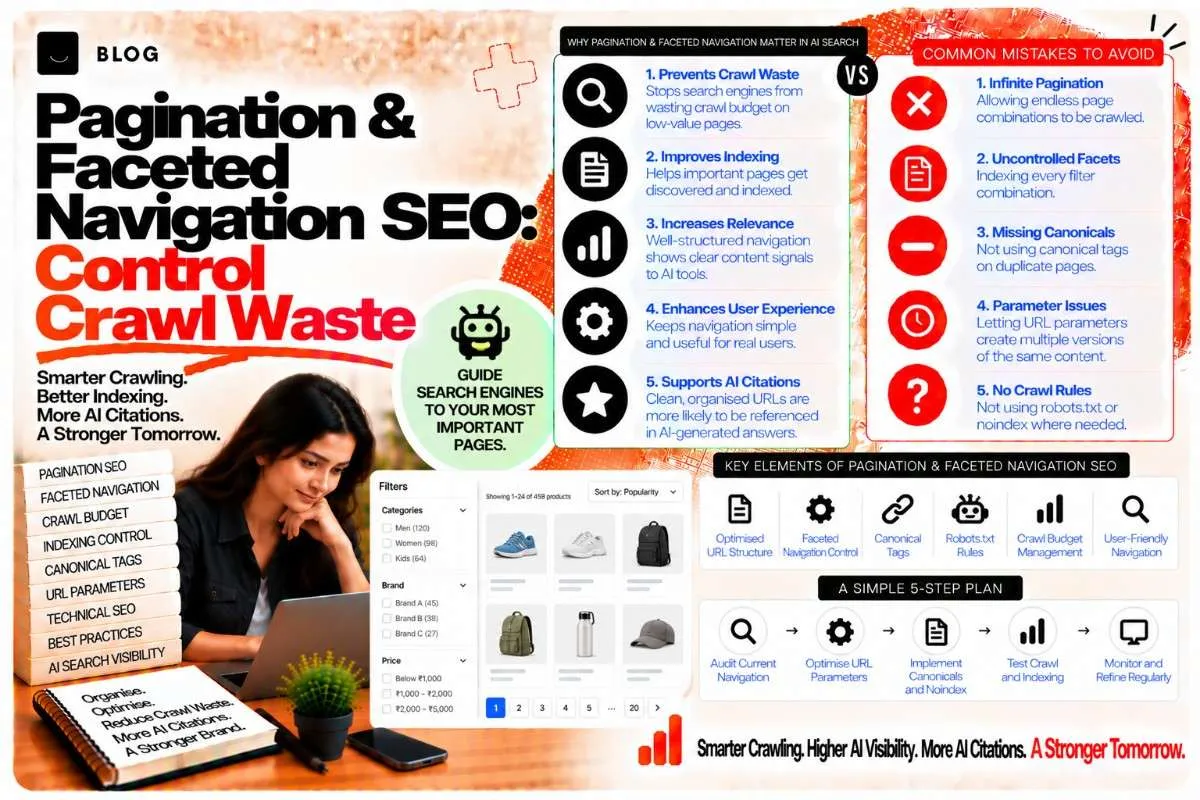
Pagination & Faceted Navigation SEO: Control Crawl Waste
A product category with 40 filter options can generate tens of thousands of URLs. Colour, size, price range, brand, sort order, and page number each add a parameter, and the combinations multiply. A site that looked modest with 400 products can present search engines with several hundred thousand crawlable addresses, most of them showing the same products in a different order.
The effect is quieter than a penalty, and often worse. Search engines spend their time crawling near-duplicate pages, new and updated products are discovered more slowly, and the signals that should concentrate on the main category page spread across hundreds of filtered variants. The site's most valuable pages can end up getting less attention than the junk.
This guide covers how pagination and faceted navigation create that waste, how to diagnose it, and how to control it without breaking the navigation that shoppers rely on.
How faceted navigation creates crawlable URLs
Faceted navigation lets users narrow a list by attributes such as size, colour, price, or availability. Each selection usually changes the URL, often by adding a query parameter. Selecting "blue" and "medium" might produce a URL such as a category path followed by parameters for colour and size.
Several things multiply the problem:
- Combinations. Each facet can be combined with others, so the number of possible URLs grows quickly.
- Sort orders. Sorting by price or newest often creates a separate URL for each sort option.
- Pagination. Each page of results may have its own URL, and paginated lists can be combined with filters.
- Session and tracking parameters. Some sites add parameters for tracking or sessions, creating new URLs for identical content.
- Empty results. Some filter combinations return nothing, creating thin pages.
Most of these URLs show content that duplicates or closely overlaps the category page. Search engines have to decide, one URL at a time, whether each is worth crawling and indexing.
Why this matters for search
Three problems follow from uncontrolled faceted URLs.
Crawl waste. Search engines allocate crawling resources to a site based on several factors. A site that exposes large numbers of low-value URLs gives crawlers more to process than the pages that matter. On large sites this affects how quickly new products and important updates are discovered. On small sites the effect is usually limited, and crawl budget is rarely the main constraint.
Signal dilution. Links, internal and external, pointing to filtered variants split the signal that the main category page should collect. If many internal links point to a colour-filtered page instead of the category, the category may rank less well than it could.
Duplicate and thin content. Filtered pages that show the same products in a different order can be treated as duplicates. Filtered pages with few or no products can be treated as thin. Either way, they dilute the quality picture of the site.
AI systems face a similar problem. A site with many near-identical product listing URLs gives them an unclear picture of which page is the authoritative source for a category.
Step 1: Measure the problem before fixing it
Start with data, not assumptions. Check:
- Indexed URLs in Search Console, using the Pages report and site-search operators, to see how many parameter URLs are indexed.
- Crawl stats in Search Console, to see the share of crawl activity going to parameter URLs.
- A full crawl with a tool such as Screaming Frog, to list every parameter pattern, its count, and whether the URLs return content.
- Server logs, if available, to see which URLs crawlers request most often.
Group the parameters into types: facets that change content (colour, size), sort orders, pagination, tracking, and session parameters. Each type needs a different response.
The keyword cannibalization audit post covers competing content pages. This post covers a different problem: URLs generated by a system that compete with the canonical category page without any editorial decision behind them.
Step 2: Decide which facet pages deserve to be indexed
Not every filtered page is waste. Some represent real search demand. "Running shoes in size 9" may be a query that people search for, and a dedicated page can serve it well.
Decide by criteria:
- Search demand. Does anyone search for this combination? Check keyword data.
- Unique value. Does the page offer content or products meaningfully different from the category page?
- Substantial inventory. Does the page show enough products to be useful?
- Editorial support. Can you write a useful introduction or guide for the page?
Index the few combinations that pass these tests, and treat the rest as navigation only. Build a short, deliberate list of indexable facet pages rather than letting every combination be crawled by default.
Step 3: Use canonical tags on filtered variants
A canonical tag tells search engines which URL is the preferred version of a page. On a filtered variant that duplicates the category page, the canonical should point to the category.
The canonical is a hint, not a directive. Search engines may ignore it if the page is significantly different or if other signals contradict it, such as strong internal links to the filtered version. So it works best as part of a consistent set of signals.
<!-- On https://example.com/shoes?colour=blue&size=9 --> <link rel="canonical" href="https://example.com/shoes/" />
Use canonicals on filtered and sorted variants that duplicate the main page. Do not canonicalize a deliberately indexable facet page to the category, because that tells search engines the facet page is not worth indexing.
Step 4: Handle pagination correctly
Search engines stopped using rel="next" and rel="prev" as an indexing signal in 2019, so those tags should not be relied on to consolidate paginated series. Instead, make each page in a series accessible and well linked.
Good practice for paginated category lists:
- Each page in the series can be indexed if it shows distinct products, with a self-referencing canonical to its own URL. Do not canonicalize every page to page one, because that hides the products on later pages from discovery.
- Link to each page with plain, crawlable links, so products on later pages can be found.
- Make sure product detail pages are linked directly from category pages and internal listings, not only through deep pagination.
- Avoid infinite scroll without a crawlable fallback. Provide paginated URLs that crawlers can request.
Canonicalizing paginated pages to page one is a common mistake. It can cause products on later pages to be discovered less well, and it does not solve the crawl problem it is often intended to fix.
Step 5: Control parameters at the source
Where the parameter has no value to search, stop it from creating crawlable URLs at all.
Options include:
- Robots rules in robots.txt to block crawling of specific parameter patterns. Be careful: blocking crawling stops search engines reading a canonical or noindex tag on those pages, and URLs already known to search engines may stay in the index. Use robots blocking for parameters that create infinite or near-infinite spaces, not as a general indexing control.
- Noindex for pages that should remain accessible to users but not appear in search. Noindex must be crawlable to take effect.
- Removing parameters that have no content value, such as tracking parameters, by stripping them from internal links.
- Using POST or client-side filtering for facets that do not need to be crawlable. This is a stronger control, but it changes how the feature works and needs careful testing.
Test any robots change in Search Console's robots tester and monitor the effect. A badly configured robots rule can block important pages.
Step 6: Design internal links with intent
Internal links are the strongest signal of which page matters. Design them so they point to the pages you want to rank.
- Link to category pages from the rest of the site, using clean URLs.
- Avoid sitewide links to filtered variants such as colour or size pages, unless those pages are intended to be indexed.
- Make filter links use nofollow or be generated by JavaScript where the variants should not be crawled, though treat nofollow as a hint rather than a guarantee.
- Keep the faceted interface usable for shoppers, even if the links it generates are not crawlable.
The internal linking strategy post covers linking patterns more broadly. The rule here is specific: the navigation that shoppers use should not accidentally become the signal that tells search engines which variants matter.
Step 7: Watch for thin and empty results
Some filter combinations return zero or very few products. These pages are thin and should not be indexed. Options include returning a 404 or a 410 for empty results, showing a noindex tag, or redirecting to the nearest populated category.
Set rules so empty combinations are handled consistently, rather than leaving them to the default behaviour of the platform.
Step 8: Verify the changes and monitor
Changes to faceted navigation take time to take effect, and mistakes can be costly. Monitor carefully.
Track:
- Indexed URL count in Search Console, which should fall as unwanted variants drop out.
- Crawl stats, which should shift toward category and product pages.
- Category and product page impressions and clicks, which should hold or rise as signals concentrate.
- Errors, such as blocked resources, accidental noindex on important pages, or redirect chains.
- Product discovery, checking that new products appear in search within a reasonable time.
Roll changes out in stages where possible. Changing many parameter rules at once makes it hard to tell which change caused which result.
What faceted navigation cannot fix
Pagination and faceted fixes will not rescue a weak category page. If the main category has thin content, no clear introduction, and poor product information, controlling the variants only concentrates attention on a weak page.
They also do not solve a slow site. If category pages are slow to load, the Core Web Vitals work matters as much as the URL controls.
Common faceted navigation mistakes to avoid
Canonicalizing all paginated pages to page one. This hides products on later pages from discovery.
Blocking parameters in robots.txt without a plan. Blocked URLs cannot have their canonical or noindex tags read, and known URLs can remain indexed.
Indexing every filter combination. This recreates the original problem at a larger scale.
Linking to filtered variants sitewide. Navigation becomes the signal, and the wrong pages gain authority.
Treating rel="next" and rel="prev" as a fix. They are not an indexing signal for consolidation.
Changing everything at once. Staged changes are easier to diagnose and reverse.
Frequently asked questions
Usually not. Noindexing later pages can stop their products being discovered and treated as valuable. Keep paginated pages indexable where they show distinct products, and focus controls on filter and sort variants that duplicate content.
No. Faceted navigation is valuable for shoppers. The problem is uncontrolled crawlable URLs. A well-designed faceted system keeps the useful combinations indexable and controls the rest.
It matters most on very large sites with many URLs. Smaller sites rarely face a crawl budget constraint, but the signal dilution and duplicate content problems still apply.
Only for parameter patterns that create endless or near-endless crawl spaces, and only after checking the effect. For most duplicate variants, canonicals and internal link design are the better controls.
Yes. Use canonical tags, noindex where appropriate, and internal link design, so the URLs remain usable for shoppers while search engines receive clear signals.
Use search demand data and check whether each combination has substantial, distinct content. Index the small set that passes, and control the rest.
Ready to build what's next?
Tell us where you're headed. We'll come back with a plan to get there.
Book an intro call