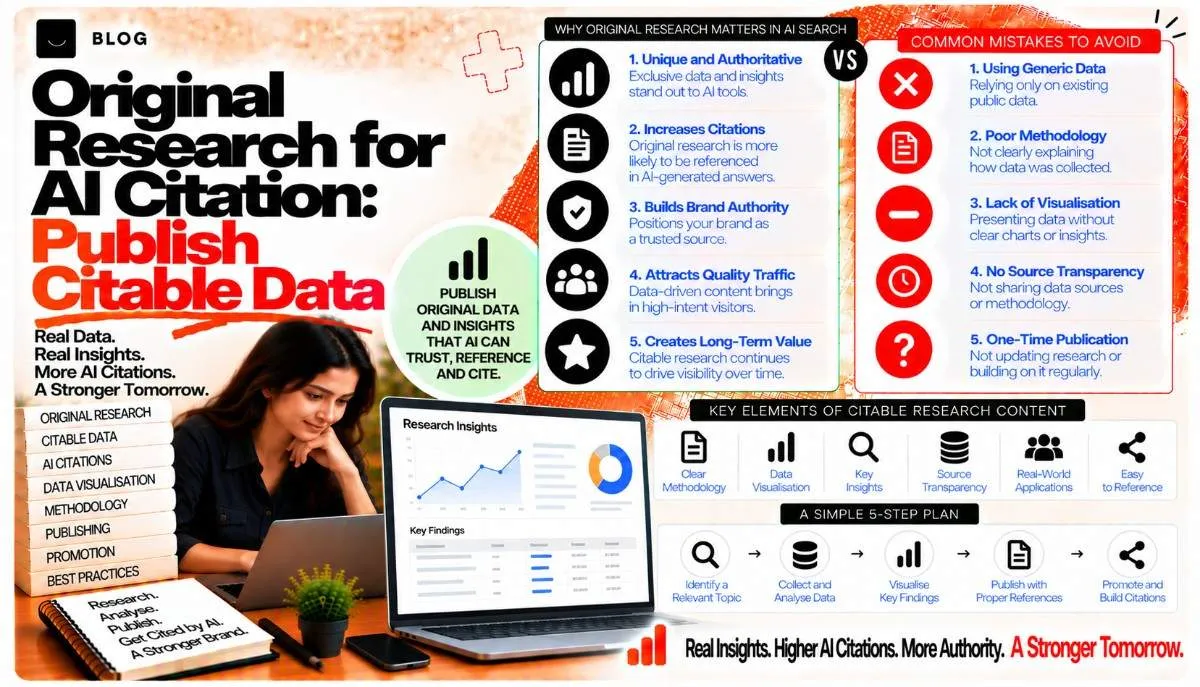
Original Research for AI Citation: Publish Citable Data
AI systems answer many questions with numbers. What share of buyers do X, how long does Y take, how many businesses have Z. When a number appears in an AI answer, the system usually wants to name where it came from, and it prefers a source that states its method, date, and sample.
Most businesses have data that could answer those questions. They have customer outcomes, project timelines, pricing patterns, and internal benchmarks. Very few publish it in a form that can be cited. The figure sits in a slide deck or a sales call, and an AI system has nothing to attribute it to.
Original research turns that internal knowledge into a citable asset. It is one of the strongest ways to become the named source in a topic, rather than one of many blogs repeating the same secondhand statistics. This guide covers how to do it responsibly: what to measure, how to disclose the method, and how to publish the findings so they can be quoted accurately.
Why original data gets cited
AI systems tend to cite sources that are specific, attributable, and distinct. A page that restates a common claim adds little, because the same claim exists in dozens of places. A page that publishes a finding nobody else has is the only available source for that finding.
Three properties make research citable:
- Named method. The page says how the data was collected, from whom, over what period, and how many responses or observations it contains.
- Specific findings. The page states the numbers and the comparison they support, not only a headline.
- Stable location. The findings sit on a page with a clear URL, a publish date, and an update history, so they can be found and referenced again.
Original research also produces natural links from other sites, because journalists, bloggers, and forum members reference a useful dataset. That links back to the external authority signals covered in the backlink strategy post.
Step 1: Choose a question that only you can answer well
The best research questions come from data you already have, or can collect without a large budget. Good candidates include:
- Outcomes from your own client or customer base, anonymised and aggregated.
- Benchmarks from a consistent tool or process you use every day.
- Survey responses from a specific, reachable audience, such as your email list or a professional community.
- Patterns in public data that you can clean and analyse better than others.
Test each candidate question against three criteria:
- Would your audience search for this answer? Check whether people ask the question, using keyword research and forum threads.
- Can you collect the data reliably? A weak sample published with confidence damages credibility more than having no research at all.
- Does your organisation have standing to answer it? Research is most credible when the publisher has real experience in the subject.
Avoid questions that can only be answered with a sweeping claim about an entire market you have not sampled. Narrow, honest questions are cited more than broad, unsupported ones.
Step 2: Design the method before you collect anything
Write the method down before collecting data, then publish it with the findings. Changing the method after seeing results is a common route to misleading conclusions.
Your method description should cover:
- Population. Who or what was measured, and how they were selected.
- Sample size. The number of responses, observations, or records used.
- Time frame. When the data was collected, including start and end dates.
- Instrument. The survey questions, measurement tool, or data source.
- Exclusions. Records or responses removed, and why.
- Known limitations. Where the sample may not represent the wider market.
Disclosing limitations is not a weakness. It is what lets careful readers, including AI systems, judge how far the findings can be trusted. A limitation stated clearly is far more credible than a limitation discovered later.
Step 3: Protect privacy and comply with data rules
Research often involves personal data, and mishandling it creates legal and reputational risk. Before collecting anything:
- Aggregate results so that no individual can be identified, and avoid publishing small groups where people could be recognised.
- Obtain consent where your collection requires it, and state how responses will be used.
- Store raw data securely, and delete it when it is no longer needed.
- Check the rules that apply in each market where you collect or publish data.
For Indian businesses, the Digital Personal Data Protection Act shapes how personal data may be collected and processed. Check current guidance with a qualified adviser before collecting personal information for research.
Never publish customer-identifiable case results without written permission. Anonymised and aggregated results are usually safer and more useful anyway.
Step 4: Analyse honestly and report what you find
Analysis is where most research goes wrong. Common errors include reporting only the findings that confirm a pre-existing view, presenting small differences as meaningful, and generalising beyond the sample.
Practical discipline:
- Report the full picture, including findings that do not support the headline you hoped for.
- Show the numbers with context. A 12% figure from 40 respondents is not the same as a 12% figure from 4,000. State the sample for every key figure.
- Avoid causal claims unless the design supports them. A correlation in a survey is a correlation.
- Separate observation from interpretation. State what the data shows, then state what you think it means, and label the second clearly.
If the findings are surprising, check the data before publishing. Surprising results are sometimes correct, and sometimes the product of a coding error or a biased sample.
Step 5: Structure the page so findings can be quoted accurately
The page that presents your research is what gets cited, so it needs to be easy to quote without distortion.
A citation-ready research page usually contains:
- A clear H1 that names the subject, the sample, and the year, for example "Survey of 240 Small Clinics on Local Search, 2026."
- A summary near the top, with the three or four headline findings stated in one sentence each.
- The method section, placed before the detailed findings, so readers see how the data was produced.
- Findings with tables or charts, each with a caption stating the sample and the question asked.
- Named limitations, in their own section.
- A short section stating how to cite the research, with the title, publisher, date, and URL.
- A publish date and an update date, so readers and AI systems can see how current it is.
Keep each finding as a self-contained statement. "Most respondents (61%) reported that Google Business Profile was their first source for finding a clinic" is quotable. "Results were interesting" is not.
Step 6: Mark up the data where it helps
Schema markup can describe a dataset page to search engines and AI systems. The Dataset type on schema.org is designed for this, and the properties include the name, description, creator, date published, and the distribution of the data file.
Use markup only for content the page actually contains. Do not describe a dataset you have not published.
{ "@context": "https://schema.org", "@type": "Dataset", "name": "Survey of 240 Small Clinics on Local Search Practices, 2026", "description": "Responses from 240 independent clinics in India, collected between January and March 2026, on the sources they use to find new patients.", "creator": { "@type": "Organization", "name": "Digital4Local", "url": "https://digital4local.com" }, "datePublished": "2026-04-01", "dateModified": "2026-04-01", "license": "https://creativecommons.org/licenses/by/4.0/", "distribution": { "@type": "DataDownload", "encodingFormat": "text/csv", "contentUrl": "https://digital4local.com/research/clinic-survey-2026.csv" } }
If you publish a downloadable file, make sure it contains only the aggregated or anonymised data described in the method. Verify the markup with Google's Rich Results Test or the Schema Markup Validator before publishing.
Step 7: Promote the research to people who will reference it
A dataset that nobody sees cannot earn citations. Plan distribution as part of the project, not as an afterthought.
Effective routes include:
- Direct outreach to journalists, newsletter writers, and industry publications that cover your subject, with a short summary and a link to the page.
- Your own channels, including your newsletter, LinkedIn, and any community where your audience already gathers.
- Internal sharing, so your sales and support teams can reference the findings in conversations.
- Presentation at events or in webinars, with the page linked from the slides.
Keep outreach honest. Offer the findings as a useful source, not as a favour that requires coverage. Most people who reference research will only do so once.
Step 8: Update and maintain the research
Research has a shelf life. Set a schedule to review the findings, and either update the page with new data or mark clearly that the results come from a specific period.
Update when:
- You collect a new wave of data that makes a comparison possible.
- A major change in the market makes the old figures misleading.
- A correction is needed. Publish corrections visibly, with the date and a note explaining what changed.
Keep the URL stable when you update. A research page that keeps accumulating citations should not be moved each year.
What original research cannot do
Original research will not compensate for weak products, poor customer experience, or a site with no clear subject focus. It is one asset among several, and its value depends on the quality of the work behind it.
It also takes time and budget. A small survey can be run in a few weeks, but a rigorous study with a large sample takes months. Start with a question you can answer well, not the largest study you can imagine.
Common original research mistakes to avoid
Publishing without a method. A statistic with no method is hard to trust and hard to cite.
Choosing a convenient sample and calling it representative. State the sample honestly and let readers judge.
Hiding limitations. Stated limitations increase credibility. Hidden ones undermine it when someone else finds them.
Using research as a sales pitch. Findings that point only to your product read as marketing, and are less likely to be cited.
Changing the method after seeing results. Decide the method in advance, and report any changes openly.
Publishing and forgetting. A dataset that is never promoted or updated loses most of its value.
Frequently asked questions
No. A well-designed survey of a specific audience, or an analysis of data you already hold, can be valuable. Sample size should match the question. A narrow question with a clear method beats a large study with a vague one.
They can, particularly when the study answers a narrow question that few others address. Clear methodology and a stable URL matter more than sample size alone, though stating the sample size is essential.
You can use tools to help with analysis, but you are responsible for checking the results. Verify every figure against the raw data before publishing, and disclose the tools used where relevant.
A roundup collects figures from other sources. Original research produces figures from your own data. The roundup depends on others' credibility; the original research establishes your own.
Gating reduces citations and referral links, because people cannot easily reference a page they must register to read. Publish the summary and key findings openly, and gate only supplementary material if at all.
Publish when you have a question worth answering and the data to answer it well. An annual cycle works for many businesses, but a single high-quality study is more valuable than a regular series of weak ones.
Ready to build what's next?
Tell us where you're headed. We'll come back with a plan to get there.
Book an intro call