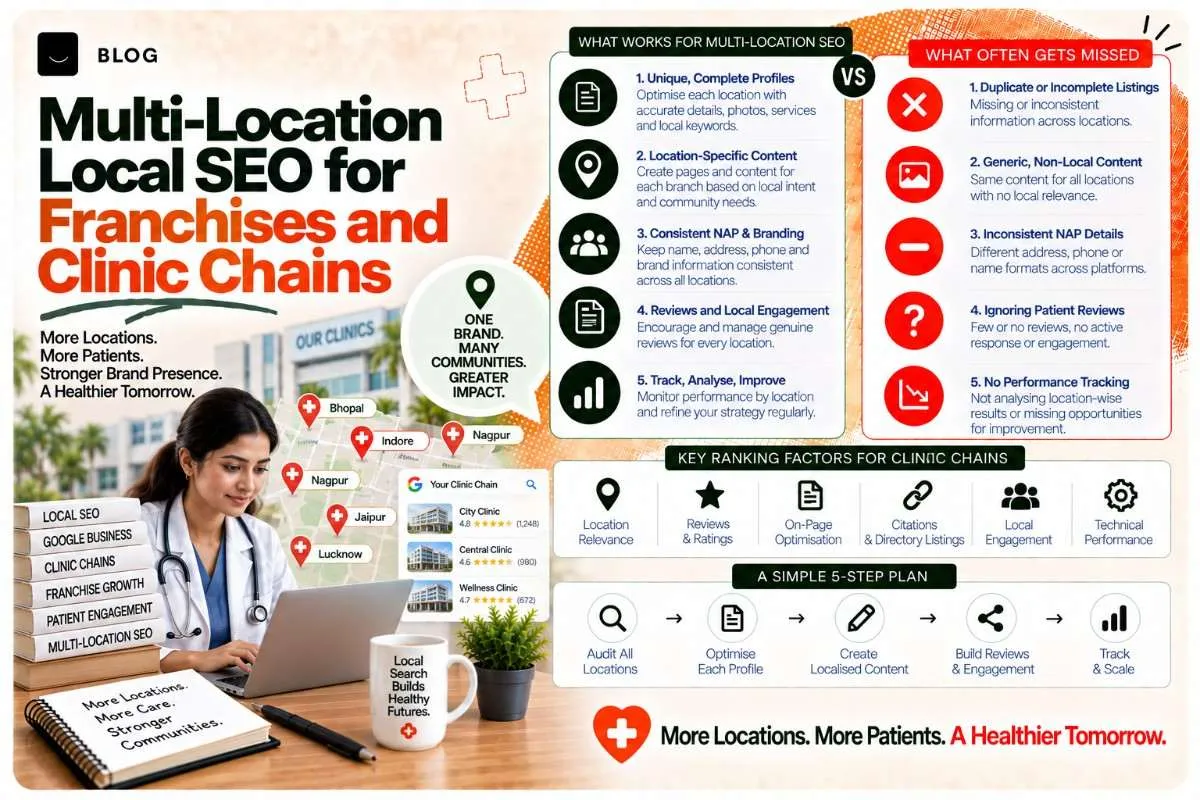
Multi-Location Local SEO for Franchises and Clinic Chains
A multi-location business is not a single-location business repeated — it is a different structural problem, because every location needs to be genuinely distinct and locally relevant while the brand as a whole needs to stay consistent and centrally coherent. Most multi-location SEO failures come from managing that tension badly in one direction or the other: locations so generic they are interchangeable, or locations so disconnected from the parent brand that neither benefits from the other's authority.
Why multi-location is a different problem, not a bigger version of the same one
The single-location guidance covered throughout this library — complete profile, accurate hours, credentialed authorship, a clear FAQ — still applies at every individual location. What changes structurally is that a multi-location business also has to solve problems a single location never faces:
- How does location #14's page avoid being a copy of location #3's page with the city name changed?
- Does a search or AI system understand that all fourteen locations belong to one coherent brand, or does it see fourteen unrelated entities?
- Who owns keeping profile #14 as complete and current as profile #1, once the person who set up profile #1 has moved on to other things?
None of these are single-location problems. All of them determine whether a chain's local SEO actually scales or quietly degrades as it grows.
The core tension: consistency vs genuine differentiation
This is the organising problem for everything below.
Too much consistency — location pages that are template copies with only the city name swapped — read as thin to both search engines and AI systems, and give a local searcher nothing that actually tells them about that location specifically. This is the far more common failure.
Too little consistency — locations that each look and read like entirely separate businesses — fails to build brand-level authority, and confuses the entity resolution problem covered in this library's entity SEO framework: is this one brand with fourteen locations, or fourteen unrelated businesses that happen to share a name?
The right balance: consistent brand voice, consistent core information architecture, and genuinely distinct, location-specific content within that consistent structure.
Building location pages that actually differ from each other
Each location page needs real, specific content that could not be copy-pasted to another location without becoming false:
- Genuinely local details — the specific practitioners or staff at that location, specific parking or accessibility detail for that building, specific local landmarks used for wayfinding
- Location-specific hours, if they genuinely differ, stated accurately rather than assumed identical to the flagship location
- A local team, named, where staffing genuinely differs by location — this is both a differentiation tool and a direct application of the named-authorship principle covered throughout this library
- Genuinely local reviews and local proof, not a generic testimonial carousel identical across every location page
- A locally-relevant FAQ section, addressing questions specific to that location where they genuinely differ — parking, specific services offered only at that branch, specific local considerations
The test: read two location pages side by side. If swapping the city name between them would make both pages equally accurate, they are not differentiated enough.
Managing profiles at scale without losing consistency
The practical operational challenge, and where most chains actually fail:
- A single source of truth for brand-level information — the core description, the brand's stated values, the parent organisation's credentials — that every location inherits rather than each location drafting independently
- A defined, mandatory field set for location-specific information, so no location profile is missing an attribute simply because whoever set it up did not think to include it
- A named owner for profile maintenance, not "whoever has time," because profile completeness at multi-location scale degrades specifically when ownership is diffuse
- A recurring audit cadence — the same discipline recommended for a single hospital at institutional scale in this library's hospital-specific post, applied to a commercial multi-location chain
The duplicate content risk, and how it actually happens
Worth naming explicitly, because it is a genuine technical risk specific to multi-location sites.
If every location page shares 90% identical text with only the city name changed, this reads as thin, templated content to a search engine, and it gives an AI system almost nothing distinct to extract about any individual location. The fix is not less content per location — it is more genuinely location-specific content, following the differentiation principles above, so each page earns its own place rather than being a near-duplicate of every other location's page.
Centralised brand entity, distributed local entities
This connects directly to the entity clarity framework covered elsewhere in this library, applied at chain scale specifically.
The parent brand is one entity. Each location is also, in a real sense, its own local entity — with its own address, its own local reviews, its own local staff — while clearly and consistently identified as belonging to the parent brand. Getting this relationship clear in schema (Organization for the parent, with individual LocalBusiness entries for each location, properly linked) and in consistent stated language across every location page is what allows a system to understand both levels correctly: this is one brand, and this is specifically its Bhopal location.
Reviews and reputation across many locations
- Reply discipline applied evenly across every location, not concentrated on whichever one someone happens to be watching
- Location-specific review monitoring, since a reputation problem at one location should not be masked by strong reviews at others in aggregate reporting
- A consistent brand voice in replies, adapted for local specifics — the same balance covered throughout this library's review-response guidance, applied at scale
What breaks first as a chain scales
In rough order of what typically fails first as a business adds locations:
- Profile completeness — new locations launch with a rushed, incomplete profile that never gets finished
- Content differentiation — location pages get copy-pasted under time pressure, with only the city name changed
- Review response consistency — newer or smaller locations get less attention than the flagship
- Named staff information — kept current for the original locations, never updated as staff at newer locations change
- Schema and entity structure — often correctly set up for the first few locations and then skipped for subsequent ones added by a different person under less scrutiny
Each of these is an ownership and process problem more than a strategy problem — which is why the practical fixes above are as much about who owns what and how often as about any specific SEO tactic.
A location-by-location audit template
For any chain auditing its current state, per location:
- Is the profile complete against the same checklist used for the flagship location?
- Is the location page genuinely distinct from the other locations' pages, or a near-duplicate?
- Are staff and credentials current and specific to this location?
- Are recent reviews replied to, at the same standard as other locations?
- Is the location correctly and consistently linked to the parent brand entity in schema and in stated description?
- Are hours, address and phone verified current, not assumed unchanged since launch?
Run this across every location on a fixed schedule, and the pattern of where a specific location falls behind usually reveals exactly where the ownership gap sits.
Frequently asked questions
A single location needs one complete, accurate, well-differentiated profile and page. A multi-location business needs every location to meet that same standard while also staying genuinely distinct from every other location and clearly, consistently identified as part of one coherent parent brand — a structural problem single-location businesses never face.
Because location pages are frequently built as templates with only the city name changed, producing pages that share the vast majority of their text. This reads as thin to search engines and gives an AI system little distinct information to extract about any individual location, undermining both conventional ranking and AI citation.
With genuinely location-specific content: named local staff, location-specific hours and accessibility details, local landmarks used for wayfinding, and a locally relevant FAQ. A useful test is whether swapping the city name between two location pages would make both equally accurate — if so, the pages are not differentiated enough.
A named owner responsible for maintaining every location's profile against the same standard, rather than leaving it to whoever set up each location individually. Profile completeness at multi-location scale most commonly degrades when ownership is diffuse and no one is accountable for the pattern across all locations.
Typically Organization schema represents the parent brand, with individual LocalBusiness entries for each location properly linked to it, allowing a system to understand both that a location belongs to a parent brand and that it has its own distinct address, hours and local details.
Profile completeness for newly added locations, which often launch rushed and incomplete, followed by content differentiation as location pages get copy-pasted under time pressure. Both are ownership and process failures more than strategic ones.
The same reply discipline and consistent brand voice should apply across every location, adapted for local specifics, with monitoring at the individual location level rather than only in aggregate. A reputation problem at one location can otherwise be masked by strong performance at others when reviewed in aggregate.
Ready to build what's next?
Tell us where you're headed. We'll come back with a plan to get there.
Book an intro call