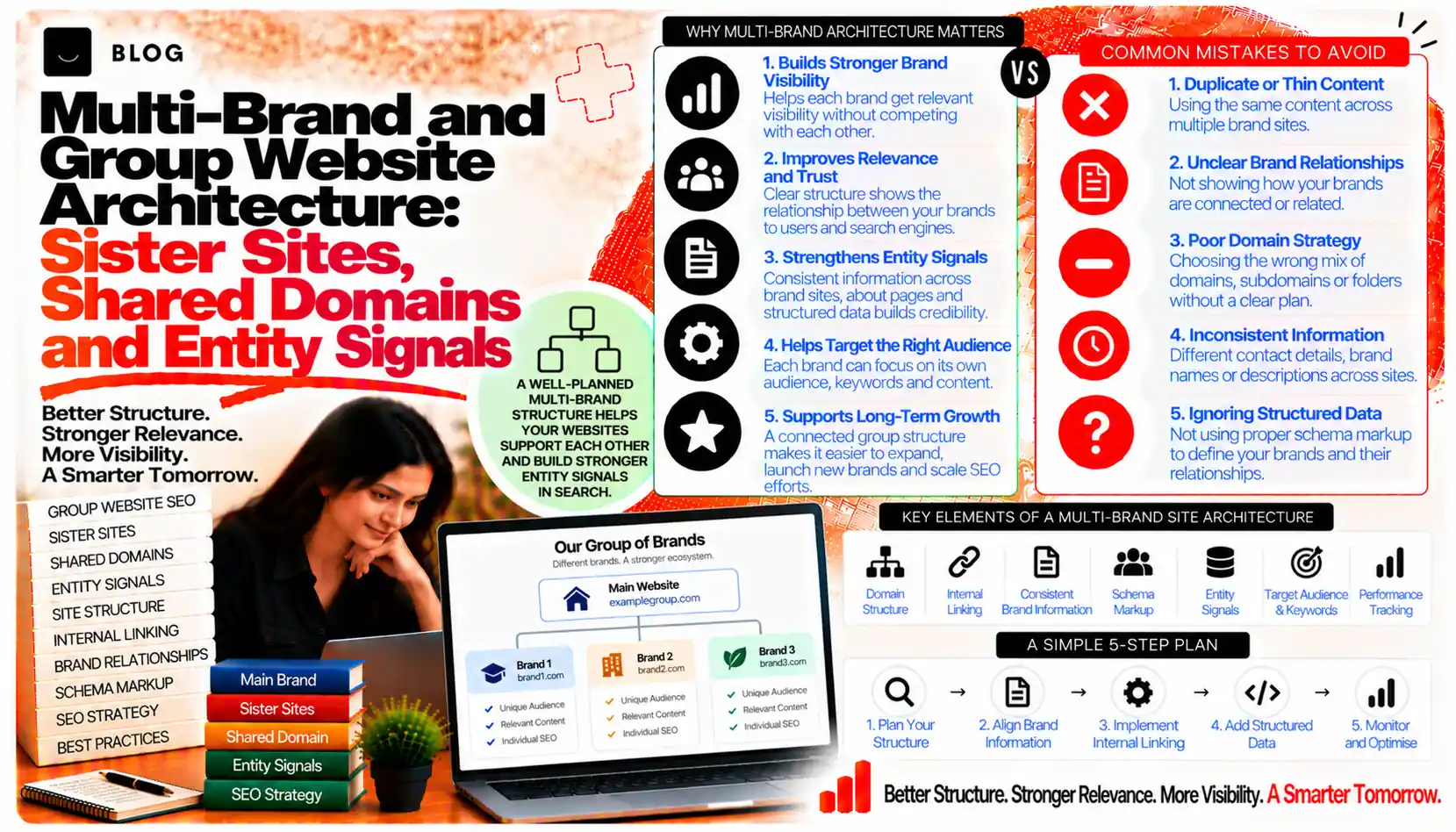
Multi-Brand and Group Website Architecture: Sister Sites, Shared Domains and Entity Signals
A group that runs several brands, universities, clinics or companies faces a question most single-brand sites never meet. Should each brand have its own website, its own domain, or a section of a shared group site? The answer shapes how search engines understand the group, how each brand builds its own authority, and how much work the team does every time a page changes.
There is no single correct structure. Each option trades control against consolidation. Separate domains give each brand a clean identity and independent reputation, but they split authority and multiply maintenance. A shared domain consolidates signals and effort, but it can blur brand boundaries and make it harder for one brand to stand on its own. The right choice depends on how distinct the brands are, how much they share, and how the audience finds them.
This guide sets out the options, the signals that tie a group together or keep brands apart, and the mistakes that cause duplication across sister sites.
What group architecture can and cannot do
A sound structure helps search engines understand which brand owns which services, which pages belong to the group, and how the brands relate. It helps each brand rank for its own queries without competing with its sisters, and it can make the group's collective authority visible to readers and to systems that assess trust.
It cannot make a weak brand strong, and it cannot merge distinct audiences into one. A group that forces unrelated brands onto one site, or splits one brand across several domains, usually loses more than it gains.
Step 1: Map the brands and their overlap
Before choosing a structure, list each brand and describe three things: the audience it serves, the services or programmes it offers, and the geography it operates in. Then mark where brands overlap.
Overlap falls into three kinds:
- Shared services in different markets, such as a group that offers the same training in two cities through two brands
- Shared services in the same market, which creates direct competition between sister sites and needs the most care
- Shared group content, such as corporate pages, leadership profiles and accreditations, which every brand may need to reference
The more overlap in the same market, the stronger the case for separating brands clearly, or for consolidating them into one site with distinct sections.
Step 2: Choose between domains, subdomains and subdirectories
Three structures are common. Each has a different effect on how signals are shared.
Separate domains give each brand its own address and identity. They suit brands with distinct audiences, different markets or strong standalone reputations. The cost is that each domain builds authority separately, and links to one brand do not directly strengthen another. Group-level signals must be built deliberately through cross-references.
Subdomains place each brand under the group domain, such as one brand at a subdomain of the group's main domain. They sit between the two options. Search engines have treated subdomains with some independence, so authority sharing is less direct than with subdirectories. Check the current guidance before relying on either behaviour.
Subdirectories place each brand in a folder of the group site, such as a path for each brand. They consolidate authority under one domain, which helps a group whose brands share an audience and a reputation. The risk is that brands can blur together if the structure, navigation and design do not separate them clearly.
For most groups with closely related brands, subdirectories offer the strongest consolidation. For brands in different markets or with unrelated audiences, separate domains are usually clearer. Make the choice once, and document it, because changing it later is a migration.
Step 3: Keep the group entity consistent
A group should be recognisable as one organisation, with its brands clearly identified as parts of it. Search engines and readers need consistent signals about who owns what.
Keep consistent:
- The group's legal and trading name on every site, with the same spelling and format
- Contact details and registered addresses where they appear, so the group and brand records match
- Leadership and accreditation pages, linked from each brand where the claims apply
- Structured data for the organisation, with each brand described accurately and linked to the parent where that is true
Describe the relationship honestly. A brand that is a division of the group should say so. A brand that operates independently should not be presented as a subsidiary for the sake of link equity, because that misrepresents the business.
The E-E-A-T and author expertise post covers how to show credibility and expertise, which applies to group leadership and to the brands' faculty or teams.
Step 4: Avoid shared boilerplate that creates duplicates
The most common failure across sister sites is duplicated content. A group copies the same "About", "Why Choose Us" and footer text across every brand, and the sites begin to look like templates of each other. Search engines see near-duplicate pages, and readers see the same message from different brands.
Make each brand's content distinct:
- Write the brand's own overview, audience description and value proposition
- Show the brand's own programmes, services, team and results
- Keep shared group content short, placed below the brand's distinct content
- Use different imagery, examples and calls to action that reflect each brand's market
Shared text is acceptable in a limited form, such as a standard accreditation statement or a group address. A full page of identical copy across sister sites is not.
Step 5: Cross-link with purpose
Links between sister sites can help readers find related brands and can signal the group's structure. They can also be overused, creating a web of links that looks manipulative or confuses visitors.
Use cross-links where they serve the reader:
- From a brand's about page to the group's overview page
- From a service page to a sister brand's service in a different market, where the reader is likely to need it
- In a clearly labelled group navigation, such as "Our group companies", with a short description for each
Avoid footer link blocks stuffed with sister domains, reciprocal link schemes and links that exist only to pass signals. The internal linking strategy post covers how link structure builds topical relationships, which applies within each brand as well as across the group.
Step 6: Separate brands clearly within shared structures
If brands share a domain or a subdirectory structure, make each brand's identity obvious. Use distinct navigation, brand names in titles and headings, separate logos and clear descriptions. A visitor should know which brand they are on at every point.
Titles and headings matter here. A page title that names the brand and the service helps both readers and search engines, as the title tags post covers. Avoid generic titles across the group that could belong to any brand.
Step 7: Handle overlaps in the same market
When two sister brands offer similar services in the same city or sector, the group risks competing with itself in search. Decide deliberately which brand will own each query, and structure the sites so that the chosen owner is clearly the stronger page.
Options include:
- Consolidate the services under one brand, and redirect or reposition the other
- Differentiate the services clearly, with distinct audiences, pricing or outcomes, so each page has a clear reason to exist
- Refer the reader from one brand to the other, where the service is genuinely better handled elsewhere
The keyword cannibalization audit post covers how to find and resolve overlapping pages, which is useful for group sites that have grown over time.
Step 8: Plan changes as migrations
Restructuring a group is a migration. Moving a brand to a new domain, folding it into a subdirectory or consolidating two brands changes URLs and signals at scale. Use the same discipline as any migration: a complete redirect map, consistent canonical tags, updated sitemaps and monitoring after launch.
The website migration checklist post covers that process, and it applies to group restructures in full. Plan the sequence so that only one major change happens at a time.
Step 9: Measure each brand and the group
Track each brand's performance separately, using its own queries, pages and conversions. Also track the group view, to show how the brands contribute together. Reporting only at group level hides a brand that is struggling, and reporting only at brand level hides overlap.
Look for:
- Brands whose impressions rise while their sister's fall in the same category, which may indicate a cannibalisation problem
- Group-level queries where none of the brands ranks clearly, which may indicate an unmet need
- Cross-links that drive traffic between brands, showing whether they serve readers
What group architecture cannot do
It cannot make unrelated brands rank for each other's queries, and it cannot create authority that the brands have not earned. It cannot remove the need for distinct content on each site. And it cannot substitute for real differences in service, audience or quality. The strongest group structures reflect how the businesses actually operate, and they make each brand's value visible.
Common group architecture mistakes to avoid
Copying one template across all brands. Pages become near-duplicates, and readers cannot tell the brands apart.
Creating false subsidiary relationships. Describe the real relationship between each brand and the group.
Stuffing footers with sister links. It looks manipulative and helps no reader.
Letting sister brands compete for the same queries. Decide which brand owns each query.
Changing structure in several steps at once. Each change is a migration, and overlapping changes are hard to diagnose.
Reporting only at group level. A struggling brand can hide behind a healthy total.
Frequently asked questions
It depends on how distinct the brands are. Separate domains suit brands with different audiences or markets. Subdirectories suit closely related brands that share an audience and reputation.
Not inherently. Subdomains share authority less directly than subdirectories, so check current guidance and choose the structure that fits the group's goals.
Not in a meaningful way. Useful cross-links that serve readers are worthwhile. Reciprocal link blocks and footer schemes are not.
Usually not. Give each brand its own page for its own service, with distinct content, or consolidate the service under one brand.
Describe the relationship clearly on each brand's about page, keep the group's name and details consistent, and link to the group overview where it helps the reader.
Yes, in similar ways. The same questions about domains, duplicate content and location pages apply, although the scale is usually smaller.
Ready to build what's next?
Tell us where you're headed. We'll come back with a plan to get there.
Book an intro call