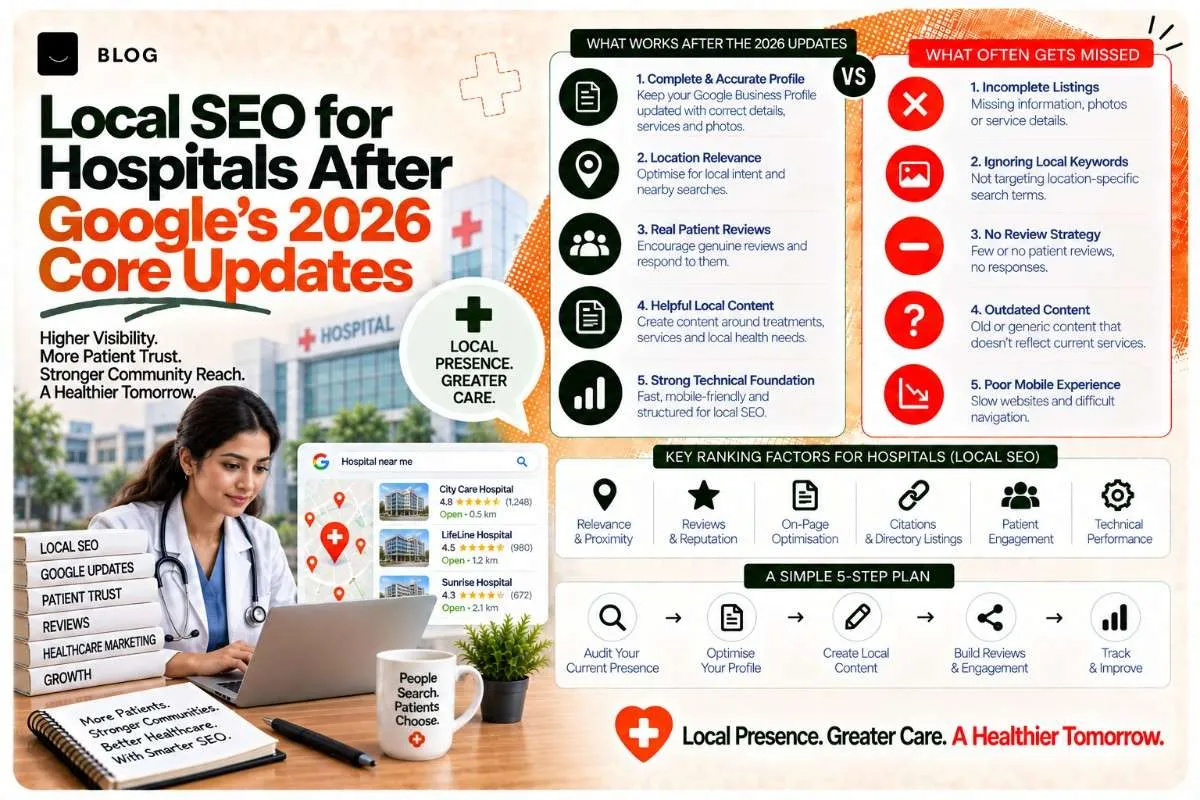
Local SEO for Hospitals After Google's 2026 Core Updates
Hospitals and multi-practitioner healthcare institutions are affected by Google's core updates differently from single-practitioner clinics, because they sit at a different scale — many departments, many practitioners, many location pages, each needing the same E-E-A-T and accuracy standards a solo clinic applies to one page. This post covers what to actually check and fix, in a diagnosis-first order, rather than reacting to an update with guesswork.
A note on verification, before anything else
VERIFY: This post discusses specific named Google core updates and their effects. Every specific claim below about what changed must be verified against Google's own official documentation and credible independent reporting before this post is published. Do not publish assumed or invented detail about what a specific update targeted or changed — this is exactly the kind of factual precision this library commits to, and getting it wrong here would be a direct contradiction of that standard.
Where this draft describes update effects in general terms rather than specific confirmed detail, that is deliberate pending verification — replace general language with specific, sourced detail once confirmed, not before.
This post also touches healthcare, so the standard compliance note applies: this is not a substitute for verifying current NMC guidance, and institutional content at hospital scale should be reviewed by whoever holds compliance responsibility across the institution, not assumed safe because individual practitioner content was already checked.
Why hospitals specifically are affected differently from clinics
The single-practitioner guidance covered elsewhere in this library — complete Google Business Profile, accurate hours, named credentialed authorship — still applies. What changes at hospital scale is the surface area.
A hospital does not have one profile to get right; it may have one for the institution and separate ones for departments or specific practitioners, each needing the same completeness. It does not have one bio to write; it may have dozens of practitioner bios, each needing the same credentialing rigor. It does not have one FAQ page; it likely needs one per department, each addressing genuinely different questions.
Core updates that reward completeness, accuracy and credentialed authorship therefore tend to expose inconsistency at hospital scale more visibly than at clinic scale, simply because there is more surface area for inconsistency to hide in.
What core updates generally target, and why healthcare is often hit harder
VERIFY: This section requires the specific factual detail described above before publishing. In general terms, pending verification: Google's core updates broadly reassess how content demonstrates expertise, authoritativeness and trustworthiness, and healthcare content sits in the high-stakes YMYL (Your Money or Your Life) category that receives particular scrutiny in this assessment, because inaccurate or poorly-sourced health information carries real potential for harm.
This is not a new dynamic specific to any one update — YMYL content has consistently faced a higher bar — but each core update tends to refine how that bar is assessed, which is why hospital and healthcare content specifically often sees more visible movement after an update than lower-stakes categories.
The practical response, not the panic response
First — diagnose before acting
Before changing anything, establish what actually happened. Pull visibility data for the period around the update. Identify which specific pages moved, and in which direction — some pages may have improved while others declined, which is common and instructive. Changing pages that did not move, based on a general sense that "the update hurt us," wastes effort and risks damaging pages that were performing adequately.
Proximity and completeness, revisited
The same profile-completeness work covered throughout this library's local SEO content, but now checked across every department or location profile the institution maintains, not just one. A hospital's main profile can be complete while three department-specific profiles sit half-finished — and those gaps are exactly the kind of inconsistency an update reassessing trust signals is likely to expose.
Department-level and specialist-level pages
Generic "our departments" pages that name a specialty in one line, without genuine depth, are the hospital-scale equivalent of the single-sentence practice-area pages that underperform for individual clinics. Each significant department or specialty deserves real depth — what it treats, who staffs it, what a patient can expect — following the same structural principles covered in this library's other healthcare and practice-area content.
E-E-A-T, at institutional scale
Every practitioner bio, complete and credentialed, consistently formatted across dozens or hundreds of practitioners rather than complete for a handful of senior staff and thin for the rest. This is genuinely more work at hospital scale, and it is also exactly the kind of systematic completeness that a core update reassessing trustworthiness is likely to reward when done, and expose when it is not.
Reviews across a large, multi-practitioner listing
At hospital scale, review volume tends to be high but review management is often inconsistent — some departments actively managed, others ignored entirely. The same reply discipline covered elsewhere in this library, applied consistently across every department rather than concentrated on whichever one someone happens to be paying attention to.
What not to do after an update
- Do not make sweeping changes based on assumption rather than diagnosed data. Identify what actually moved before acting on it.
- Do not chase every theory published about what the update targeted. Much of what circulates after any core update is speculation, some of it from sources with no actual insight into Google's systems. Verified primary guidance and observed data on your own site matter more than secondhand theorising.
- Do not treat update recovery as a one-time project. The underlying work — completeness, accuracy, credentialed authorship, consistency at scale — is ongoing maintenance, not a task that finishes once visibility recovers.
- Do not panic-remove content that was performing adequately because a page elsewhere on the site declined. Diagnose at the page level, not the site level.
A monitoring routine going forward
- Track visibility by page or department, not only site-wide, so future movement can be diagnosed quickly rather than triggering another broad guess.
- Maintain a standing audit cadence for profile and bio completeness across every department, on a schedule, rather than only when a problem is noticed.
- Follow Google's own official communications about future updates directly, rather than relying on secondhand summaries.
- Keep the same freshness discipline covered elsewhere in this library — hospital content, especially department and service descriptions, needs the same periodic review as any other content that can go stale.
Frequently asked questions
Healthcare content sits in the high-stakes YMYL category, which receives particular scrutiny in how core updates reassess expertise, authoritativeness and trustworthiness. Hospitals, with many departments, practitioners and location pages, often see this scrutiny expose inconsistencies in completeness or credentialing that are harder to spot at a smaller clinic's scale.
Diagnose before acting. Pull visibility data for the specific period, identify which pages moved and in which direction, and avoid making sweeping site-wide changes based on assumption. Some pages may have improved while others declined, which is common and provides more useful information than a general sense that the update hurt the site.
Because the same standards — complete profiles, credentialed authorship, accurate department information — apply across many more units. A hospital's main profile can be complete while individual department profiles or dozens of practitioner bios remain inconsistent, and that surface area for inconsistency is larger than at a single clinic.
This depends on the specific institutional structure and platform guidelines for healthcare listings, and should be confirmed directly rather than assumed. Whatever structure is used, each profile or listing needs the same completeness standard applied consistently, since incomplete secondary listings undermine the overall entity picture.
With the same consistent reply discipline recommended for any healthcare provider, applied evenly across every department rather than concentrated on whichever one currently has attention. Uneven review management at hospital scale is a common and visible inconsistency.
No. The underlying work — completeness, accuracy, credentialed authorship and consistency maintained across a large institution — is ongoing, not a project that concludes once visibility recovers. Core updates periodically reassess these same qualities, so lapses that develop after recovery can resurface the same issues.
From Google's own official communications and credible independent reporting, rather than secondhand theories that circulate after any update, many from sources with no genuine insight into the update's actual mechanics. Observed data from the institution's own pages is more reliable than general speculation.
Ready to build what's next?
Tell us where you're headed. We'll come back with a plan to get there.
Book an intro call