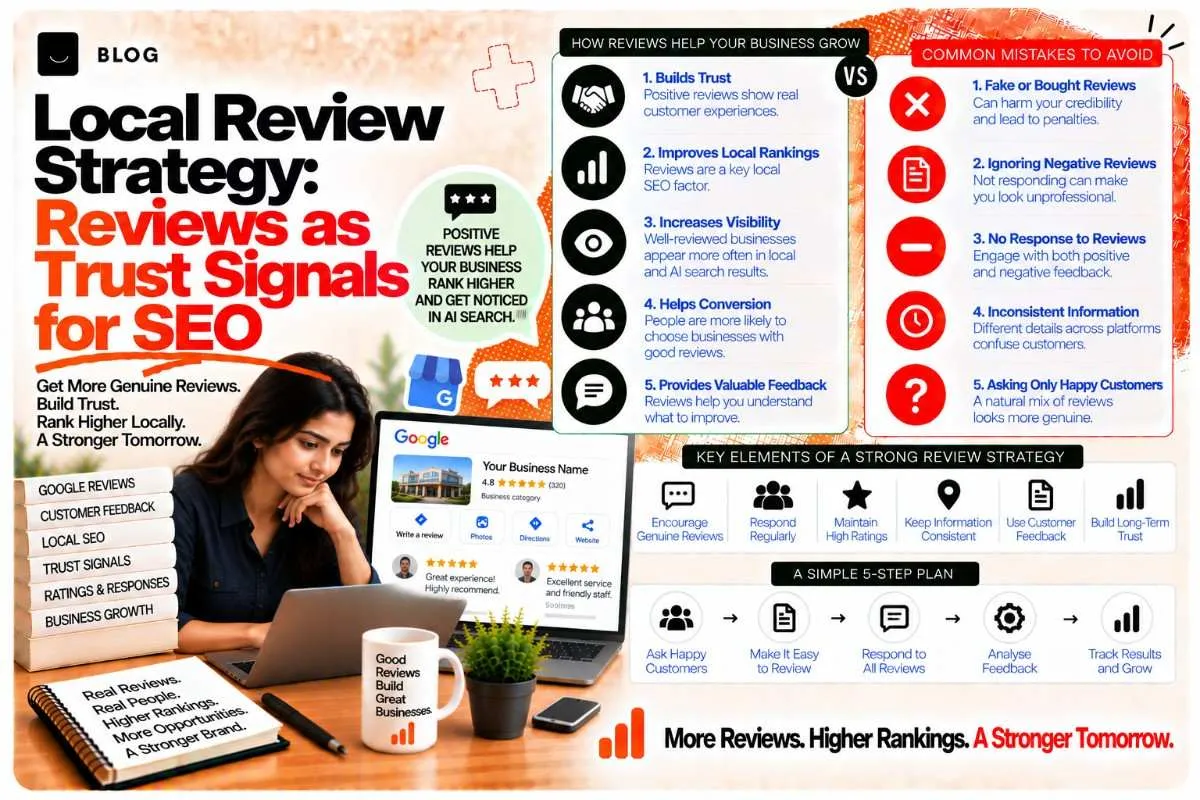
Local Review Strategy: Reviews as Trust Signals for SEO
Reviews aren't just customer feedback. They're a direct ranking signal for local search. A business with 50 reviews, all 4–5 stars, will outrank a competitor with 10 reviews, even if both serve the same market.
But reviews are also a trust signal to AI systems. When ChatGPT, Perplexity, or Google's AI is evaluating whether to recommend a local business, it considers: "How many reviews does this business have? What's the average rating? How recent are the reviews? How does the business respond to feedback?"
A deliberate review strategy — managing velocity, responding to reviews, and monitoring sentiment — directly impacts both local ranking and AI recommendation likelihood.
How reviews signal trust to Google and AI systems
Traditional Google ranking uses reviews as a ranking factor through several mechanisms:
- Review volume — more reviews signal popularity and customer engagement
- Rating score — higher average ratings (4.0–5.0 stars) rank better
- Review recency — recent reviews signal that the business is active; old reviews signal stagnation
- Review velocity — steady flow of reviews (e.g., 2–3 per week) is healthier than bursts followed by silence
- Sentiment analysis — positive language in reviews boosts ranking; negative language hurts
AI systems use these same signals plus one additional layer: response patterns. If a business responds to every review thoughtfully and quickly, AI systems interpret that as: "This business cares about customer feedback and is engaged."
A business that ignores reviews, doesn't respond, or responds defensively signals: "This business doesn't care about customer satisfaction."
The review velocity strategy: maintaining steady growth
Review velocity is the rate at which you accumulate new reviews. A business getting 2–3 reviews per week is healthier than one getting 20 reviews one month, then zero for three months.
Why velocity matters:
- Consistent signal of activity — steady reviews tell Google your business is actively serving customers
- Harder to fake — a sudden spike in reviews looks suspicious to Google's algorithms and can trigger spam flags
- Better for AI signals — AI systems track business activity; steady reviews show ongoing operation
Building a review-request system
To maintain steady review velocity:
1. Automate review requests — after a sale, service, or transaction, send an automated request asking the customer to leave a review. Timing is critical: 1–2 days after the transaction.
2. Multiple request channels — email, SMS, and in-app/in-person requests increase likelihood. Different customers respond to different channels.
3. Make review-leaving easy — provide direct links to review platforms (Google, Trustpilot, industry-specific sites). Don't make customers search for where to leave a review.
4. Incentivize without gaming — offering a discount or entry into a contest for reviews is fine; offering specific payment for 5-star reviews is not (Google flags this).
5. Target volume, not perfection — aim for 2–3 reviews per week. Yes, some will be negative; that's normal and actually improves trust (all 5-star reviews look fake).
6. Expand review surfaces — don't rely only on Google. Ask customers to review on:
- Google Business Profile
- Industry-specific sites (e.g., Trustpilot, Sitejabber)
- Yelp (if applicable)
- LinkedIn (for B2B)
- Your own website
Measuring review velocity
Track your weekly review count:
- Target: 2–3 new reviews per week (for local service businesses)
- Baseline: 1 review per week (minimum healthy rate)
- Red flag: Zero new reviews in a month
Use a spreadsheet or CRM to track:
- Date review was posted
- Platform (Google, Trustpilot, etc.)
- Rating (1–5 stars)
- Sentiment (positive, neutral, negative)
Review response strategy: how and when to respond
Responding to reviews is critical. It signals that you care about feedback and are engaged with your customers. It also directly influences ranking and AI evaluation.
How to respond to positive reviews
Keep positive review responses short (2–3 sentences), genuine, and personalized.
Example:
"Thank you, Sarah! We're glad your experience was great. We always aim to exceed expectations, and your feedback means a lot. We hope to see you again soon!"
Best practices:
- Address the reviewer by name
- Reference something specific they mentioned
- Thank them genuinely
- Invite repeat business or next steps
Avoid:
- Generic copy-paste responses (Google can detect this)
- Over-promotional language ("Buy our premium package!")
- Defensive tone
How to respond to negative reviews
Negative reviews are opportunities to show accountability and problem-solving. Respond carefully:
Example of a good response:
"Hi Raj, thank you for sharing your feedback. We're sorry your experience fell short. The issues you mentioned aren't our standard, and we'd like to make it right. Can you reach out to us at [email/phone] so we can resolve this directly?"
Best practices:
- Apologize for the specific issue mentioned
- Take responsibility (don't blame the customer)
- Offer to resolve it (offline if needed)
- Keep it professional and empathetic
- Respond quickly (within 1–2 days)
Avoid:
- Arguing with the customer
- Making excuses
- Defensive language ("That's not what happened")
- Attacking the customer's credibility
Response timing and conversion
Respond to reviews within 24–48 hours. Quick responses signal engagement and show that you're actively monitoring feedback.
Track your response rate:
- Target: Respond to 100% of reviews (even 1-star ones)
- Baseline: Respond to 80%+ of reviews
- Red flag: Less than 50% response rate
Sentiment analysis: what language signals trust
The sentiment of reviews — not just the star rating — influences ranking and AI evaluation.
Positive review language includes:
- "Professional," "knowledgeable," "friendly"
- "Solved my problem," "exceeded expectations"
- "Highly recommend," "will come back"
- Specific results ("Increased my traffic by 40%")
Negative review language includes:
- "Unprofessional," "unresponsive," "rude"
- "Didn't deliver," "wasted money"
- "Would not recommend," "avoid"
- Specific failures ("Still no results after 3 months")
Google's algorithms analyze review language to weight sentiment. A 4-star review saying "excellent service, very professional" might carry more weight than a 5-star review saying "good" with no detail.
AI systems do similar analysis. A business with reviews praising "expertise," "professionalism," and "results" will be recommended over one with generic 5-star reviews.
To improve sentiment:
- Deliver results that warrant positive language
- Ask specific questions in your follow-up ("Did we solve your problem?")
- Train staff to be responsive and professional (language in reviews reflects actual experience)
- Address negative sentiment by fixing the underlying problems
Managing multi-platform reviews
Local businesses appear on multiple platforms: Google, Yelp, Trustpilot, Facebook, industry-specific directories. Each contributes to your review profile and AI perception.
Priority order:
- Google Business Profile (highest impact) — Google's own reviews system; heavily weighted in local ranking
- Industry-specific platforms (high impact) — Trustpilot for general services, Yelp for restaurants/local, Avvo for legal, Healthgrades for medical, etc.
- Social media (medium impact) — Facebook reviews, LinkedIn recommendations
- Your own website (medium impact) — testimonials and case studies
Strategy:
- Request reviews across all platforms, but prioritize Google and industry-specific sites
- Monitor all platforms regularly (set up Google Alerts for your business name + "review")
- Use a review management tool (Birdeye, Podium, Trustpilot) to centralize monitoring
- Respond to reviews on all platforms within 24–48 hours
The review strategy for different business types
Local service businesses (plumbers, electricians, doctors, lawyers):
- Target: 2–3 reviews per week
- Priority platforms: Google, Yelp, industry-specific
- Emphasis: Professional credentials, problem-solving
E-commerce and product businesses:
- Target: 5+ reviews per week
- Priority platforms: Google, Amazon, Trustpilot
- Emphasis: Product quality, shipping experience, customer service
SaaS and service agencies (like Digital4Local):
- Target: 1–2 reviews per week
- Priority platforms: Google, G2/Capterra (for SaaS), industry-specific
- Emphasis: ROI, implementation support, results
Restaurants and hospitality:
- Target: 3–5 reviews per week
- Priority platforms: Google, Yelp, TripAdvisor
- Emphasis: Food quality, atmosphere, service
Common review strategy mistakes
Don't ignore negative reviews.
Negative reviews are opportunities. A business that responds thoughtfully to criticism looks more credible than one with all 5-stars. Google and AI systems both recognize this.
Don't ask for only 5-star reviews.
Asking customers to leave reviews is fine. Asking them specifically to "leave a 5-star review" is against Google's policies and can get your reviews filtered.
Don't rely on a single platform.
If all your reviews are on Google, you're vulnerable to algorithmic changes. Diversify across Google, industry-specific, and other platforms.
Don't respond defensively to criticism.
If a customer leaves a 1-star review, respond professionally and helpfully, not defensively. This shapes how potential customers perceive your brand.
Don't let reviews stagnate.
If your most recent review is 6 months old, your business looks inactive. Maintain consistent velocity.
Frequently asked questions
There's no magic number, but competitively, you should aim for at least 20–30 reviews before expecting strong local visibility. Once you have 50+, you're competitive in most markets. For AI visibility, aim for 50+ with a 4.5+ average rating.
Indirectly. While Google primarily uses Google reviews for local ranking, reviews on other platforms signal overall reputation and feed into AI evaluation. A business strong on all platforms outranks one strong only on Google.
Google updates rankings regularly, but noticeably improved ranking typically takes 2–4 weeks after a surge in positive reviews.
Yes, if possible. Responding to 100% signals engagement and trust. If you can't respond to every review, at least respond to all 1-star and 2-star reviews.
Only if they're fake, off-topic, or violate platform rules. You can't delete reviews just because they're negative. Reporting them only works if they truly violate guidelines.
Report them to the platform (Google, Yelp, etc.). Provide evidence that the review is fake (e.g., the reviewer never made a purchase). Most platforms remove clearly fake reviews within 1–2 weeks.
Ready to build what's next?
Tell us where you're headed. We'll come back with a plan to get there.
Book an intro call