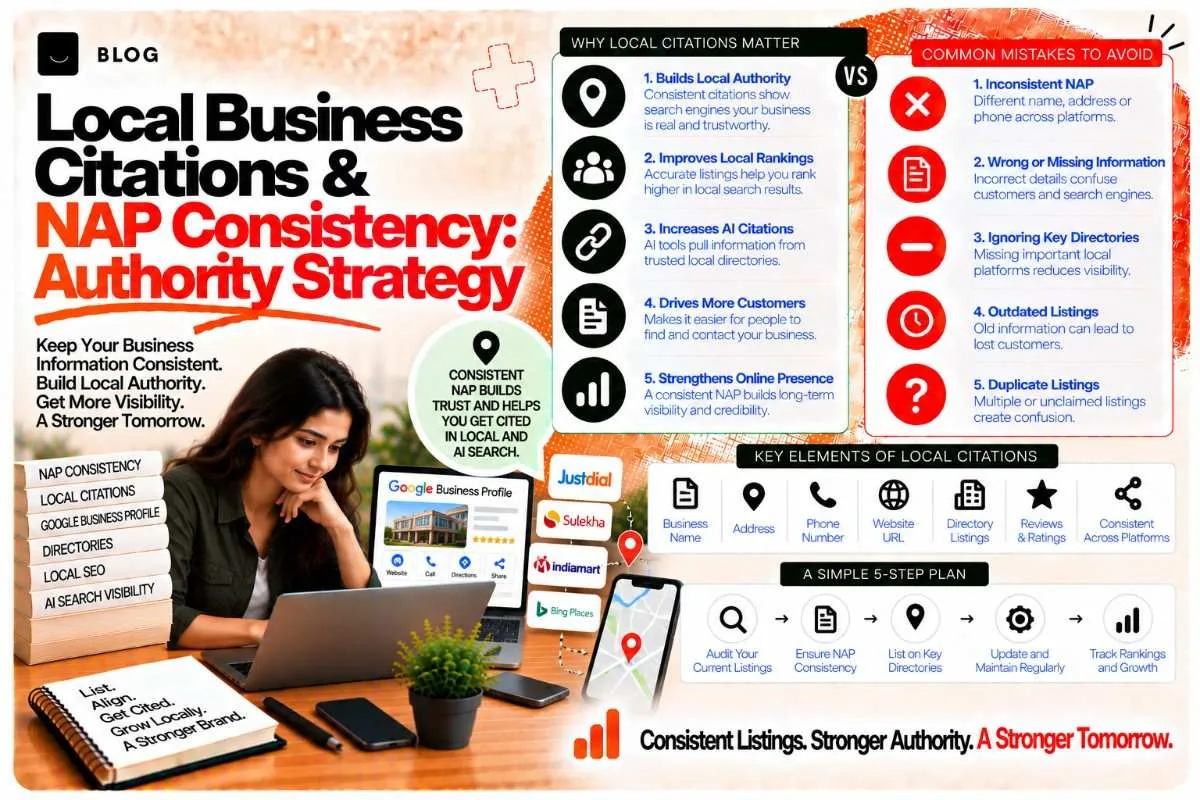
Local Business Citations & NAP Consistency: Authority Strategy
A "citation" in local SEO isn't a reference or mention. It's a business listing — your business name, address, and phone number (NAP) published on a directory, review platform, or aggregator.
Citations are incredibly valuable for local ranking and AI visibility. They serve as proof that your business exists, is legitimate, and is trusted. The more authoritative directories that list your business with consistent information, the higher your local authority signals.
But citations only work if they're correct and consistent. A business listed as "Digital4Local" on Google, "Digital 4 Local" on Yelp, and "D4L" on another directory looks confused, not authoritative.
This guide covers how to build citations strategically, maintain NAP consistency, and use citation velocity to improve local ranking and AI recommendation.
How citations signal authority to Google and AI systems
Citations work at two levels:
For Google local ranking:
- Trust and legitimacy — a business listed on many authoritative directories looks more legitimate
- Location signals — citations confirm your business location and service area
- Name consistency — consistent NAP across citations tells Google your business info is reliable
- Citation velocity — steady citation building signals ongoing business legitimacy (not a one-off)
For AI systems:
- Existence verification — AI systems check whether a business is listed in authoritative directories
- Credibility check — if a business is listed in multiple high-authority directories, AI systems trust it more
- Service area confirmation — citations help AI systems understand where you operate
- Recency — recent citations signal that the business is active; old citations signal abandonment
A business listed in 50 authoritative directories with consistent NAP will be recommended by AI systems over a business with 5 citations or inconsistent information.
NAP consistency: why it matters and how to audit
NAP = Name, Address, Phone. NAP consistency means your business information is identical across all directories and platforms.
Why NAP consistency matters:
When you have inconsistencies:
- "Digital4Local" vs. "Digital 4 Local" (name spelling)
- "123 Main St" vs. "123 Main Street" (address format)
- "+91-755-123-4567" vs. "07551234567" (phone format)
Google and AI systems see these as different businesses. Each variation dilutes your authority signals and confuses your profile. Consistency tells them: "This is the same business, confirmed across multiple sources."
How to audit NAP consistency:
1. List all your current citations — Google Business Profile, Yelp, Trustpilot, industry-specific directories, local listings, social media
2. Document your canonical NAP — decide on one official version:
- Business name (exactly as it appears on legal documents)
- Full address (street, city, postal code, country)
- Primary phone number (decide on format: +91-755-123-4567 or 075 5123 4567)
3. Audit each listing — go through each citation and check:
- Is the name exactly consistent?
- Is the address format the same?
- Is the phone number format the same?
- Are there outdated addresses or old phone numbers?
4. Correct inconsistencies — update each listing to match your canonical NAP
5. Monitor going forward — set quarterly reminders to re-audit your top citations
Common NAP inconsistencies to fix:
- "Suite 100" vs. "Suite #100" vs. "#100"
- "Street" vs. "St" vs. "St."
- "India" vs. leaving country blank
- Using secondary phone numbers or extensions as the primary number
Citation building strategy: where to focus
Not all directories are equal. Focus your effort on high-authority, relevant directories that Google and AI systems recognize.
Tier 1: Essential directories (start here)
Google Business Profile (critical)
- Most important for local ranking and AI visibility
- Free; non-negotiable
Apple Maps (high value)
- Used by Siri and Apple devices; AI systems track it
- Free; verify accuracy
Local directory networks (high value for your region)
- Yelp (for restaurants, service businesses, e-commerce)
- Trustpilot (for service providers and SaaS)
- Industry-specific: Avvo (legal), Healthgrades (medical), Houzz (home services)
- Regional: Sulekha (India), DMOZ-alternatives
Tier 2: High-authority directories (secondary focus)
- Better Business Bureau (BBB)
- Local Chamber of Commerce
- LinkedIn Company Page
- Local/regional business directories
- Industry associations and directories
Tier 3: Supplementary citations (lower priority, but useful)
- Social media profiles (Facebook, Instagram, TikTok)
- Amazon (if e-commerce)
- Aggregators and review sites relevant to your industry
- Local news or chamber websites
Citation building strategy:
- Tier 1 first — ensure perfect NAP on all Tier 1 directories
- Tier 2 next — expand to industry-relevant and high-authority directories
- Tier 3 last — fill in supplementary citations as time allows
- Maintain quarterly — re-audit at least every 3 months
Citation velocity and timing
Citation velocity is the rate at which you accumulate new citations. Like review velocity, consistent citation growth signals business legitimacy.
Healthy citation velocity:
- Target: 2–5 new citations per month
- Baseline: 1 new citation per month
- Red flag: No new citations in 3 months
Why timing matters:
- Consistent growth — spreading citations over time looks more natural than a sudden spike
- Ongoing legitimacy — new citations signal that your business is actively maintaining presence
- Algorithmic trust — Google and AI systems recognize sporadic citation spikes as potentially artificial
Citation building timeline:
- Month 1–2: Build Tier 1 citations (Google, Yelp, industry-specific)
- Month 2–4: Build Tier 2 citations (BBB, directories, associations)
- Month 4+: Maintain and expand Tier 3, monitor for accuracy
Common citation mistakes to avoid
Don't let citations go stale.
If your address, phone, or business name changes, update every citation. Old listings hurt authority.
Don't submit to low-quality directories.
A citation on a spammy directory can hurt your profile more than it helps. Focus on high-authority directories.
Don't rely on automated citation services alone.
Some services auto-submit your business to hundreds of directories. This can introduce inconsistencies and get you listed in low-quality directories. Manage citations manually when possible; use services only as a supplement.
Don't use secondary phone numbers or extensions as your primary number.
Use your main business number on all citations. Don't list department numbers or individual extensions as your primary NAP.
Don't ignore citations outside your region.
If you list on Google.com and Google.co.uk with different addresses, you're confusing the algorithm. Decide which markets you serve and be consistent.
Don't submit to irrelevant directories.
Getting listed as a "legal services provider" when you're a web designer dilutes your authority. Submit only to relevant directories.
Citation tools and services
Manual submission (best practice):
- Visit each directory's submission page
- Verify exact NAP before submitting
- Save submission confirmations and login credentials
Citation management tools:
- Yext (comprehensive but expensive; manages 1000+ directories)
- BrightLocal (affordable; includes audit and monitoring)
- SEMrush Local (SEO-focused; includes citations)
- Moz Local (built for local businesses; citation tracker)
- Birdeye (focused on reviews and citations)
Bulk submission services:
- LocalServiceAds (Google's own)
- Directory submission services (use with caution; verify quality)
Measuring citation impact
Track:
- Total citations — count how many directories list you
- Authority of citations — track citations on high-authority directories vs. low-authority ones
- Citation consistency — audit quarterly to find NAP discrepancies
- Local ranking — monitor your ranking for local keywords in Google Search Console
- Local traffic — track local/regional traffic in Google Analytics
- AI recommendation — test whether you appear in AI system recommendations for local queries
How to know if your citation strategy is working:
- Your local rankings improve
- Local website traffic increases
- You appear in AI system recommendations for your service area
- Review requests increase (more visibility = more potential customers)
Frequently asked questions
There's no magic number, but competitively, aim for at least 20–30 citations on high-authority directories. For strong local visibility, 50+ citations across multiple tiers is more competitive.
Yes. Significant inconsistencies (especially on high-authority directories) can hurt your local ranking. Even minor inconsistencies (street vs. st.) can confuse Google's algorithms.
Yes, consistently. If your address is "123 Main St Suite 100," include "Suite 100" on all citations in the same format.
No. Use your single primary business phone number across all citations. If you have a local number and a toll-free number, pick one for citations; use the other as secondary contact info when possible.
New citations typically show ranking impact within 1–3 months. Major citation cleanup (fixing consistency issues) can take 2–4 weeks to show results as Google re-crawls and re-evaluates.
Yes. Citations signal authority even without a clickable link. A reference to your NAP on an authoritative directory helps, even if readers can't click through to your site.
Ready to build what's next?
Tell us where you're headed. We'll come back with a plan to get there.
Book an intro call