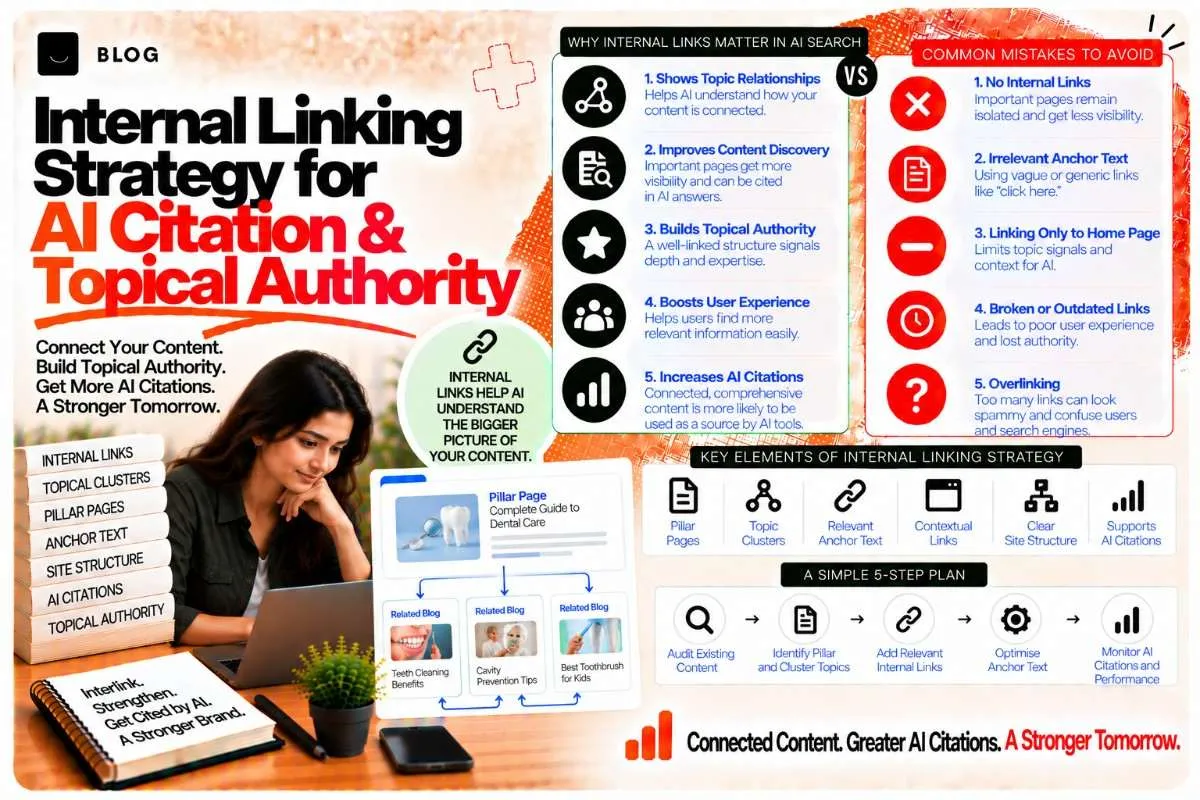
Internal Linking Strategy for AI Citation & Topical Authority
Internal linking has two jobs: help users navigate your site, and tell search engines how your content relates.
For AI systems, internal linking is even more critical. When an AI system crawls your site, internal links are how it understands:
- "What is this content about?"
- "How does this relate to other content?"
- "What topics is this site authoritative on?"
Strategic internal linking can increase your AI citation likelihood significantly. Poor internal linking (or no linking) can bury valuable content where AI systems can't find it or understand its significance.
This guide covers how to structure internal links for AI understanding and topical authority.
How AI systems use internal links to understand content
AI systems follow internal links to:
1. Map content relationships
When an AI system sees Link A → Link B, it understands that A and B are related. If Link A is "Entity SEO" and Link B is "NAP Consistency," the system concludes: "NAP Consistency is part of Entity SEO."
2. Identify topical authority
When a site has 20 posts all linking to and from a central "Entity SEO" post, the system concludes: "This site is authoritative on Entity SEO."
3. Establish hierarchy
When a post links to 10 related posts, the system understands: "This is a central hub; those are satellite topics."
4. Determine importance
When many posts link to one post, the system concludes: "This post is important in this topic area."
Strategic anchor text for AI understanding
Anchor text is the linked text in a link. Example: "Learn more about Entity SEO" — "Entity SEO" is the anchor text.
AI systems use anchor text to understand what the linked page is about.
Good anchor text:
- Descriptive — tells you what the linked page covers
- Relevant — directly related to the linked content
- Natural — sounds like human writing, not keyword stuffing
- Variety — not always the same phrase
Good anchor text examples:
- "Learn how to implement Entity SEO"
- "NAP consistency is a key part of Entity SEO"
- "Read our Entity SEO Playbook for comprehensive guidance"
- "The Entity SEO strategy includes multiple components"
Bad anchor text:
- Generic: "Click here," "Read more," "More info"
- Keyword-stuffed: "Best cheap entity SEO services in Bhopal SEO strategy"
- Misleading: Anchor text doesn't match linked content
- Over-linked: Every third word is a link
Anchor text distribution for topical authority
Use a mix of anchor text types:
| Type | Example | Percentage |
|---|---|---|
| Exact keyword | "Entity SEO" | 10–20% |
| Partial keyword | "Entity SEO strategy" | 20–30% |
| LSI/related | "Business identity optimization" | 20–30% |
| Branded | "Digital4Local's Entity SEO guide" | 10–15% |
| Generic | "Learn more," "Additional resource" | 20–30% |
This distribution signals natural linking. 50% exact-match anchors looks artificial; 10–20% looks natural.
Linking patterns for topical authority
Pattern 1: Hub-and-spoke (pillar-cluster)
Structure:
- Hub post: "Complete Entity SEO Guide"
- Spoke posts: "NAP Consistency," "Author Credentials," "Schema Markup," etc.
- Spokes link back to hub
- Spokes link to each other (when relevant)
What AI systems understand:
"This site has a comprehensive Entity SEO guide with 8 related subtopics. This is a topical hub."
Pattern 2: Hierarchical linking
Structure:
Level 1 (Hub): Entity SEO ↓ Level 2 (Clusters): NAP Consistency, Author Credentials, Schema Markup ↓ Level 3 (Detail): Specific tactics, tools, examples
Each level links to parent and siblings.
What AI systems understand:
"This site has deep, hierarchical coverage of Entity SEO. Each level builds on the previous."
Pattern 3: Topic cluster linking
Structure:
All posts in a cluster link to:
- The pillar/hub post (first 100 words)
- 2–3 other relevant cluster posts
- NO links outside the cluster (keeps authority within)
What AI systems understand:
"This cluster is tightly related. The site has deep expertise in this topic area."
Pattern 4: Bidirectional linking
Structure:
- Post A links to Post B with anchor "Read about [Topic B]"
- Post B links back to Post A with anchor "Part of [Topic A]"
What AI systems understand:
"These posts have a two-way relationship. Topic A and Topic B are interconnected."
Internal linking best practices for AI
1. Link contextually, not for SEO
Links should serve readers first. A link in the middle of a sentence is better than a link at the end of a post.
Good:
"As explained in our Entity SEO guide, NAP consistency means…"
Bad:
"You can also learn about Entity SEO. Learn more."
2. Link to the most relevant page, not the most authoritative page
If you're explaining "NAP consistency," link to your NAP consistency guide, not your Entity SEO hub. Relevance > authority for AI.
3. Limit internal links per post (3–5 outbound)
Each link dilutes the value of the others. Too many links (10+) confuse readers and AI systems. Quality > quantity.
4. Use keyword-rich anchor text, but keep it natural
You can and should use keywords in anchor text, but it must sound natural.
Good: "Our Entity SEO Playbook covers all aspects…"
Bad: "Our Entity SEO for local business optimization guide…"
5. Link to supporting content, not competing content
Link to content that supports the current post's argument, not content that answers the same question differently.
6. Update internal links when you update posts
If you update a post and change its focus, check what links to it. Anchor text might no longer match.
7. Link from high-authority pages to new pages
New content gets crawled faster if linked from established, high-traffic pages.
Internal linking audit checklist
- Orphaned content — Are any important posts not linked from anywhere? (Fix by adding links)
- Overlinked posts — Do any posts have 10+ outbound links? (Trim to 3–5 most relevant)
- Anchor text variety — Is anchor text diverse, or repetitive? (Mix up anchor types)
- Broken links — Are there any dead links? (Fix or remove)
- Topical cohesion — Do links within a topic cluster support each other? (Add reciprocal links where relevant)
- Link relevance — Do anchor texts match the linked content? (Update mismatch)
- New content coverage — Are new pages linked from relevant existing posts? (Add links if missing)
Frequently asked questions
3–5 outbound links is ideal. This is enough to show relationships without overwhelming readers or diluting link value.
All internal links should be dofollow by default. Nofollow is only for untrusted content (user comments, affiliate links). Never use nofollow on internal links.
Relevance > keywords. A natural, relevant anchor text that uses keywords is best. A keyword-stuffed anchor that doesn't match the content hurts.
2–4 weeks for AI systems to recrawl and re-evaluate. Improvements in AI citation usually appear within a month of linking changes.
Yes, but do it naturally. If you mention your content, link to it. But don't force links just for SEO. Natural context is key.
Similar impact. Good internal linking helps both Google ranking and AI citation. It's not one or the other.
Ready to build what's next?
Tell us where you're headed. We'll come back with a plan to get there.
Book an intro call