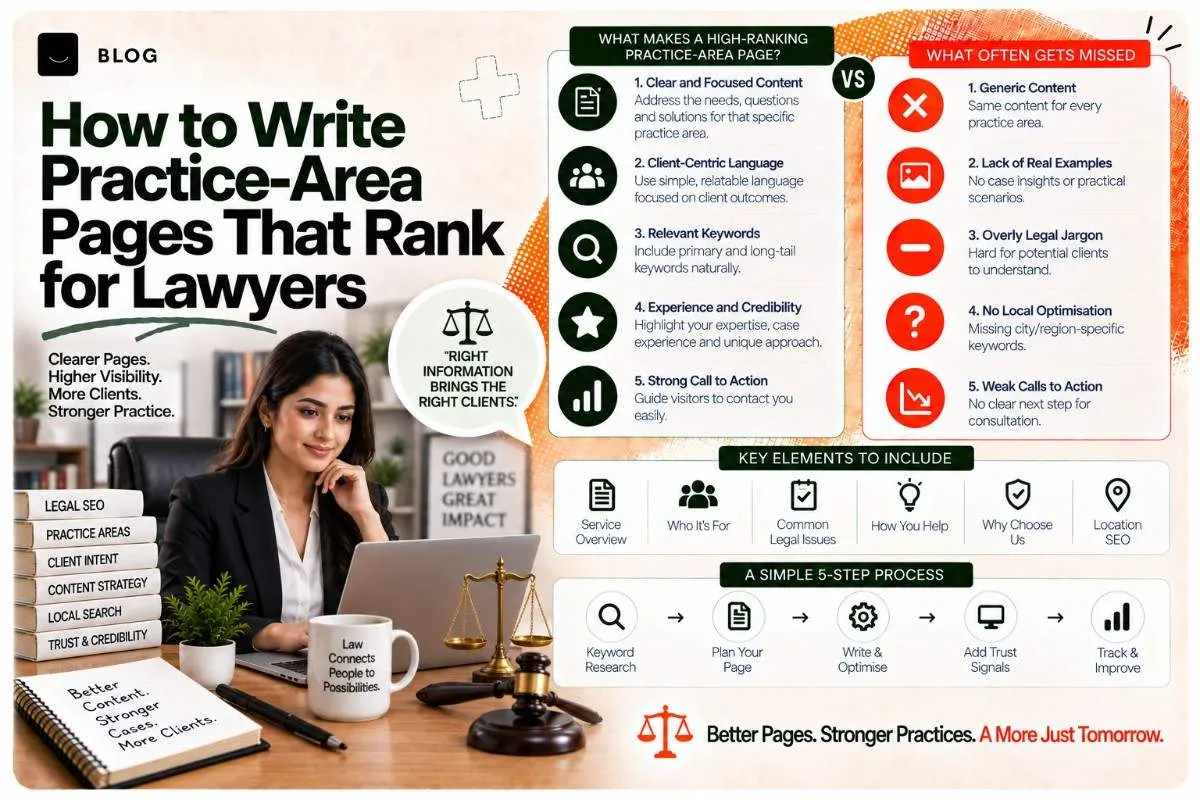
How to Write Practice-Area Pages That Rank for Lawyers
A practice-area page that ranks and gets cited by AI answer engines does one specific job: it explains, generally and informationally, what an area of law covers and how a matter in that area typically proceeds — without soliciting, without comparing, and without any claim about outcomes. Most law firm websites either skip this content entirely or write it so thin it satisfies neither a search engine nor a reader. This post covers the structure that does both, inside the constraints that apply to legal advertising.
A note on scope, and on Bar Council rules
Advocates in India are subject to Bar Council of India rules that restrict advertising and solicitation, historically among the strictest professional conduct frameworks covered anywhere in this library. This post describes a content structure built around informational, non-solicitous practice-area explanation — it does not summarise the full advertising rules, and it should not be read as doing so.
VERIFY: This post requires compliance verification before publishing, more so than most in this library given the strictness of the applicable rules. Confirm the informational framing below against current Bar Council of India guidance, and strongly consider review by a lawyer familiar with advocate advertising rules specifically, not general marketing compliance.
The structure below is built to stay on the informational side of that line throughout — no superlatives, no outcome claims, no comparison, no direct solicitation. Where a firm's own reading of current rules is more conservative than this structure, the firm's reading governs.
Why most law firm practice pages fail
Two failure patterns, in opposite directions.
Too thin to be useful or to rank. A single sentence — "We handle property disputes" — under a practice area heading. Nothing for a reader to learn, nothing specific for a search engine or AI system to extract, and no differentiation from any other firm's identical one-line page.
Written as advertising rather than information, which in most professional contexts is a marketing weakness and in the legal context specifically risks crossing into territory the applicable rules restrict. Comparative claims, success rate statistics, and persuasive language belong to a different register than what a practice-area page in this profession can safely contain.
The structure below threads between these — substantive enough to be genuinely useful and to rank, informational enough to stay clearly on the safe side of the applicable rules.
The structure that works, section by section
The direct-answer opening
A 50-70 word paragraph stating plainly what the practice area covers — the category of legal matter, in plain language, without any claim about the firm's success in it. This is both the AEO-relevant opening (the part most likely to be extracted for a snippet or an AI answer) and the section requiring the most compliance care, since it sets the tone for everything that follows.
What the practice area actually covers
The genuine scope of the practice area — the types of matters it includes, in specific, informational language. Not "we handle all property matters" but a real list: title disputes, partition suits, tenancy matters, whatever genuinely falls within the practice area, described factually.
The process, explained plainly
What generally happens in a matter of this type — the typical stages, roughly how long different stages might take, what documentation is typically needed. General and educational, never a specific prediction about how a reader's own matter would proceed, since that constitutes advice requiring an actual consultation.
What clients typically ask, answered generally
A short FAQ addressing the genuinely common questions in this practice area — general and informational, explicitly not individual legal advice, with a clear statement to that effect. This is exactly the content that both AEO and GEO reward, and exactly the content most law firm sites are missing entirely.
When to actually contact a lawyer
A brief, honest closing section on when a matter of this type genuinely warrants legal consultation — informational rather than a solicitation to hire this specific firm, framed around helping the reader recognise their own situation rather than persuading them.
One page per practice area, not one page for all of them
A single "Our Practice Areas" page listing ten specialisations in one paragraph each satisfies neither a search engine nor an AI system looking for depth on any one of them. Each genuine practice area deserves its own page, built to the structure above, specific enough to be useful on that one topic.
This mirrors the same architectural point made throughout this library about service pages generally: depth on one topic beats breadth across many thin ones, for search visibility and for AI citation alike.
Where E-E-A-T signals belong on the page
- A named, credentialed author or reviewing advocate for the page — bar enrolment, years of practice, relevant experience in this specific area
- General experience described factually — years handling this category of matter, general volume where that can be stated informationally rather than as a claim of success
- No case results, no numbers claiming a success rate, both for the compliance reasons above and because such figures are rarely verifiable by a reader in any event
Named, credentialed authorship is one of the strongest E-E-A-T signals available anywhere in this library, and it is also one of the safest from a compliance perspective — a stated credential is a verifiable fact, not a promotional claim.
What never belongs on a practice-area page
- Comparative claims — "the best," "leading," any comparison to other firms or advocates
- Success rate statistics or outcome guarantees of any kind
- Direct solicitation language — urging a specific reader to hire this specific firm rather than informing them generally
- Client testimonials about case outcomes, which sit in territory that should be checked carefully against current rules before use, if used at all
- Anything presented as legal advice for a reader's specific situation rather than general information
How this content earns AI citation, not just rankings
Legal questions are exactly the category where AI answer engines are most cautious about sources, because the stakes of a wrong or misleading answer are high. That caution favours precisely the kind of content this structure produces: credentialed authorship, careful factual framing, explicit statements of limitation, and no promotional overreach.
This connects directly to the argument made throughout this library's regulated-industry content: the constraints that make legal content slow to produce are the same constraints that make it more trustworthy — to a careful reader and to an AI system assessing which source to cite — than promotional content from a less careful publisher.
A short worked example
For a "Property Dispute Resolution" practice area:
Opening (50-70 words): states plainly that property disputes cover title conflicts, partition matters, tenancy disputes and related issues, and that resolution typically involves negotiation, mediation or litigation depending on the specific matter.
Coverage section: lists the specific categories of property dispute genuinely handled.
Process section: explains, generally, the typical stages a property dispute might move through — initial assessment, attempted resolution, and litigation if necessary — without predicting how any specific matter would unfold.
FAQ: answers genuinely common general questions — "how long does a property dispute typically take," "what documents are typically needed" — each with a clear general-information framing.
Closing: a brief, informational note on when this type of matter typically warrants consulting an advocate, without direct solicitation.
Frequently asked questions
Yes, within the constraints of Bar Council of India rules on advertising and solicitation. Informational content explaining what a practice area covers, how matters in that area typically proceed, and general answers to common questions can be published while staying clearly on the informational side of those rules, avoiding comparative claims, outcome statistics and direct solicitation.
Most are either too thin to be useful — a single generic sentence — or written in a promotional register that both underperforms for search and AI citation and risks crossing into territory restricted by advocate advertising rules. Genuinely informational, specific, well-structured content performs better on both counts.
One page per genuine practice area, built with real depth on that specific topic. A single page listing multiple practice areas in a sentence each satisfies neither search engines looking for topical depth nor AI systems looking for specific, extractable information on any one practice area.
Comparative claims about being better than other firms, success rate statistics or outcome guarantees, direct solicitation urging a specific reader to hire the firm, and anything presented as advice for a reader's specific situation rather than general information. Client testimonials about case outcomes also require careful checking against current rules.
A named advocate with stated bar enrolment and relevant experience is one of the strongest trust signals available, both for readers and for AI systems assessing which sources to cite on high-stakes legal questions. It is also one of the safest signals from a compliance perspective, since a stated credential is a verifiable fact rather than a promotional claim.
Legal questions carry high stakes if an answer is wrong or misleading, so answer engines tend to favour sources that demonstrate credentialed authorship, careful factual framing and explicit statements of limitation over sources that appear promotional or overreaching. This favours exactly the kind of restrained, informational content that advocate advertising rules already require.
Genuinely common general questions about the practice area — typical process, typical timeline, what documentation is typically needed — answered informationally with a clear statement that this is general information rather than advice for the reader's specific situation, which would require an actual consultation.
Ready to build what's next?
Tell us where you're headed. We'll come back with a plan to get there.
Book an intro call