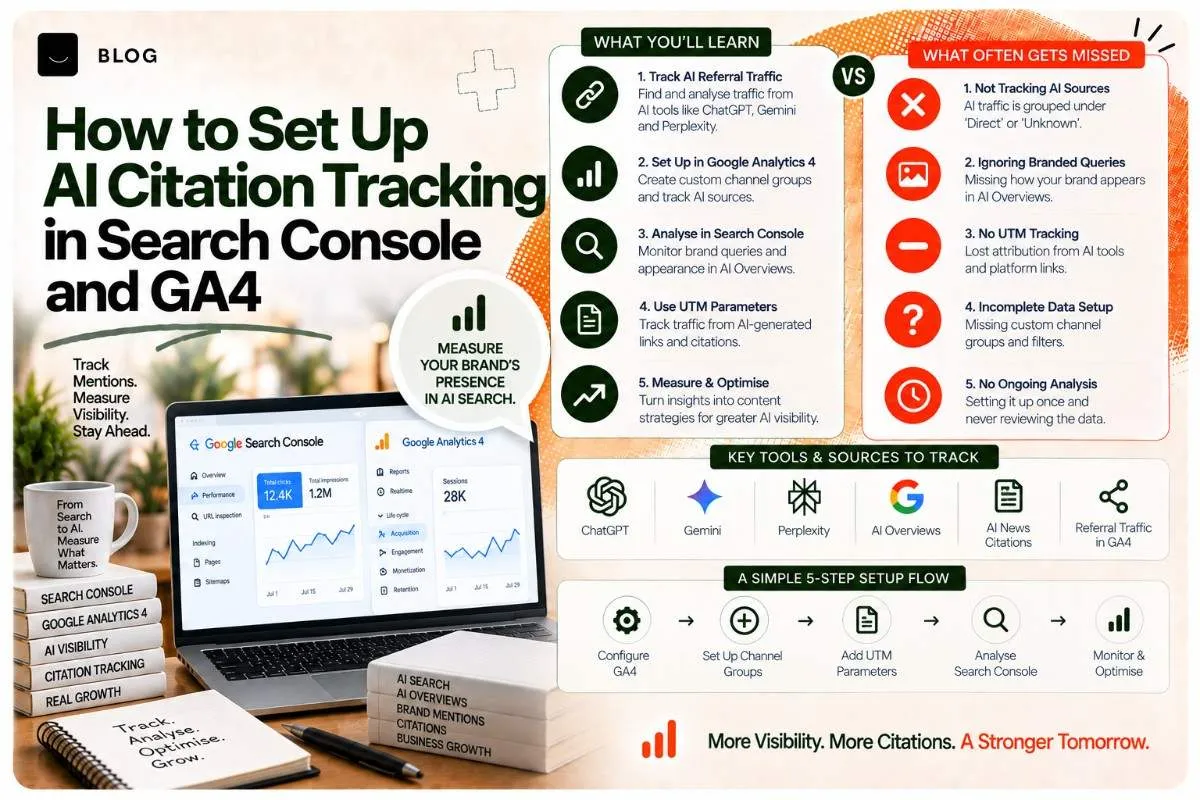
How to Set Up AI Citation Tracking in Search Console and GA4
Neither Search Console nor GA4 has a dedicated "AI citations" metric, and no combination of settings creates one. What they can do, set up correctly, is show branded search lift as a proxy for zero-click AI exposure, and segment referral traffic arriving from AI platforms. This is the setup guide for both, plus the manual tracking layer that has to sit alongside them because the tools alone do not answer the question.
Set expectations before you set up anything
This needs saying plainly before any configuration steps, because it is the most commonly misunderstood part of GEO measurement.
Search Console does not show whether your content appeared in an AI Overview or was cited by ChatGPT. No official reporting surface for that exists in Search Console today. GA4 does not have a built-in "AI traffic" category. What it can do is segment referral traffic from known AI platform domains, when a visitor actually clicks through — which a meaningful share of AI-answer exposure never produces, because the whole point of an AI answer is that the user often does not need to click anywhere.
Both tools are useful for what they measure. Neither measures citation directly. Setting them up correctly means using them for what they are good at — proxies and referral segments — and pairing that with the manual tracking that is currently the only direct way to know whether AI systems mention a brand.
Part 1 — Search Console: branded search as a proxy
The theory: if AI answer engines are citing a brand more often, awareness rises, and people search for the brand by name more often — even when they never clicked through from wherever they heard about it. Branded search volume, tracked over time, is a reasonable proxy for that kind of zero-click exposure.
Setup:
- In Search Console, go to Performance → Search results.
- Filter Queries to isolate branded terms — the business name and close variants. A saved filter or a regex match covering common misspellings works well here.
- Set the date range to at least six months, ideally a year, so a real trend is visible against normal fluctuation.
- Track total branded impressions and clicks separately. Impressions rising while clicks stay flat or fall — a widening gap between the two — is the zero-click signal worth watching.
- Save this as a recurring monthly export or a saved report you check on the same day each month, not an ad-hoc check.
What this tells you: direction, over months. A steady rise in branded impressions with a flattening or falling click-through rate is consistent with people encountering the brand somewhere zero-click — which includes but is not limited to AI answers; it also includes voice assistants, social mentions and plenty else.
What this does not tell you: which AI platform, which query, or whether any specific piece of content was the source. It is a directional signal, not an attribution tool.
Part 2 — GA4: segmenting AI referral traffic
VERIFY: GA4's interface, event names and default channel groupings change, and Google periodically adjusts how referral traffic is categorised. Confirm the exact navigation path below against the current GA4 interface before publishing — the underlying approach (segmenting by referral source domain) is stable; the specific menu path is not guaranteed to be.
Setup:
- In GA4, go to Reports → Acquisition → Traffic acquisition.
- Add a filter or build a custom segment for Session source containing known AI platform domains — chatgpt.com, perplexity.ai, gemini.google.com, and any others relevant to your audience.
- Because AI referral traffic often lands in "Direct" or an unclassified bucket rather than being recognised automatically, build this as an explicit segment rather than trusting default channel grouping to catch it.
- Create a saved exploration or a custom report combining this segment with conversion events, so referral volume and downstream action sit in the same view.
- Compare this segment's behaviour against your organic search traffic — session duration, pages per session, conversion rate. AI referral traffic often shows different engagement patterns, and that comparison is frequently more informative than the raw volume.
What this tells you: actual visits that arrived via a click from an AI platform, and what those visitors did once they landed. This is real data, not a proxy — but it only captures clicks, and a click is the minority outcome of an AI answer, not the majority one.
What this does not tell you: anything about the exposure that did not result in a click. A brand mentioned in an AI answer that the reader found sufficient, with no click at all, leaves no trace here whatsoever. This is why Part 2 alone understates AI impact, sometimes substantially.
Part 3 — the manual layer neither tool replaces
This is not optional, and it is not a lesser method standing in until better tooling arrives. It is currently the only direct way to answer "am I being cited," because neither Search Console nor GA4 can answer that question at all.
- Build a fixed list of ten to twenty prompts a real customer would plausibly ask — specific, not generic.
- Run every prompt across ChatGPT, Perplexity and Google's AI surfaces, on a fixed schedule — monthly is realistic for most teams.
- Record, for each prompt and platform: whether the brand was mentioned, what was said, and whether a source was cited.
- Keep this in a simple spreadsheet, same format every month, so month-over-month comparison is possible.
- Cross-reference: when a manual test shows a new citation appearing, check whether Part 1's branded search or Part 2's referral segment moved around the same time. Over several months, this builds a genuine (if informal) sense of which citations actually move the other two numbers.
This manual layer is unglamorous and it is genuinely the current state of the art for this specific question. Any tool claiming to fully automate it should be asked exactly how, and the honest answer today is that full automation of citation tracking is not a solved problem.
Putting it together into one monthly report
A workable structure, reviewed on the same day each month:
- Branded search trend (Search Console) — direction over the past three, six and twelve months
- AI referral segment (GA4) — volume and engagement, compared to organic
- Manual citation results — the current month's prompt-by-prompt findings, compared to last month
- What changed — any content published, updated or fixed since the last report, so movement can be tentatively connected to specific work
Resist the urge to draw a confident causal line between any single piece of content and a movement in any single number. GEO measurement at this stage is directional and cumulative, not attributable action by action — and reporting it with more precision than that actually exists is a worse failure than reporting it honestly as imprecise.
A worked example of what the data can and cannot tell you
Say a business publishes a strong piece of content in March. By June:
- Branded search impressions have risen 20% — consistent with increased visibility, but also consistent with a seasonal pattern, a competitor's ad campaign driving comparison searches, or unrelated word of mouth. The data alone cannot distinguish between these.
- AI referral sessions have doubled from a very small base — real, but if the starting point was five sessions a month, ten is still a small number to draw conclusions from.
- Manual testing shows the brand now appears in 6 of 15 tracked prompts, up from 2 — the most direct evidence of the three, and the one that actually answers the original question.
The honest report combines all three, states the manual result as the primary finding, and treats the other two as supporting directional context rather than proof.
Common mistakes in this setup
- Treating GA4 referral volume as the complete picture. It captures clicks only, and clicks are the minority outcome of AI exposure.
- Checking branded search over a two-week window. Normal fluctuation swamps any real signal at that timeframe; six months is closer to right.
- Skipping the manual layer because it is manual. It is the only part of this setup that directly answers the question everything else is a proxy for.
- Attributing a single number's movement to a single piece of content. Rarely defensible with the data available; state correlation, not causation.
- Setting this up once and never returning to it. The value is in the trend across months, which requires the same measurement, taken the same way, repeated on a schedule.
Frequently asked questions
No. Search Console has no dedicated reporting for AI Overview appearances or AI citations as of current documentation. What it can show is branded search volume over time, which serves as an indirect proxy for zero-click exposure that may include AI answers among other sources — it is not a direct measurement of AI citation.
No. AI referral traffic from platforms like ChatGPT or Perplexity has to be segmented manually, typically by filtering for session source containing known AI platform domains, because default channel grouping often places this traffic in "Direct" or an unclassified bucket rather than identifying it automatically.
Because neither tool captures exposure that does not result in a click, and a meaningful share of AI-answer exposure never produces one — the reader often gets their answer without visiting the source. Manually running a fixed set of prompts across AI platforms and recording whether a brand is mentioned is currently the only direct way to measure citation itself.
Branded search lift is a rise in searches for a business's own name, tracked in Search Console, used as an indirect signal that awareness is increasing — potentially including awareness created by AI-answer exposure. It is a proxy, not proof, since branded search can rise for many reasons unrelated to AI citation.
Monthly is realistic for most teams, using the same fixed set of tracked prompts and the same measurement method each time. Checking branded search trends over periods shorter than several months usually shows normal fluctuation rather than a meaningful signal, so shorter review windows tend to produce misleading conclusions.
Rarely with confidence. GEO measurement at this stage is directional and cumulative rather than precisely attributable — multiple factors typically move at once, and the tools available do not isolate a single cause. Reporting should state what changed and what moved together, without claiming a causal link the data cannot support.
The major consumer AI assistants relevant to the business's audience, commonly including chatgpt.com, perplexity.ai and gemini.google.com, expanded to include any other AI platforms known to be relevant. This list should be revisited periodically, since new AI search surfaces continue to launch.
Ready to build what's next?
Tell us where you're headed. We'll come back with a plan to get there.
Book an intro call