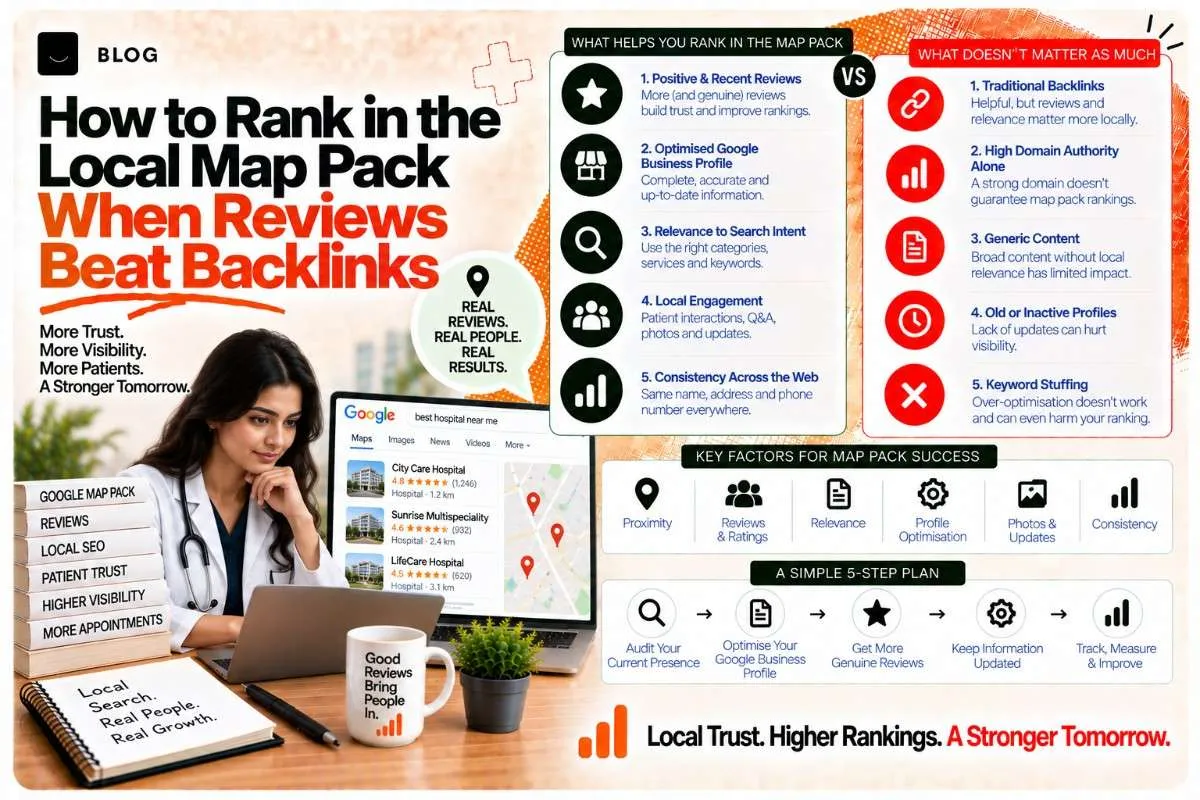
How to Rank in the Local Map Pack When Reviews Beat Backlinks
The local map pack does not behave like organic search. A well-linked, domain-authoritative website can still lose map pack visibility to a nearby competitor with fewer backlinks and a stronger, more recent, more positive review profile. Review velocity and sentiment function as a local trust signal domain authority cannot fully substitute for, which means a map pack strategy built purely around traditional SEO tactics is incomplete.
Why the map pack behaves differently from organic
Organic ranking rewards content relevance and domain authority built up over time, much of it earned off-page through backlinks. The map pack is answering a narrower, more immediate question — "which nearby business should I actually trust right now" — and proximity, profile completeness, and recent local social proof weigh more heavily in that specific, immediate-decision context than they do in organic ranking generally.
What review velocity actually means
Not just total review count, but the rate at which new reviews arrive. A business with 200 reviews accumulated over five years but nothing in the last six months sends a weaker current-trust signal than a business with 40 reviews, most from the last three months. A system assessing "which business is currently active and currently trusted" reads recent velocity as evidence the business is genuinely operating and genuinely engaging customers right now.
Why sentiment matters as much as volume
A high review count with a declining average rating is a warning sign, not a strength. Sentiment — the actual content and tone of recent reviews, not just the star average — increasingly factors into how both search systems and AI assistants describe a business, since review text is directly-quotable source material covered throughout this library's local SEO content.
Where backlinks still matter for local
Not irrelevant — a genuine local press mention, a chamber of commerce listing, or a relevant local directory link still contributes real authority and, more importantly, the kind of third-party corroboration covered in our entity SEO framework. The point is not that backlinks stopped mattering; it is that they are one signal among several the map pack weighs, and for many small local businesses, review velocity is the more achievable lever in the short term.
A practical review-velocity strategy
Ask for reviews consistently, as part of a repeatable process — after a genuinely positive interaction, not as a one-off campaign. Reply to every review, positive and negative, with specific detail — covered in depth in our hotel and restaurant review-response guidance, which applies to any local business. Monitor sentiment trends over time, not just the current star average, since a declining trend is an earlier warning than a dropped average alone. Treat review response as a standing operational habit, not a project that runs for a month and stops.
What not to do
Never incentivise reviews with discounts or offers — this violates most platforms' policies and, separately, produces exactly the kind of inflated, low-trust signal the whole exercise is meant to avoid. Never let review requests concentrate into a single burst — a sudden spike followed by silence reads as manipulated, not as genuine velocity. Never ignore negative reviews — an unanswered negative review is a worse signal than a promptly, professionally answered one.
Frequently asked questions
For the local map pack specifically, review velocity and sentiment often weigh more heavily than they would in organic ranking, since the map pack is answering an immediate, proximity-based trust question. Backlinks still contribute, particularly genuine local press and directory mentions, but review activity is frequently the more achievable lever for a small local business.
The rate at which new reviews arrive, not just the total count. A steady, recent flow of reviews signals a currently active, currently trusted business more strongly than a large historical total with little recent activity.
Yes. Review text is directly quotable source material for systems describing a business, so the actual content and tone of recent reviews — not just the star average — factors into how both search systems and AI assistants characterise a business.
Yes, when done consistently as a genuine process following a positive interaction, without incentives like discounts, which violate most platforms' policies and produce inflated, low-trust signals. A steady, ongoing pattern of requests reads as authentic; a sudden concentrated burst does not.
Ready to build what's next?
Tell us where you're headed. We'll come back with a plan to get there.
Book an intro call