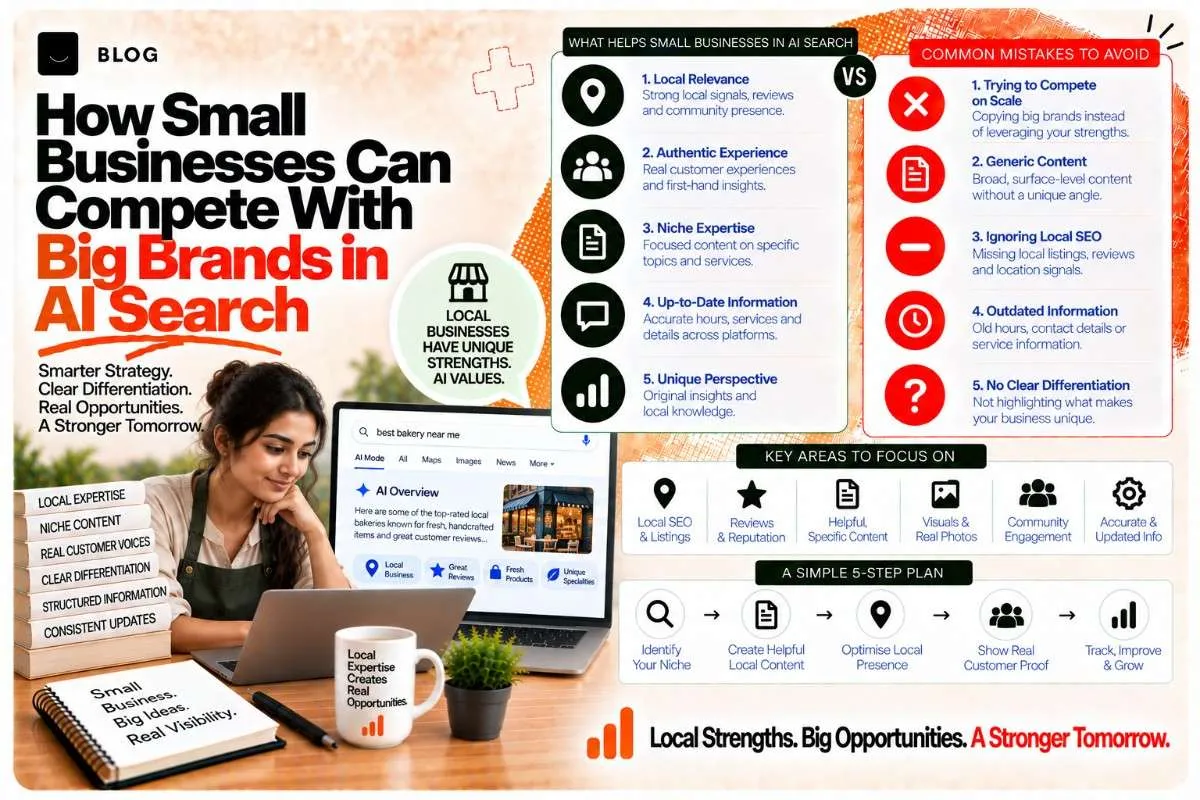
How Small Businesses Can Compete With Big Brands in AI Search
Type a buying question into ChatGPT, Perplexity, or Google's AI Overview, and it's natural to assume the answer will favor the brand with the biggest budget. More content, more backlinks, more PR mentions — surely that wins.
It doesn't automatically.
AI search systems are not simply ranking by domain size or ad spend. They're assembling an answer from whichever sources most clearly and specifically address the question being asked, and "most specific" is a race a small business can actually win. This isn't a motivational claim — it follows from how these systems work, and it points to a concrete set of things a small business can out-execute a big brand on, starting now.
Why big brands don't have the advantage you'd expect
A large brand's website is usually built for breadth: one page has to speak to every customer segment, every city, every use case, because that's what scales across a big organization. That breadth is an asset for brand awareness and a liability for AI citation, because generative engines are pulling for narrow, specific answers to narrow, specific questions.
When someone asks an AI assistant "what should I ask a wedding photographer before booking them in [city]," the ideal source isn't a national photography chain's generic services page. It's a page that answers that exact question, with that exact specificity. A big brand rarely has that page, because writing 200 hyper-specific pages for 200 hyper-specific questions doesn't fit their content operation. It fits yours.
There's also an approval-speed asymmetry. A large company's content has to move through legal review, brand guidelines, and multiple stakeholders before publishing. A small business can publish a genuinely useful, specific answer this week. AI systems reward whoever answers the question well and recently — not whoever has the biggest logo.
What this does not mean: this isn't a claim that small businesses beat big brands on every query, or that AI search has erased the advantages of scale, budget, and existing authority. A well-known national brand with a strong website and real topical depth still has real advantages, especially for broad, high-competition queries. The claim here is narrower and more useful: on specific, local, and long-tail questions — which make up most of what real buyers actually ask — the advantage tilts toward whoever answers most precisely, and that is a fair fight.
Five things a small business can out-execute a big brand on
1. Answering the exact question a real customer would ask
Big-brand content is written for search volume; small-business content can be written for the actual question. Instead of a generic "Our Services" page, a small business can build a page — or a strong FAQ block — that answers the specific thing someone would type into an AI assistant: "How much does [service] cost in [city]," "What's included in a [service] package," "How long does [process] take."
This is not keyword stuffing. It's writing the actual question as a heading and answering it directly in the first two sentences, in language a generative engine can lift cleanly.
2. Naming a real, credentialed person behind the answer
AI systems increasingly weigh who is saying something, not just what is said — a pattern covered in more depth in our Entity SEO Playbook. A big brand's content is usually attributed to "The Marketing Team" or has no visible author at all. A small business owner or specialist can attach their own name, credentials, and experience to the content: "Written by [Name], who has run [X] for [Y] years in [city]." That's a specific, verifiable entity a generative engine can associate with expertise — something a faceless corporate byline cannot offer.
3. Being verifiably local in a way a national brand structurally can't be
A national brand can claim to serve a city. A local business can prove it: a real address, real local reviews mentioning real neighborhoods and real landmarks, a Google Business Profile with photos taken on-site, and content that references specific, checkable local detail. AI systems doing local-intent queries lean on exactly this kind of corroborating detail. This is the same structural gap covered in our piece on why GBP signals often outweigh website content for local leads — and it's a gap in the big brand's favor to close, not yours.
4. Publishing and updating faster
Freshness matters for AI citation — stale content gets quietly passed over even when it was once authoritative. A big brand's publishing pipeline might take weeks to update a page. A small business can update a pricing page, a service description, or an FAQ answer same-day when something changes, and that currency is a real, measurable signal.
5. Going deeper on the questions that only your customers ask
A national brand writes for the median customer across every market it serves. A small business can go deep on the specific edge cases and questions its actual customers ask — the "what if my situation is unusual" questions that never make it into a big brand's generic FAQ because they're not common enough to justify the space nationally. For a niche, local audience, those questions are common, and answering them well is a form of specificity a big brand's content model isn't built to produce.
A worked example
Imagine a national gym chain and a single independently owned gym in a mid-size city, both targeting people searching AI assistants for "best gym for beginners in [city]."
The chain's page is a templated location page: address, hours, a photo carousel, a generic list of amenities repeated across 200 locations.
The independent gym publishes a page — or even just a well-structured blog post — titled "What a Beginner Should Actually Expect at Their First Gym Session in [City]," written by the owner, naming specific equipment orientations they run, specific class times for first-timers, and answering the real anxieties beginners have (what to wear, whether anyone will judge them, what the first session actually involves). It links to genuine, checkable local reviews that mention the beginner program by name.
When an AI assistant is asked "what should a beginner expect at a gym in [city]," the independent gym's page is a far better source to draw from — not because it's a small business, but because it's specific, credentialed, current, and verifiably local. The chain's scale didn't help it here; its genericness worked against it.
A 90-day plan to act on this
Days 1–30 — Foundation. Audit your existing pages for genuine specificity: are you answering real questions in the customer's own words, or describing yourself in general terms? Add named, credentialed authorship to your key pages. Ensure your NAP (name, address, phone) is identical everywhere it appears online, and that your Google Business Profile is complete with real, recent photos.
Days 31–60 — Depth. Identify the 10–15 specific questions your actual customers ask most often — not what a keyword tool suggests, but what people actually say in calls, emails, and reviews. Write direct, specific answers to each, formatted so an AI system can lift them cleanly (short, direct opening sentence; supporting detail after).
Days 61–90 — Proof and freshness. Add checkable local specificity: neighborhood names, real project or client examples (with permission), genuine review excerpts. Set a recurring review of your highest-traffic pages — monthly at minimum — to update anything that's gone stale, per the freshness discipline that matters for ongoing AI citation.
The honest limit of this advantage
None of this means outranking a major brand on a broad, highly competitive national query is realistic for most small businesses, and it shouldn't be the goal. The opportunity is in the long tail of specific, local, and situational questions — which is also where most of a small business's actual customers are searching. Winning there consistently, over months, is what builds the kind of cumulative visibility that starts to matter even on harder queries.
Frequently asked questions
Big brands typically have an advantage for broad, high-competition queries due to existing authority and content volume. For specific, local, and long-tail questions — which make up most real buyer queries — that advantage shrinks or disappears, because AI systems favor precise, current, well-corroborated answers over generic breadth.
Traditional rankings have historically rewarded domain authority and backlink volume, both of which favor larger, older sites. AI systems assembling an answer are weighing how directly and specifically a source answers the exact question asked, which narrows the gap for smaller, more specific sources.
Identify the 5–10 questions customers actually ask most often, and write direct, specific answers to each as their own clearly headed sections — not folded into a general services page.
It contributes to entity clarity, which AI systems use to judge whether content comes from a real, credible source. It's one signal among several, not a silver bullet on its own, but it costs nothing to add and has no downside.
No — but resources are usually better spent first on the specific, local, long-tail questions where a small business can realistically win, before competing for broad terms where scale advantages are harder to overcome. blog-small-business-compete-big…
Ready to build what's next?
Tell us where you're headed. We'll come back with a plan to get there.
Book an intro call