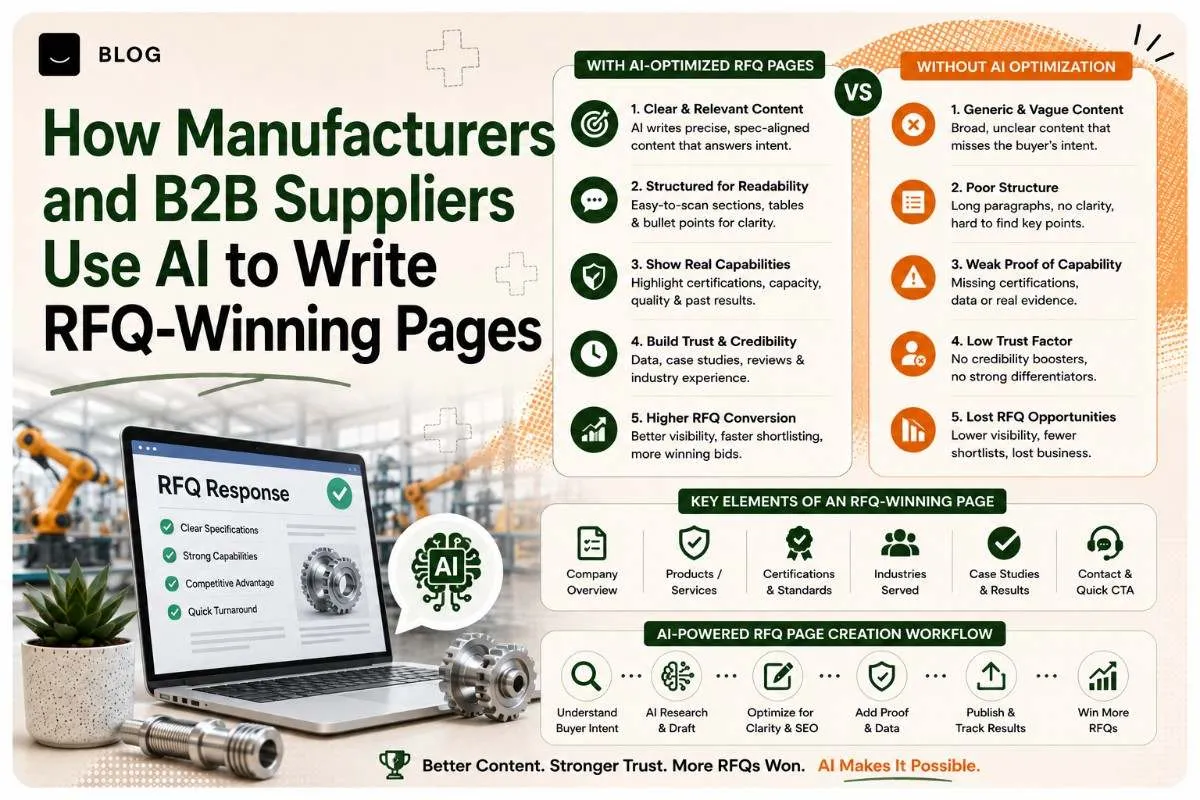
How Manufacturers and B2B Suppliers Use AI to Write RFQ-Winning Pages
An RFQ-winning page is a product or capability page that gives a procurement buyer enough specific, verifiable detail to shortlist you without a phone call first. AI can draft these pages far faster than a technical team usually manages — but only if a real engineer verifies every specification before it publishes. This guide covers the page structure, the prompts, and the verification step that makes the difference between a page that wins quotes and one that quietly costs you them.
What an RFQ-winning page actually is
Most manufacturer websites have product pages. Very few have RFQ-winning pages. The difference is what a buyer can do after reading it.
A product page describes what you make. An RFQ-winning page answers the questions a procurement buyer has to resolve before they can put you on a shortlist: does this match my specification, can you make it in the quantity I need, do you hold the certifications my compliance team will ask for, and what do you need from me to quote.
If any one of those is missing, the buyer does one of two things — sends a vague "please share details" email that costs your sales team a week of back-and-forth, or moves to the supplier whose page answered it.
Why most manufacturer websites lose the enquiry before it starts
The pattern is consistent across Indian manufacturing and B2B supply websites, and it is worth naming plainly:
- Marketing language where specifications belong. "High-quality precision components manufactured to international standards" tells a buyer nothing. Tolerances, materials, and grades tell them everything.
- A single "Products" page covering forty products. Nothing on it is specific enough to match a search or a procurement query for any one of them.
- Specifications locked inside a PDF catalogue. A downloadable PDF behind a form is invisible to search engines and largely invisible to AI answer engines. The buyer who wanted that data has already left.
- No indication of capacity. A buyer needing 50,000 units cannot tell whether you are a 500-unit workshop or a plant that could take the order.
- Certifications mentioned as a logo strip. No numbers, no scope, no issuing body — nothing a compliance officer can verify.
None of this is a writing problem in the usual sense. It is a problem of nobody having had the time to sit down and write out what the engineering team already knows.
That is precisely the gap AI closes.
What changed: procurement research now starts inside an AI assistant
Procurement research used to run through Google, trade directories, and industry contacts. A meaningful share of it now starts with a buyer typing something like "who manufactures IS 2062 E250 steel fabricated assemblies in Madhya Pradesh with in-house galvanising" into ChatGPT, Perplexity, or Gemini — and then working from the shortlist that comes back.
This changes what a page has to do. A traditional search result gets clicked and read. An AI answer gets extracted — the engine pulls the specific facts it can find, states them, and cites the source. A page written in marketing prose has nothing extractable in it. A page with a clear specification table, a named material grade, and a stated production capacity has a great deal.
This is the mechanism behind Generative Engine Optimization, and B2B manufacturing is one of the best-suited categories for it. Procurement queries are long, specific, and technical — exactly the queries where a precise page beats a well-known brand with vague content.
A caution on the size of this shift. The direction is clear and observable — you can test it yourself in ten minutes by running your own product queries through three AI assistants and seeing who gets named. What is not yet reliably measurable is what share of Indian B2B procurement research now runs through AI tools. Anyone quoting you a precise percentage is almost certainly repeating a vendor estimate. Treat this as a channel worth being visible in, not one with a settled number attached.
VERIFY: If you cite any adoption statistic in this post, source it from a primary study, not an agency blog.
The five blocks every RFQ-winning page needs
Structure first. AI drafts each of these well once you know what you are asking for.
1. The specification table
A real HTML table — not an image, not a PDF. Rows for every parameter a buyer would specify: material grade, dimensions and tolerances, finish options, load ratings, standards conformed to. This is the single most extractable element on the page and the one most manufacturer sites are missing entirely.
2. The application block
What this product is actually used for, in named industries and use cases. Buyers frequently search by application before they search by product name — someone needs a solution for a conveyor loading point long before they know the part is called an impact bed.
3. The capability and capacity block
Machines, processes, in-house versus outsourced operations, typical batch sizes, and lead times. Be specific and be honest. A buyer who discovers at quotation stage that galvanising is outsourced with a three-week lead time is a lost buyer; one who read it on the page and enquired anyway is a qualified one.
4. The compliance and certification block
Certification name, issuing body, scope, and validity. "ISO certified" is not usable by a compliance team. "ISO 9001:2015, issued by [body], scope covering [processes], valid to [date]" is.
5. The enquiry block
State exactly what you need in order to quote — drawing, quantity, material preference, delivery location, timeline. A buyer who knows what to send sends it. A buyer facing a blank "Contact Us" form usually does not.
Where AI helps — and where it will cost you the enquiry
AI is genuinely good at:
- Turning an engineer's rough notes, a spec sheet, or an old catalogue page into structured, readable page copy
- Generating the application block — it is good at listing plausible industries and use cases for a described component, which your team then edits down to the real ones
- Writing the same product page for six product variants without the quality collapsing by the fourth
- Drafting FAQ blocks that mirror the questions your sales team answers on calls
- Rewriting engineering language into something a non-technical purchasing manager can follow, without dropping the numbers
AI will actively hurt you at:
- Specifications. A language model will produce a confident, plausible, wrong tolerance. It has no idea what your machines hold. Every number in the specification table must come from your team, not the model.
- Certifications. Never let AI generate certification text. A fabricated or overstated certification claim is a legal and commercial problem, not an SEO one.
- Capacity and lead times. The model will guess. Your plant manager knows.
- Standards references. IS, ASTM, DIN and ISO numbers get confidently mixed up. Every standard cited needs checking against the actual standard.
The rule that makes this work: AI writes the prose, your engineers supply every number. Reverse that and you will publish a page that reads beautifully and loses you a customer at the first technical conversation.
A prompt template for a product or capability page
Paste your own raw material into the bracketed sections. The more unpolished detail you give it, the better the draft.
You are writing a product page for a B2B manufacturing website. The audience is a procurement buyer or design engineer evaluating suppliers, not a consumer. COMPANY: [name, location, what you make, years operating] PRODUCT: [product name] VERIFIED SPECIFICATIONS (use these exactly, do not alter, do not add any specification I have not listed): [paste raw spec notes — material grades, dimensions, tolerances, finishes, standards, load ratings] PRODUCTION: [processes in-house vs outsourced, typical batch size, lead time] KNOWN APPLICATIONS: [industries and use cases you have actually supplied] COMMON BUYER QUESTIONS: [what your sales team gets asked on every call] Write the page with: 1. A 50-word opening that states plainly what the product is, what it is made from, and what it is used for. 2. An applications section covering the industries listed above. 3. A capability section covering processes, capacity and lead time. 4. A short FAQ answering the buyer questions above, each answer 40-70 words and self-contained. 5. An enquiry section stating exactly what information we need to quote. Rules: - Do NOT invent any specification, tolerance, certification, capacity figure or standard number. Use only what I supplied above. - Where you think a specification is needed but I have not given it, insert [MISSING SPEC: describe what is needed] instead of guessing. - No superlatives. No "world-class", "cutting-edge", "best-in-class". - Write in plain sentences a purchasing manager can scan quickly.
The [MISSING SPEC] instruction is the important one. It converts the model's guessing instinct into a checklist your engineering team can fill in — which is a far more useful output than a page that looks finished and is quietly wrong.
The verification pass that has to happen before anything publishes
Non-negotiable, and it takes about twenty minutes per page:
- An engineer reads every number. Not a marketing reviewer. Someone who knows the machines.
- Certifications checked against the actual certificate — name, body, scope, validity date.
- Standards numbers verified against the standard itself, not the model's recollection of it.
- Lead times and capacity confirmed by whoever runs production, in writing.
- Every [MISSING SPEC] resolved or removed. A published page containing a bracketed placeholder is worse than no page.
If your team cannot commit twenty minutes per page to this, publish fewer pages. Ten verified pages outperform forty unverified ones, and the unverified ones carry a real commercial risk that the SEO upside does not offset.
How to tell whether it's working
Three things worth tracking, in order of how quickly they move:
- Enquiry quality. The fastest signal, and it does not need a tool. Are incoming enquiries arriving with a drawing, a quantity, and a timeline attached, or are they still "please share details"? A page that answers the buyer's questions produces better-specified enquiries within weeks.
- AI citation. Run ten to fifteen procurement-style queries a buyer would plausibly type — specific ones, with material grades and locations in them — through ChatGPT, Perplexity, and Google AI Overviews, once a month. Record whether you are named. This is manual, and manual is fine at this scale.
- Search visibility on long-tail technical queries. Not "steel fabrication company" — the specification-level queries where your new pages actually compete.
The first of those matters most. AI citation is a means; a better-qualified enquiry landing in your inbox is the outcome you are actually buying.
Frequently asked questions
AI can write the prose, structure, applications and FAQ sections of a technical product page very effectively. It cannot be trusted to generate specifications, tolerances, certifications, standards numbers or capacity figures — those must be supplied by your engineering team and verified before publishing, because a language model will produce plausible, confident and incorrect technical values.
An RFQ-winning page is a product or capability page containing enough specific, verifiable information for a procurement buyer to shortlist a supplier without an initial call. It typically includes a specification table, application detail, production capability and capacity, certification detail, and a clear statement of what the supplier needs in order to quote.
Procurement research increasingly begins with a buyer asking an AI assistant a specific technical question and working from the shortlist it returns. AI answer engines extract concrete details — material grades, capacities, certifications — from pages that state them clearly. Manufacturer websites written in general marketing language give these engines nothing to extract or cite.
On the page, as real HTML text and tables. Specifications locked inside a downloadable PDF, especially one behind a form, are largely invisible to search engines and AI answer engines. A PDF catalogue can still exist for buyers who want it, but the same data should be readable directly on the page.
Fewer, verified pages outperform many unverified ones. Each page should cover one product or one capability specifically enough to match a buyer's technical query. A single "Products" page listing forty items is not specific enough to rank or be cited for any of them, but neither is a rushed set of forty pages nobody has checked.
Fabricated technical detail. A language model will generate a confident tolerance, certification or standards reference that is wrong. Published as fact on a supplier website, that becomes a commercial and potentially legal problem, not just an accuracy one — which is why an engineer's verification pass before publishing is not optional.
Ready to build what's next?
Tell us where you're headed. We'll come back with a plan to get there.
Book an intro call