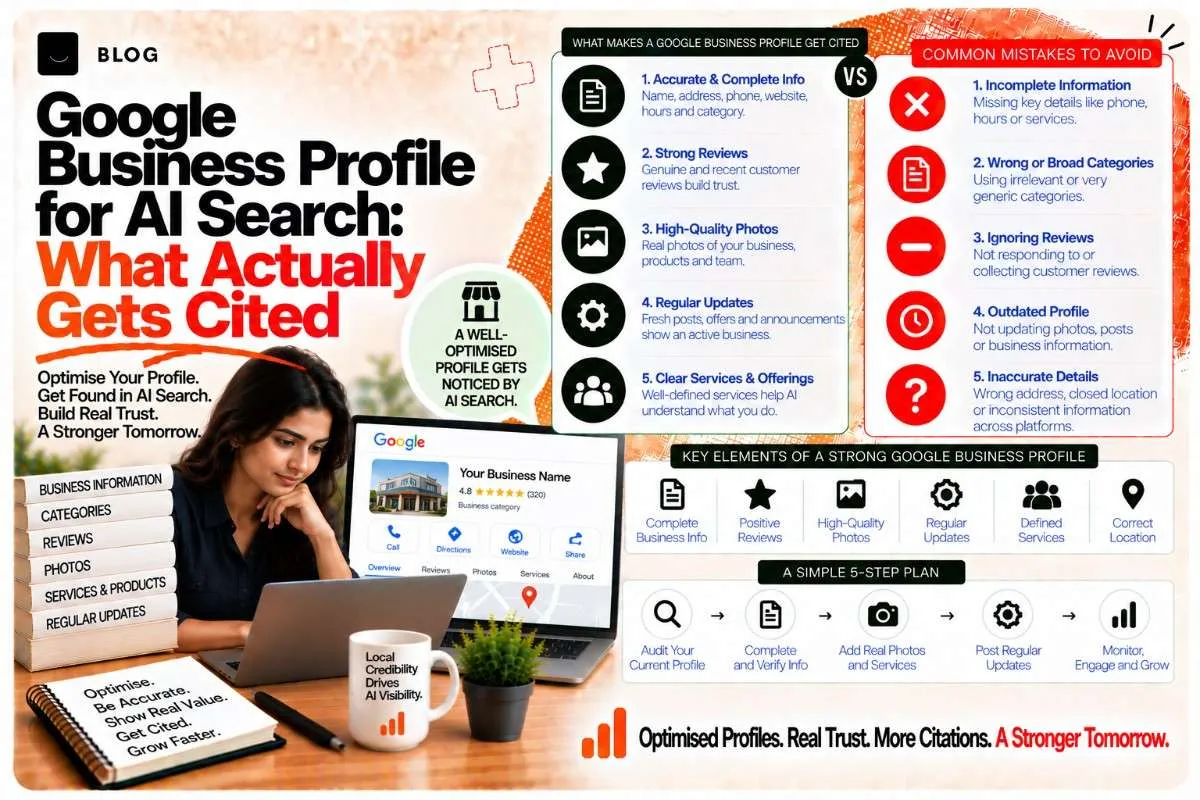
Google Business Profile for AI Search: What Actually Gets Cited
Google Business Profile used to be a local-ranking tool: optimize your GBP, get better Google Map Pack visibility, drive foot traffic and local calls. That's still true. But GBP has quietly become something else in the AI search era — a structured data source that answer engines directly pull from when answering local, service-specific, and entity-related questions.
When someone asks ChatGPT "what are the hours of a dentist in [city]," or Perplexity "best [service] providers in [location]," these AI systems aren't always crawling your website first. They're pulling from Google Business Profile, Google Maps data, verified business information, and reviews. Your GBP is now a direct citation source, not just a local-ranking factor.
This changes what you should optimize in your GBP — and what you should ignore.
How AI systems use Google Business Profile data differently than Google Maps ranking
In traditional local SEO, a complete GBP drives better Google Maps visibility, which drives clicks and calls. Ranking in the Map Pack is about review count, review rating, NAP consistency, and click-through rate signals.
AI systems use GBP data differently. When an AI is answering a question about a business or service, it reads:
- Business name, category, and description — to confirm the entity and what it does
- Hours and phone number — to answer "when are they open" and "how do I contact them" questions directly
- Service areas and service list — to confirm whether a business serves a location or offers a specific service
- Photos — to visually corroborate the business exists and is real
- Reviews and review snippets — to pull trust signals and customer experience details into an answer
This is the same information that goes into a Knowledge Panel, and it's increasingly what AI systems cite directly.
The difference: in traditional local SEO, you optimize for ranking. In AI search, you optimize for citation accuracy and completeness. Ranking still matters, but being cited is a separate advantage.
What to optimize in your GBP for AI citation
1. Business name (exact match, no marketing fluff)
Your GBP business name should match your legal business name, and it should be identical everywhere it appears (website, LinkedIn, Facebook, directories). Don't use:
- "The Best [Service] in [City]" — marketing language, not an entity name
- Abbreviations inconsistently (ABC Marketing vs. A.B.C. Marketing)
- Multiple versions (John's SEO vs. John SEO Agency)
AI systems use the business name to identify and match your entity across sources. Inconsistency makes you invisible to this process.
2. Business category (specific, primary category first)
Your primary GBP category signals what you do to AI systems. If you're a "Marketing Agency," that's generic. If you're "Digital Marketing Agency" or "SEO Consultant," that's more specific and useful to an AI deciding whether to cite you for a query.
Choose your primary category carefully:
- Put your most defensible, most-searched service as the primary category
- Additional categories are less weighted by AI systems, so don't rely on them alone
- Avoid vague categories; specificity helps AI match you to relevant queries
3. Business description (action-oriented, service-specific, under 750 characters)
Your GBP description is now a direct citation source. When an AI is answering "what services does [business name] offer," it may pull directly from this description.
A weak description: "We are a marketing agency offering a range of services."
A strong description: "Digital marketing agency specializing in SEO, AEO, paid advertising, and video production for local and mid-market businesses in Bhopal. We focus on search visibility, lead generation, and measurable results."
The strong version tells an AI system:
- What services you offer (specifically named)
- Who you serve (local/mid-market)
- What you focus on (measurable results)
- Geographic location (Bhopal)
4. Hours and contact information (exact, current, in standard format)
AI systems cite hours directly. If your hours are wrong, stale, or inconsistent, an AI will cite the wrong information — or refuse to cite you at all.
Standard format:
- Use 24-hour time or consistent AM/PM formatting
- Update hours immediately if they change (seasonal, holiday, renovation)
- Include phone in one consistent format (e.g., +91-755-123-4567)
- If you have multiple locations, each needs its own GBP with location-specific hours
5. Service list (explicit, accurately scoped)
GBP allows you to list specific services you offer. This is a direct matching signal for AI systems answering service-specific queries.
Example: instead of leaving this blank, list:
- SEO Services
- Website Development
- Content Writing
- Performance Marketing
AI systems deciding whether to cite you for "content writing services in Bhopal" will check your service list. If content writing is listed, citation probability goes up.
6. Service areas (specific cities, not "nationwide" unless you genuinely serve all)
If you serve multiple cities, list them explicitly in service areas. Don't just say "India." The more specific you are, the better AI systems can match you to location-specific queries.
For a local business: list your primary city plus any nearby cities where you actively serve customers.
For a regional business: list specific states or regions, not the entire country.
7. Photos (professional, recent, diverse types)
AI systems don't use photos for ranking, but they use them to verify that you're a real business. A profile with zero photos signals low confidence to an AI considering citation.
Include:
- Logo or business photo (clear, professional)
- Office/storefront photo (if you have a physical location)
- Team photos (if relevant to your service)
- Work samples or recent project photos (for service businesses)
- Keep photos current (update every 6–12 months)
8. Reviews and review responses (quality over quantity)
AI systems read review content to pull user experience details into answers. They also check whether you respond to reviews (a signal of active management).
Best practices:
- Encourage genuine customer reviews (don't fake them)
- Respond to all reviews, positive and negative, within 1–2 days
- Keep responses brief, professional, and specific (don't use a generic template)
- Let review content speak for itself; don't argue with negative reviews
What NOT to optimize in your GBP (common mistakes)
Don't use keywords in your business name.
"Best SEO Services in Bhopal" is not a business name. Your actual business name is. This practice (keyword-stuffed names) used to work for ranking but now signals low authenticity to both Google and AI systems.
Don't hide behind a generic description.
"We offer marketing solutions for all industries" is too vague. AI systems get more signal from a description that names specific services and states who you serve.
Don't leave fields blank or incomplete.
Every field in GBP is a citation source. Blank fields mean AI systems can't confirm information and are less likely to cite you. A complete profile signals seriousness and confidence.
Don't list services you don't actually offer.
If you list "Video Editing" but you don't do it, an AI asking your customers (via reviews or citations) will uncover the inconsistency. Stick to what you actually do.
Don't ignore review management.
Responding to reviews shows you're active and engaged. No response to any review signals negligence to AI systems evaluating your reliability.
The bigger picture: GBP as part of entity clarity
Optimizing your GBP for AI citation is part of the larger entity-clarity framework. When Google, ChatGPT, Perplexity, and other AI systems see:
- A consistent business name everywhere
- A GBP with complete, specific information
- Review content that corroborates your claims
- Schema markup on your website that matches your GBP
- External mentions (directory listings, press) that align with your GBP
...they build confidence that you're a real, credible, consistent entity worth citing. Each piece reinforces the others.
For more on entity clarity at the business level, see our Entity SEO Playbook.
Frequently asked questions
Yes, but not directly. A complete, accurate GBP with good reviews and engagement helps with Map Pack ranking. Optimizing for AI citation is a parallel benefit, not a separate ranking factor for Maps.
Yes, but they're less likely to cite you. They prefer structured, verified data (like GBP) over having to parse your website. A complete GBP makes citation more likely.
Update hours, phone, and service areas immediately if they change. Update photos and descriptions every 6–12 months. Review information updates automatically as customers leave new reviews.
Yes. Each location needs its own GBP with location-specific information, hours, phone, and address. This allows AI systems to answer location-specific queries accurately.
Yes. AI systems read review content to understand customer experience and pull positive details into answers. They also check whether you respond to reviews as a signal of active management.
Update one or both so they're consistent. AI systems get more confident in citation when information aligns across sources. Priority order: GBP, then website, then directories.
Ready to build what's next?
Tell us where you're headed. We'll come back with a plan to get there.
Book an intro call