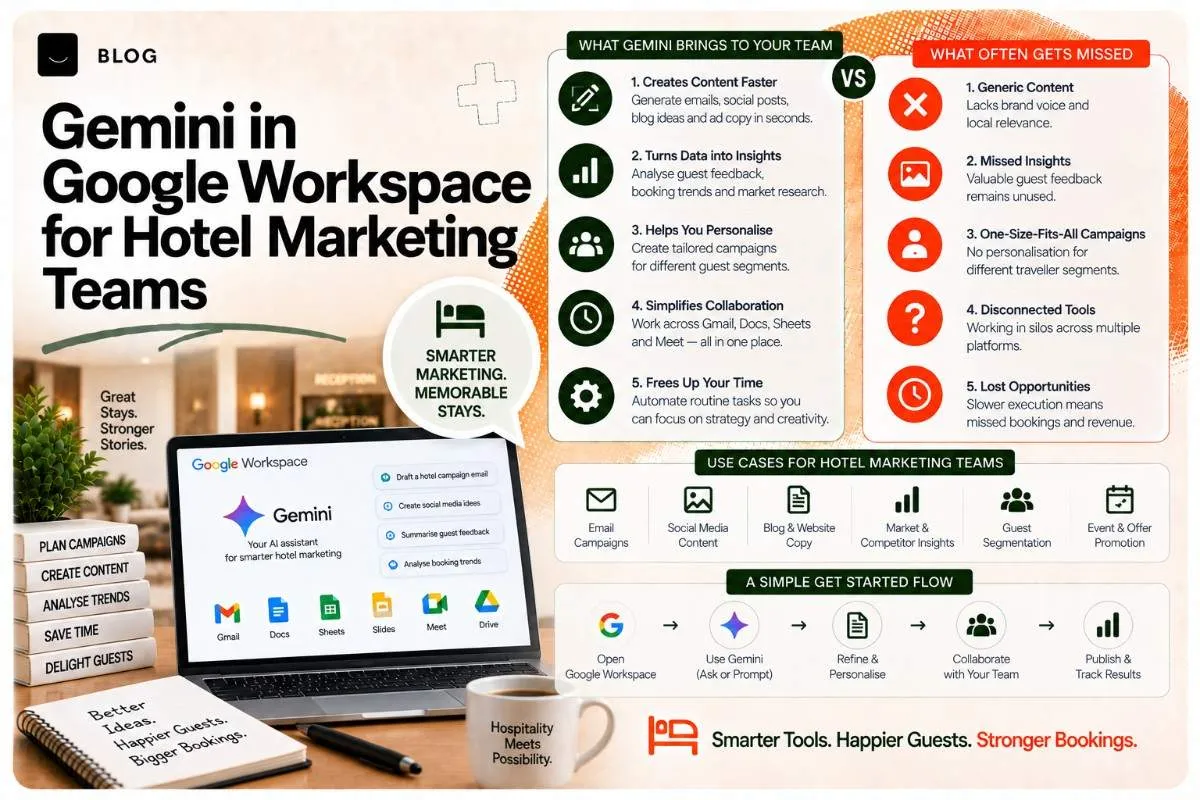
Gemini in Google Workspace for Hotel Marketing Teams
Most independent hotels run marketing out of the same Gmail, Docs and Sheets they use for everything else, with one or two people doing the work of an entire department. Gemini built into those apps drafts guest emails, offer copy and property descriptions inside the tools already in use, without a separate platform to learn. This post covers what that actually looks like, where it saves real time, and where a draft needs a person's eyes before it goes anywhere near a guest.
Why this matters for a team that is usually one or two people
Independent and boutique hotels rarely have a marketing department in any formal sense. Usually it is the owner, the front office manager, or one person wearing several hats, writing guest emails, seasonal offers and social captions in whatever time is left after operations.
The value of AI built into tools already in daily use is specifically that it removes the "which new platform do I need to learn" barrier. If your team already drafts in Gmail and Docs, having drafting assistance inside those apps is a lower-friction improvement than adding a separate marketing tool nobody has time to master.
A note on verifying what is current
VERIFY: Gemini's specific features inside Workspace, and exactly which apps and plan tiers include them, change regularly and are Google's decision, not something this post can guarantee stays accurate. Before publishing, confirm current feature availability directly against Google Workspace's documentation, and update the app-by-app section below if anything has changed. Do not name a specific feature you have not confirmed exists today.
The underlying argument — that AI assistance inside familiar tools lowers the barrier for a small team — holds regardless of which specific features are current. The app-by-app detail below should be treated as illustrative and re-verified before publishing.
What this actually looks like across the apps you already use
Gmail — guest correspondence
Drafting assistance in Gmail can help with pre-arrival information emails, post-stay follow-ups, responses to common enquiries, and replies to booking platform messages — all starting points a person then edits for accuracy and tone rather than sending unedited.
The genuinely useful case is repetitive correspondence with the same shape every time: a pre-arrival email that always covers check-in time, parking and how to reach the property, just with different guest names and dates. Drafting assistance handles the repetitive structure; a person supplies and checks the specific details every time.
Docs — offers, packages and property descriptions
Seasonal offer copy, package descriptions, and property description drafts for listing platforms or your own website. Useful for getting a structured first draft quickly, particularly when adapting one offer into several lengths for different platforms — a short version for social, a longer one for the website, a version for a booking platform's character limit.
Sheets — organising and drafting from booking data
Less about generating marketing copy directly and more about organising the information that feeds it — grouping guest data by stay type or season to identify who a targeted offer should go to, or turning a messy list of package details into a structured comparison a person can then write from.
Where this genuinely saves time
- First drafts of repetitive correspondence. The structural work of a pre-arrival email or post-stay follow-up, done in seconds rather than from a blank page each time.
- Adapting one piece of content into several formats and lengths. The same offer, reshaped for social, website and booking platform, without redoing the writing from scratch each time.
- Organising scattered information into something you can draft from. Turning rough notes about a package into a structured comparison.
- A starting point when nobody has time to write. A rough draft that exists is far easier to improve than a blank page nobody gets to.
Where it will embarrass you if unchecked
- Any specific factual claim about the property. Amenities, policies, pricing, availability, check-in times. A draft will confidently state something that sounds plausible and is wrong about your specific property, because it has no way of actually knowing your policies.
- Anything sent to a guest without a read-through. Particularly pre-arrival and post-stay correspondence, where an error affects someone's actual visit, not just a marketing impression.
- Tone that does not match your property. A boutique heritage property and a business hotel should not sound the same, and generic drafting defaults toward generic tone unless corrected.
- Seasonal or festival details. Dates, hours and offers tied to specific occasions need checking against your actual current information every time, not assumed from a previous year's draft.
- Anything that reads as a claim rather than a description — "the best views in the city" is a claim; "rooms overlooking the lake on the east side" is a description. The second is defensible and specific; the first invites disappointment.
A short brief that makes every draft better
Write this once, keep it somewhere your team can paste from, and use it every time:
- Property character in one line — heritage, boutique, business, resort
- Voice — warm and personal, or crisp and efficient
- Three facts every guest communication should be consistent about — check-in time, main contact method, one distinguishing feature
- Words to avoid — most properties have a short list of overused phrases they are tired of
Pasting this ahead of any drafting request produces output closer to your actual voice than a bare request will, for the same reason a brand voice brief improves review responses elsewhere in this library — a model drafts well once it has your specifics, and poorly on generic instructions alone.
A workable weekly routine
- Draft repetitive correspondence in a batch, rather than one email at a time as they come in — pre-arrival templates, common enquiry responses, refreshed periodically rather than written fresh each time.
- Read every draft before it goes to a guest. Not skim — read, checking specifically for factual claims about the property.
- Adapt seasonal offers into the formats you need, once the core offer is written and checked, rather than rewriting from scratch for each platform.
- Keep the property brief updated — a change in policy, hours, or a new amenity should update the brief so future drafts reflect it.
What this does not replace
- Knowing your own guests. No drafting tool knows what your specific repeat guests care about. That judgment stays with your team.
- A genuine content strategy. Faster drafting is not the same as knowing what to communicate and when. The strategy question comes first; the drafting help speeds up execution of a plan someone still has to make.
- Review responses, which need their own discipline — covered separately in our post on replying to hotel reviews in brand voice, because the accuracy stakes and the audience are different from guest correspondence.
- Getting found in the first place. Faster guest communication does not affect whether AI assistants recommend your property to someone who has never heard of you — that is a search and AI-visibility question, covered in our hotel AEO guide.
Frequently asked questions
Yes, particularly for drafting repetitive guest correspondence, adapting offer copy into different formats and lengths, and organising booking information into something a person can draft from. It works inside the Gmail, Docs and Sheets a small hotel team likely already uses, which lowers the barrier compared to learning a separate marketing tool.
Any specific factual claim about the property — amenities, policies, pricing, check-in times, availability — and anything tied to a specific season or festival date. Drafting tools will confidently state something plausible-sounding that is wrong about your specific property, because they have no way of knowing your actual current policies.
No. Faster drafting speeds up executing a plan someone still has to make — what to communicate, to which guests, and when. Deciding on that strategy remains a judgment call that depends on knowing your own property and guests, which a drafting tool cannot supply.
By writing a short brief once — property character, voice, key consistent facts, and words to avoid — and pasting it ahead of any drafting request. This produces output much closer to the property's actual voice than a bare request, in the same way a documented brand voice brief improves consistency in review responses.
No. It is general drafting assistance built into everyday productivity tools, useful for correspondence and content drafts. It does not include hotel-specific features like booking management, review aggregation or channel-specific distribution, which dedicated hospitality marketing tools are built to handle.
Not directly. Guest correspondence drafting helps a hotel communicate faster with people who have already booked or enquired. Getting discovered by new guests, including through AI-generated recommendations, is a separate search and AI-visibility question that depends on different factors covered elsewhere.
Ready to build what's next?
Tell us where you're headed. We'll come back with a plan to get there.
Book an intro call