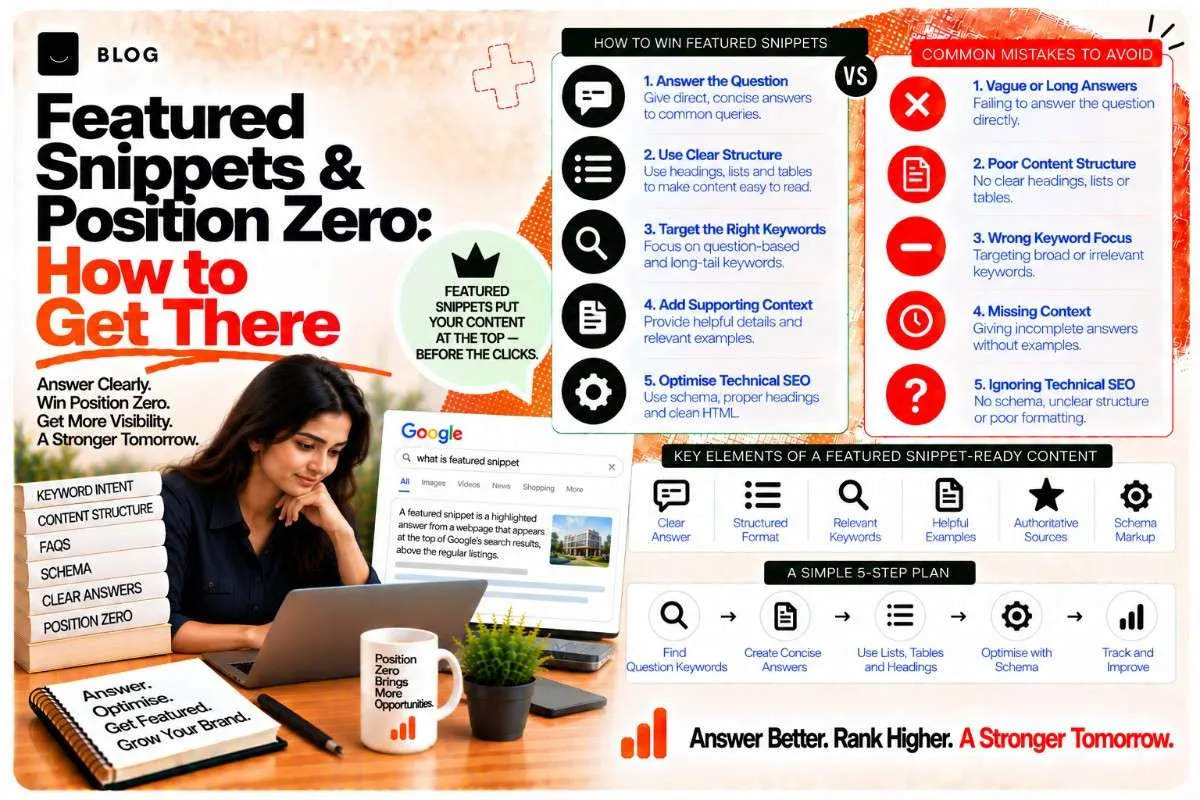
Featured Snippets & Position Zero: How to Get There
A featured snippet — that boxed answer at the top of Google Search, above the #1 organic result — is one of the highest-value SEO wins you can get. It's position zero. It gets clicks. It gets citations in voice search. It signals authority.
But getting there isn't luck. It's a specific, repeatable process.
The challenge: featured snippets don't rank like normal results. You can't just write good content and hope Google picks it. You have to structure your content, format your answers, and optimize for the specific answer formats Google shows for your target keyword.
This guide covers exactly how to do that.
What is a featured snippet and why does it matter
A featured snippet is Google's extracted answer to a search query, shown in a box above the #1 organic result. When someone searches "how much does SEO cost," Google pulls an answer from one of the top-ranking pages and displays it prominently.
Featured snippets exist in several formats:
- Paragraph snippets — 40–60 word excerpt from a page
- List snippets — ordered or unordered list of items
- Table snippets — data organized in rows and columns
Each format serves a different type of question.
Why featured snippets matter:
- They get clicks. Featured snippets attract CTR because they're visually prominent and answer the question directly.
- They're cited in voice search. Voice assistants (Google Assistant, Alexa, Siri) read featured snippets aloud as answers.
- They signal expertise. Owning the featured snippet for a keyword signals that you have the definitive answer.
- They boost AI visibility. AI systems (ChatGPT, Perplexity, Google AI) use featured snippets as credible sources to cite.
Featured snippets are especially valuable for local service businesses, e-commerce, and any business answering common questions.
The featured snippet opportunity: which keywords have snippets
Before optimizing, check whether a keyword has a featured snippet. If it doesn't, you can't get one — Google only shows snippets for certain query types.
Keywords that typically have featured snippets:
- "How to..." questions ("How to implement entity SEO")
- "What is..." definitions ("What is voice search")
- "Why..." explanations ("Why do backlinks matter")
- "Best..." comparisons ("Best SEO tools for startups")
- Measurement questions ("How much does SEO cost," "How long does SEO take")
- Process questions ("What are the steps to...")
Keywords that don't typically have snippets:
- Branded searches ("Digital4Local SEO agency")
- Transactional searches ("SEO services near me")
- Navigational searches ("Google Search Console login")
To check whether a keyword has a snippet:
- Search the keyword in Google
- Look for the featured snippet box above the #1 result
- Note the format (paragraph, list, or table)
If a snippet exists, note who currently owns it. This is your competitor. Your goal is to beat them.
How to structure content for paragraph snippets
Paragraph snippets are the most common format. They typically show 40–60 words extracted from a page.
To optimize for paragraph snippets:
1. Answer the question directly in the first 100 words
Google extracts featured snippets from the top-ranking pages for a keyword. But it pulls the answer that directly responds to the question, not just any paragraph.
Place your direct answer near the top of your page, before diving into supporting detail.
Example structure:
How much does SEO cost?
SEO costs typically range from ₹5,000–₹50,000+ per month, depending on your scope and competition level. Most small businesses invest ₹10,000–₹25,000 monthly for comprehensive SEO services covering technical, on-page, and off-page optimization.
[Then expand with detail below...]
2. Use the exact question as a heading
If someone searches "how much does SEO cost," use that exact phrase (or a very close variant) as an H2 or H3 heading.
Google matches question queries to headings that match or closely paraphrase the question.
3. Keep your answer 40–60 words for maximum extract likelihood
Featured snippets extracted from paragraph snippets typically show 1–3 sentences (40–60 words). Write your answer in that range, then expand the detail below.
Example:
"SEO pricing varies widely based on scope and competition. Freelancers charge ₹500–₹2,000/month for basic optimization. Agencies typically charge ₹10,000–₹50,000/month. Enterprise-level strategies can exceed ₹100,000/month. The average small business should budget ₹15,000–₹30,000/month."
This is approximately 50 words and answers the question completely.
How to optimize for list and table snippets
List and table snippets require slightly different structuring.
List snippets
List snippets show ordered or unordered items. They're ideal for "best," "steps," or "how to" queries.
To optimize for list snippets:
- Use a heading that matches the query (e.g., "Best SEO Tools for Startups")
- Create an ordered list (1, 2, 3...) or unordered list (bullets)
- Keep list items concise (one sentence each)
- Use 5–10 items (not 3, not 20)
- Add a brief description under each item if helpful
Example:
Best SEO Tools for Startups
- Google Search Console — free, essential for monitoring rankings and errors
- Google Analytics 4 — free analytics; track traffic and user behavior
- Ubersuggest — affordable keyword research and competitor analysis
- Yoast SEO — WordPress plugin for on-page optimization guidance
- Ahrefs Free — basic backlink analysis (paid version is comprehensive)
Google extracts this list format directly and displays it as a featured snippet.
Table snippets
Table snippets are ideal for comparison queries or structured data.
To optimize for table snippets:
- Use a heading that matches the query (e.g., "SEO Tools Comparison: Cost & Features")
- Create a clean table with 3–5 columns and 4–8 rows
- Label columns clearly (Tool, Cost, Best For, etc.)
- Use easy-to-scan data (numbers, short phrases, not paragraphs)
- Keep the table visible (not nested in a collapse or scroll)
Example:
| Tool | Cost | Best For | Ease of Use |
|---|---|---|---|
| Google Search Console | Free | Ranking tracking | Very easy |
| Ahrefs | $99–$999/mo | Backlink analysis | Moderate |
| Semrush | $120–$1000/mo | Competitive analysis | Moderate |
| Ubersuggest | $12–$18/mo | Budget keyword research | Easy |
Featured snippet positioning: where your answer should appear
Google typically pulls featured snippets from pages ranking in the top 3–10 organic results for that keyword. You don't need to be #1 to get the snippet (though #1 is better).
But placement on the page matters:
- Ideal: Answer appears within the first 100 words, in a clearly formatted section
- Acceptable: Answer appears in the first 300 words
- Unlikely: Answer appears after 500+ words of preamble
Google needs to identify your answer quickly. If it's buried deep in the page, you're less likely to get the snippet.
Structure recommendation:
- H1 (page title)
- Brief introduction (1–2 sentences)
- Your direct answer in H2/H3 with the question
- The 40–60 word answer
- Detailed supporting content below
Testing your featured snippet optimization
After you publish, test whether you own the featured snippet:
- Google the keyword — does your featured snippet appear? If yes, you're winning. If no, note who's winning.
- Check the format — if Google shows a paragraph snippet, is your answer format paragraph-style? If Google shows a list, do you have a list?
- Monitor in Google Search Console — go to Performance > Queries and filter for the keyword. Is your page showing with the "Featured snippet" label?
- Test A/B variations — if you're not getting the snippet, try adjusting:
- The answer length (shorter vs. longer)
- The heading match (exact phrase vs. paraphrase)
- The format (paragraph vs. list)
- The position (move the answer higher on the page)
Give each change 2–4 weeks to take effect. Google doesn't always update featured snippets immediately.
Common featured snippet mistakes to avoid
Don't over-optimize at the expense of readability.
Your answer should be clear and useful to humans, not just extraction-friendly for Google.
Don't ignore the current snippet owner.
If someone else owns the snippet, study their answer. What format do they use? How long is their answer? Can you improve on it?
Don't duplicate the same answer in multiple places on the page.
If you repeat the same answer twice, Google might extract the second instance instead of the first, or skip your page entirely.
Don't forget mobile formatting.
Featured snippets should display well on mobile. Test your tables and lists on small screens.
Don't abandon underperforming keywords.
If you don't get the snippet in 2 months, it doesn't mean you won't. Keep optimizing and testing variations.
Featured snippets and AI visibility
Featured snippets have become increasingly important for AI search visibility. When ChatGPT, Perplexity, or Google AI is answering a question, it often cites the source of the featured snippet as a credible answer.
If you own the featured snippet for "how much does SEO cost," you're likely being cited in AI answers to that question.
This makes featured snippet optimization doubly valuable: you get Google Search CTR + AI citation visibility.
Frequently asked questions
Rarely. Google pulls featured snippets from top-ranking pages (usually top 3–10). If your page doesn't rank for the keyword, you won't get the snippet. Rank first, then optimize for snippet extraction.
Typically 2–8 weeks after publication if you're ranking in the top 10 and your answer format matches what Google shows. Some keywords take longer if multiple strong answers exist.
No. Only one page owns the featured snippet for each keyword. But you can own snippets for multiple variations of the same question (e.g., "how much does SEO cost" vs. "what is the average SEO cost").
Indirectly. Featured snippet pages tend to rank higher overall and get more traffic, which can boost your site's authority and improve rankings for related keywords.
Yes. Featured snippets increase CTR even for #1-ranking pages. The snippet box is eye-catching and can increase traffic significantly.
Some queries don't have snippets (branded, transactional, or navigational searches). Focus on keywords that already have snippets; you have a much higher chance of success.
Ready to build what's next?
Tell us where you're headed. We'll come back with a plan to get there.
Book an intro call