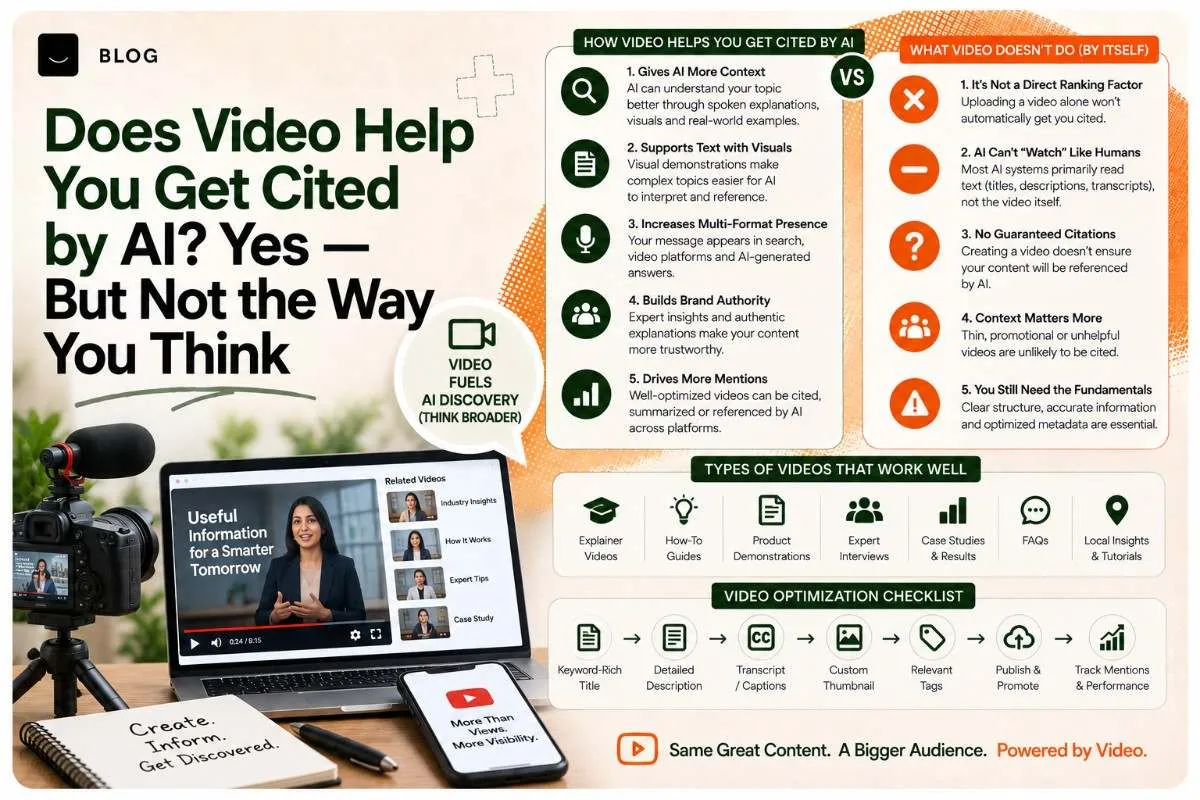
Does Video Help You Get Cited by AI? Yes — But Not the Way You Think
AI answer engines assemble answers from text. They do not watch your footage. But video still earns AI visibility, because a video that is properly transcribed, captioned, described and embedded on a real page produces a substantial body of specific, quotable text — often more specific than anything the same team would have written from scratch. The visibility comes from the text the video generates, not from the video itself.
The uncomfortable starting point
Most advice about video and AI search skips straight to tactics. It is worth being clear about the mechanism first, because it determines everything that follows.
When someone asks ChatGPT, Perplexity or Google's AI Overviews a question, the system retrieves and synthesises text. A twelve-minute video explaining your process, sitting on a page with a title and nothing else, contributes almost nothing to that. The information in it is genuinely valuable and effectively unavailable.
This is why "we should do more video for SEO" so often produces no measurable result. The video was fine. Nothing extractable came out of it.
The good news is that the fix is cheap and almost entirely mechanical.
Where the text around a video actually comes from
Four sources, in rough order of value.
The transcript
The single highest-return asset. A full transcript published as text on the page turns a ten-minute video into two thousand words of specific, spoken-register content.
Two things make transcripts unusually good source material. First, people speaking about their own work are more specific than the same people writing marketing copy — they name actual figures, actual constraints, actual mistakes. Second, spoken language is naturally question-and-answer shaped, which is close to how these queries arrive.
Publish it as readable text on the page, not as a download, and clean it up: remove filler, fix names and technical terms, add headings. An auto-generated transcript with the mistakes left in is worse than none, because the errors become the facts.
The captions
Upload a proper .srt or .vtt caption file rather than relying on auto-captioning. Captions are read by platforms and indexed. They are also, straightforwardly, an accessibility requirement — reason enough independent of any search argument.
Auto-captions in Indian-accented English and in Indian languages remain unreliable enough that reviewing them is not optional. A caption file with mangled product names is actively harmful.
The description and chapters
Platform descriptions are indexed text. Most are wasted on a link and a subscribe request. Write a real summary that states what the video covers and what someone will know afterwards.
Chapters or timestamps carry a secondary benefit: they force you to name the sections, which is a compact outline of the content in text form.
The page the video sits on
A video hosted only on a platform gives that platform the visibility. A video embedded on a page you own, with a transcript and a written summary beneath it, works for you. Do both — publish to the platform for reach, embed on your own page for the asset.
The five video types worth making for this
Not all video generates useful text. These do.
1. The explainer answering one specific question. One question per video, phrased as customers phrase it. The transcript becomes a near-complete answer page.
2. The walkthrough or process video. Someone showing how something is done, narrating as they go. These produce unusually specific transcripts because the speaker is describing something in front of them rather than recalling it.
3. The customer or client conversation. Real language about real problems. The transcript captures how customers actually describe their situation, which is frequently different from how the business describes it — and closer to how the query gets typed.
4. The comparison or teardown. Honest comparison content is disproportionately valuable to answer engines because balanced sources are favoured over promotional ones. Video is a comfortable format for it.
5. The expert commentary on something that just changed. Fast to produce, and timely content earns citation when there is little else published.
What does not generate useful text: brand films, montages, footage set to music, and anything where nobody speaks. Those may be excellent for other reasons. They are not doing this job.
What editing decisions actually affect this
Where editing choices have downstream consequences for extractable text:
- Do not cut the specifics. The instinct in an edit is to tighten — to cut the pause where someone recalls an exact figure, or the caveat that slows the pace. Those are precisely the sentences worth keeping. A tighter video with the specifics removed is a weaker asset.
- Keep the structure legible. Clear sections make chapters possible, which makes headings possible in the transcript.
- Do not let music bury speech. Obvious, routinely violated, and it degrades every automated caption and transcript downstream.
- On-screen text is not readable text. The same rule that applies to product images applies here: anything appearing only as a graphic in the video needs to exist in the transcript or description too.
- Edit for a spoken opening. If the first fifteen seconds are a logo animation, the transcript opens with nothing. Start with someone saying what the video is about.
That last point is a genuinely useful instruction to give an editor, and almost nobody gives it.
The workflow: one shoot, several assets
The economics only work if one recording produces several things.
- Record once, with clear audio and someone speaking specifically.
- Edit the primary video for the platform it is going to.
- Generate a transcript, then have a person clean it — names, terms, numbers, filler.
- Publish the video on a page you own, with the cleaned transcript and a written summary beneath it.
- Upload a reviewed caption file to the platform.
- Write a real description with chapters.
- Cut short vertical clips from the same recording for social.
- Where the transcript is strong enough, develop it into a written article — usually faster than writing from a blank page, and often more specific.
Steps 3 to 8 are where the value is, and they are the steps most commonly skipped because the video felt finished at step 2.
VideoObject schema, and what it does
Add VideoObject structured data to any page with an embedded video: name, description, thumbnail, upload date, duration and, where available, a transcript property.
Be accurate about what this achieves. It helps search engines understand and potentially display the video, and it makes the page's contents machine-legible. It is not a mechanism by which an AI answer engine watches your video. Structured data describes; it does not transmit the content.
Implement it because it is correct and low-effort, not because someone has promised it produces AI citations.
How to tell whether it is working
Video's contribution here is genuinely hard to isolate, and it is more honest to say so than to offer a false metric.
What is worth tracking:
- Whether the transcript page ranks or gets cited for the question the video answers. This is the clearest signal, because it measures the text asset directly.
- Time on page for pages with an embedded video and transcript, against comparable pages without.
- Citation checks on the specific questions your videos answer, run monthly across three assistants — the same manual method used elsewhere in this library.
- Platform metrics for their own sake — watch time, retention — which measure whether the video is good, a separate and equally important question.
What is not worth claiming: that a given citation came from a video. You will not be able to demonstrate that, and asserting it undermines everything else in the report.
What video will not fix
- A video without a transcript contributes almost nothing to AI visibility. If only one thing from this post gets implemented, make it that.
- Video does not compensate for a thin site. If the underlying pages are weak, adding video does not change what an engine has to work with.
- Volume is not the lever. Five properly-processed videos beat thirty published with auto-captions and no transcripts.
- Video hosted only on a platform builds the platform. Embed on your own pages as well.
- There is no verified figure for video's contribution to AI citation rates. Anyone quoting one is guessing. The recommendations here hold on mechanism, not on a statistic.
Frequently asked questions
No. Answer engines assemble responses from text, so a video contributes to AI visibility only through the text associated with it — the transcript, captions, description, chapters, and the page it is embedded on. A video published without any of that contributes almost nothing, regardless of its quality.
It is the single highest-return step. A ten-minute video produces roughly two thousand words of specific, spoken-register text, and people speaking about their own work tend to be more concrete than the same people writing marketing copy. Publish the transcript as readable text on the page and have a person clean up the auto-generated version first.
Both. Publishing to a platform gives reach and platform search visibility; embedding on a page you own, with a transcript and written summary beneath it, builds an asset on your own domain. Hosting only on a platform means the visibility accrues there rather than to your site.
Video in which someone speaks specifically: explainers answering one question, process walkthroughs, customer conversations, honest comparisons, and timely commentary. Brand films, montages and footage set to music may serve other purposes well, but they generate no useful text.
It helps search engines understand and potentially display your video, and makes the page machine-legible, which is worth doing. It is not a mechanism by which an answer engine accesses the video's content. Structured data describes a video; it does not transmit what is said in it.
The main risk is cutting the specifics. Tightening an edit often removes the pause where someone states an exact figure or adds a caveat — the most valuable sentences in the transcript. Also: keep speech clearly audible above music, do not let on-screen graphics carry facts absent from the transcript, and open with someone speaking rather than a logo animation.
Fewer, properly processed. Five videos with cleaned transcripts, reviewed captions, real descriptions and embedded pages will outperform thirty published with auto-captions and no transcript. The processing steps after the edit are where the visibility comes from.
Ready to build what's next?
Tell us where you're headed. We'll come back with a plan to get there.
Book an intro call