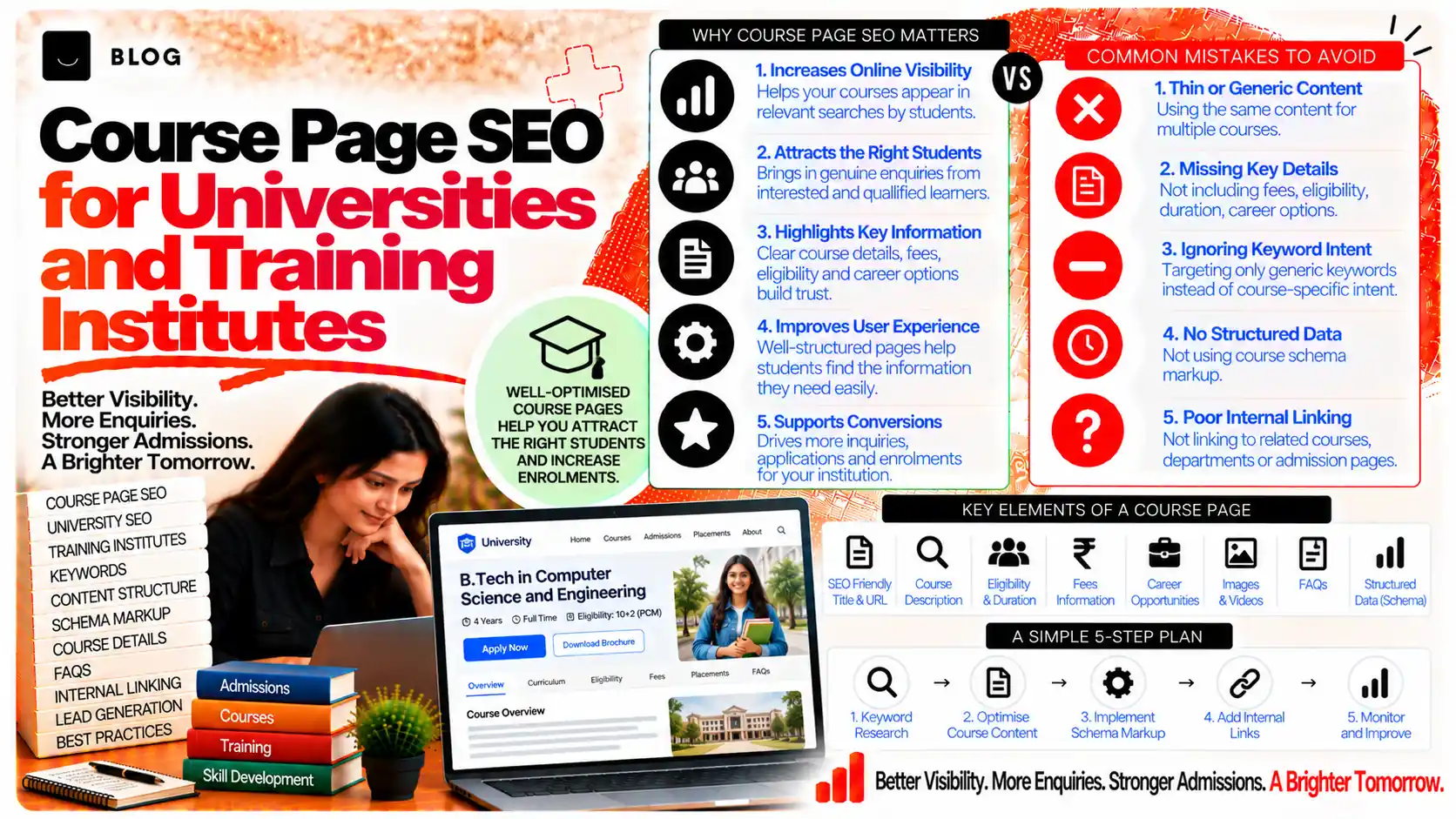
Course Page SEO for Universities and Training Institutes
A prospective student rarely searches for an institution first. They search for a programme: a particular degree, a diploma, a certification or a skills course, often with a city or a mode of study attached. Parents comparing options, working professionals looking for upskilling and corporate learners choosing a training provider all do the same. Course pages are where that search lands, and they are often the most important pages an institute has for enrolment.
Many course pages fail that job. They copy the prospectus text, repeat the same paragraph across dozens of programmes, show admission dates that expired last year, and bury the fee and eligibility details that decide whether a reader applies. Search engines see thin, duplicated pages. Readers see uncertainty.
This guide covers how to structure each programme page, what it must say to convert, how to keep it current across intakes, and how to avoid the duplication that comes from running many similar programmes.
What course page SEO can and cannot do
Good course pages can capture searches for specific programmes and help readers decide, with clear facts about eligibility, cost, duration and outcomes. They can also reduce the enquiries that ask basic questions the page should have answered.
They cannot make an unaccredited programme recognised, and they cannot guarantee admissions, placements or outcomes. Any claim about results must be accurate and supported by the institute's own data. Where regulations govern how programmes may be described, follow them.
Step 1: Decide which programmes need their own page
Each programme that has a distinct audience, curriculum or intake deserves its own page. Programmes that differ only in a name or a minor detail should not each have a near-identical page. Combine them, or make the differences substantive.
Ask:
- Does the programme have a different eligibility route, duration, mode or fee structure?
- Does it attract a distinct search audience with its own terms?
- Does it have enough real content to justify a page of its own?
Where two programmes share most content, a single page with clearly separated variants usually performs better than two thin pages.
Step 2: Structure the page around the reader's decision
A prospective student is asking a set of practical questions. The page should answer them in the order a reader needs them.
A strong course page includes:
- An H1 and title that name the programme and the level, such as "Master of Business Administration (MBA), Full-Time, Bhopal". Keep the title specific and avoid stuffing.
- A summary box near the top, with duration, mode, fees, eligibility, next intake and location.
- Programme overview explaining what the course covers, who it is for and what makes it distinctive.
- Curriculum, presented as headings and clear modules rather than a single block of text.
- Eligibility stated plainly, with the entrance route, minimum qualifications and any documents needed.
- Fees and payment information, including what is included and any additional costs, stated honestly.
- Outcomes and careers, based on the institute's own data, with the method and the date the data covers.
- Faculty with real names, roles and credentials, linked to profiles where they exist.
- Application steps and a clear call to action.
- Frequently asked questions drawn from enquiries the institute actually receives.
The E-E-A-T and author expertise post covers how to make faculty and institutional credibility visible on the page.
Step 3: Make each page distinct
The most common problem on course sites is duplication. A university with thirty programmes can publish thirty pages that share the same introduction, the same paragraph on facilities and the same generic line about career growth. Search engines see little reason to rank any of them, and readers cannot tell them apart.
Make each programme page specific in its substance:
- A curriculum unique to the programme, not a list shared across departments
- Eligibility and fees that reflect the programme's actual route
- Faculty and project examples relevant to that course
- An overview that says what the programme is for, not what the institute is proud of
Where content must be shared, such as accreditation or campus facilities, keep the shared section short and place it below the distinct content, not at the top of every page.
Step 4: Keep intakes and dates current
Admission windows and intake dates change. An expired date on a course page is one of the fastest ways to lose a prospective student, and it signals an outdated site to search engines.
Set a process so that:
- Intake dates and application windows are updated when they change, not once a year
- Expired intake information is replaced with the next date, or a clear "applications open soon" message
- Fees are reviewed at each academic cycle and the date of the last review is visible where appropriate
- Eligibility changes are reflected promptly
The content freshness post covers when a page update is meaningful. For course pages, meaningful updates are factual changes to intake, fees, eligibility and curriculum.
Step 5: Handle programme changes and retirements
Programmes are revised, merged and discontinued. A programme that no longer runs should not keep a live page that offers an application route.
Decide, for each change:
- Update the page where the programme continues with changes to content or intake
- Redirect to the successor programme where a new programme replaces the old one with a similar purpose
- Keep the page with a clear status where the programme is closed to new applicants but students are still enrolled, and link to alternatives
- Remove or archive where the programme has ended, after checking links and search history
The content pruning post covers the decision logic for removing or merging pages, which applies to discontinued programmes.
Step 6: Show accreditation and recognition accurately
Prospective students and employers look for evidence of recognition. Present accreditation, approvals and partnerships exactly as they are, with the body that granted them. Do not imply recognition that does not exist, and do not describe approvals in a way that suggests more than they cover.
Where a programme is approved for one purpose but not another, say so. Clear, accurate statements protect the institute and the reader, and they support trust signals that search engines and readers both value.
Step 7: Support discovery across campuses and locations
Institutes with several campuses or cities face a choice: one page per programme for all locations, or a separate page per campus. Separate campus pages can capture local searches, but they multiply duplication if the content is identical.
A sound approach is usually one main programme page, with location-specific details such as campus facilities, local admission contacts and city-level information on separate pages where those details are substantial. The city pages and local SEO strategy in the programme's other work applies here, with the same caution about duplication.
Step 8: Build internal links that guide the reader
Course pages should link to the information a reader needs next: the admissions process, fee details, faculty profiles, student outcomes and the relevant enquiry form. They should also link to related programmes, so a reader considering one option can compare others.
Use descriptive anchor text, such as "view the admissions process for this programme" rather than "click here". The internal linking strategy post covers how link structure builds topical relationships across a site.
Step 9: Measure what the pages do
Judge course pages by enquiries, applications and enrolments, not by traffic alone. Search Console shows which programme queries bring visitors. Analytics and the admissions system show what those visitors do next.
Look for:
- Programme pages with impressions but few clicks, which may need clearer titles or descriptions
- Pages with traffic but few enquiries, which may lack fees, eligibility or a clear route to apply
- Pages with high exit rates on the application step, which may need simpler forms or clearer steps
- Expired or stale pages still receiving visits, which need an update or a redirect
What course page SEO cannot do
It cannot make a programme attractive to the right students if the content, fees or outcomes do not meet their needs. It cannot replace accurate admissions information or responsive enquiry handling. And it cannot promise enrolments, placements or results. The strongest course pages are accurate, specific and kept current, and they answer the questions a serious applicant asks.
Common course page mistakes to avoid
Copying the prospectus across programmes. Pages become near-duplicates that nobody ranks.
Leaving expired intake dates live. It loses applicants and signals a neglected site.
Hiding fees or eligibility. Readers leave when they cannot find the basics.
Overstating recognition or outcomes. Claims must match the institute's approvals and its own data.
Keeping discontinued programmes open for applications. It misleads applicants and wastes enquiry handling.
Creating a page per campus with identical content. Duplication outweighs the local benefit.
Frequently asked questions
Yes, for programmes with distinct eligibility, curriculum, mode or audience. Combine programmes that differ only slightly, and make sure every page has substantive content.
Whenever they change. Intake information should never be left to expire on the page.
Only what the institute can support with its own data, with the method and the period stated. Avoid general claims that cannot be checked.
Some structured information can help search engines understand the programme, but markup should match what is visible on the page and follow current guidance. It does not guarantee any search feature.
Redirect to a successor where one exists. Where students are still enrolled, keep the page with a clear status. Otherwise archive or remove it after checking links and history.
Yes. Training institutes, skills academies and professional certification providers face the same questions about programme detail, intakes and recognition.
Ready to build what's next?
Tell us where you're headed. We'll come back with a plan to get there.
Book an intro call