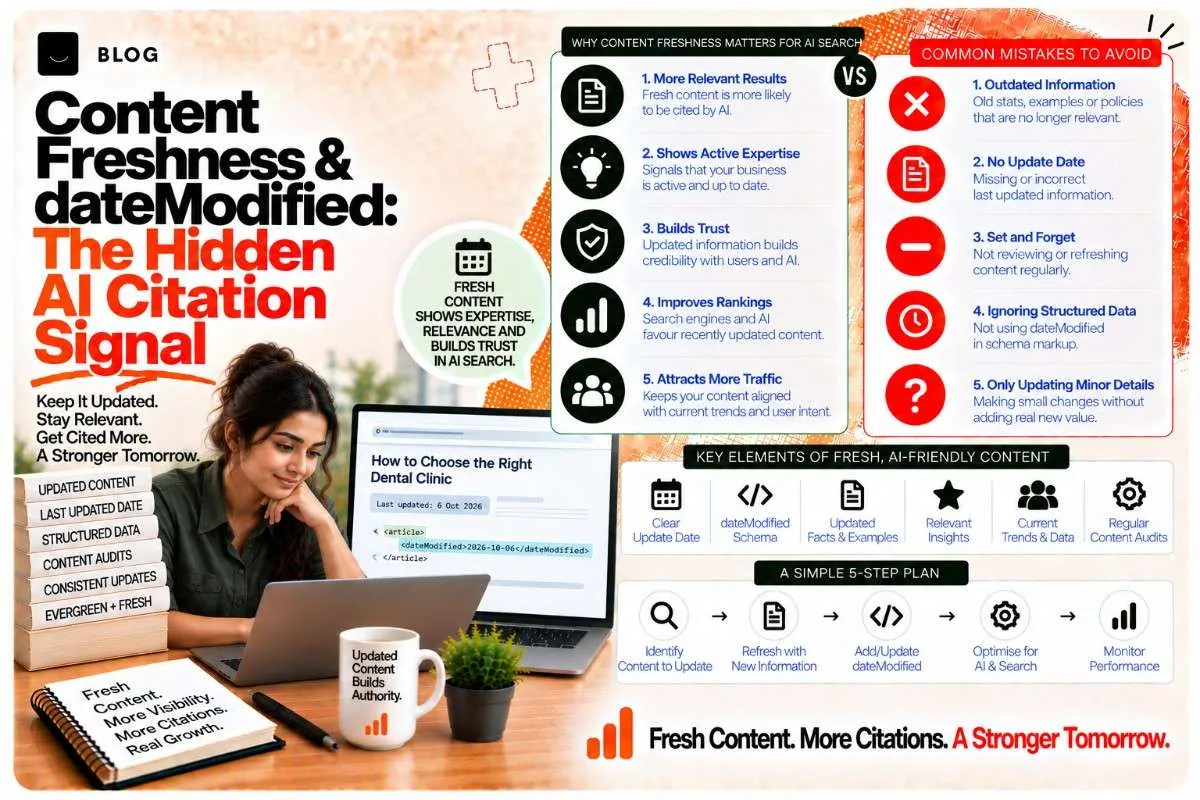
Content Freshness & dateModified: The Hidden AI Citation Signal
A blog post you published three years ago ranks in Google. It gets clicks, it's useful, it's still technically accurate. You don't touch it.
Now ask: is ChatGPT, Perplexity, or Google's AI system going to cite it?
The answer depends less on ranking and more on freshness. AI systems use content age and update frequency as a credibility signal in ways traditional Google ranking doesn't. A page that hasn't been updated in years gets lower citation probability, even if it's well-written and well-ranked. A page you deliberately updated last month, even if it's not "new" content, gets higher citation probability.
This shift has created a hidden SEO discipline: the freshness mandate. And it changes what you should do with old content.
Why AI systems weight freshness differently than Google's ranking algorithm
Google's ranking algorithm uses freshness as one signal among dozens. Content age matters more for news and trending topics; for evergreen content, freshness is less critical. A guide written in 2022 that's still accurate ranks fine.
AI systems that cite content operate differently. They're building an answer right now, for a reader asking a question right now. They're asking: "What's the most current, authoritative answer to this question?" In that context, freshness isn't optional — it's a tie-breaker.
Consider two sources answering "What's the best way to optimize for AI search in 2026?":
- Source A: published 2024, never updated
- Source B: published 2024, updated three times in 2026
Both might have useful information. Source B signals that someone is actively maintaining it, thinking about the topic, incorporating new developments. AI systems weight that signal. They're more likely to cite Source B.
This is especially true for:
- Technology and tools (AI capabilities, platform features, pricing models change)
- Regulations and compliance (laws, guidelines, industry standards evolve)
- Market data and statistics (search trends, usage patterns, costs shift year-over-year)
- Best practices (what works in 2024 may not work in 2026)
- Geographic or time-sensitive content (local services, event planning, seasonal content)
For deeply evergreen content (definitions, history, fundamental concepts), freshness matters less. For anything with a "current" or "best" angle, it matters a lot.
How to signal freshness to AI systems: the dateModified schema approach
The most reliable way to signal freshness to AI systems is through schema markup — specifically, the dateModified field in your article schema.
Here's a correct implementation:
{ "@context": "https://schema.org", "@type": "BlogPosting", "headline": "Content Freshness & dateModified: The Hidden AI Citation Signal", "datePublished": "2024-03-15T10:00:00Z", "dateModified": "2026-10-08T14:30:00Z", "author": { "@type": "Person", "name": "Abhishek Raikwar" }, "image": "https://example.com/image.jpg", "description": "Why AI systems favor fresh content and how to use dateModified correctly." }
The key fields:
- datePublished — when the post was first published (never change this)
- dateModified — the most recent time the post was meaningfully updated (change this every time you update)
- author — named individual, not "The Marketing Team" (supports entity clarity)
When you update a page, update the dateModified timestamp to the current date and time. AI systems and Google will see this and recognize that the page has been refreshed.
What counts as a meaningful update (that deserves a dateModified bump)?
Not every tiny edit should trigger a dateModified update. The goal is to signal that you've actively reviewed and improved the content, not to spam timestamps.
Updates that justify a dateModified change:
- Adding new research, statistics, or case studies
- Incorporating new tools, strategies, or best practices
- Rewriting a section for clarity or accuracy
- Adding or refreshing examples
- Correcting factual errors or outdated information
- Expanding a section with new details or depth
- Updating pricing, availability, or time-sensitive information
Updates that don't require dateModified change:
- Fixing typos or grammar
- Reformatting for readability (no content change)
- Updating links within the same site
- Adding minor punctuation or style fixes
- Moving sections around without changing content
The rule of thumb: if you're reading the page and thinking, "A reader would notice this is different," it's a meaningful update. If you're the only one who'd notice, it's not.
The freshness frequency strategy: how often should you update?
The frequency depends on your content type and topic. There's no magic number, but here's a practical framework:
Monthly updates (for high-priority or high-competition topics):
- Topics where you're actively competing for visibility (your core service pages, flagship posts)
- Topics where information changes frequently (AI capabilities, regulations, market data)
- Topics that are consistently driving traffic and potential customers
- Example: "SEO/AEO/GEO Services in [City]" — update monthly with new client results, fresh statistics
Quarterly updates (for medium-priority or medium-volatility topics):
- Topics where some information evolves, but not rapidly (strategies, frameworks, how-tos)
- Topics that drive moderate traffic but aren't your highest priority
- Topics that compete with other sources
- Example: "Entity SEO Playbook" — update quarterly with new examples or refined frameworks
Annual or biennial updates (for evergreen, stable topics):
- Fundamental definitions and background information
- Historical context and timeless principles
- Topics where information doesn't change (language, history, basic concepts)
- Example: "How to Use FAQPage Schema Markup" — update annually to ensure technical details are current
Trigger-based updates (event-driven):
- When Google announces an algorithm update or new feature
- When a regulation changes
- When a platform discontinues or significantly changes something you've written about
- When you discover an error or outdated fact
- Example: After a Google core update, update any posts that reference past updates with new information
The byline and authorship angle: freshness + entity clarity
A fresh dateModified timestamp is more credible when paired with a named, credentialed author. Compare:
"Updated: October 8, 2026 | By The Marketing Team"
vs.
"Updated: October 8, 2026 | By Abhishek Raikwar, SEO Lead with 5+ years experience in search visibility"
The second signals that a real person with expertise reviewed and improved the content. AI systems weight this signal when deciding whether to cite. This is part of the entity clarity framework — the more specific and verifiable your authorship, the more confidence AI systems have in your content.
An audit checklist: how to catch and fix freshness gaps
- Identify your high-priority content — your top 10–20 posts by traffic or revenue impact
- Scan for outdated dateModified timestamps — content older than 6–12 months (depending on topic volatility)
- Read each post with a critical eye — does any factual claim feel outdated? Any statistics from 2023 or earlier? Any strategy that's changed?
- Make updates where needed — even if just a paragraph, rewrite or expand with current thinking
- Update the dateModified timestamp — change the schema to reflect the update date
- Check the schema — run it through Google's Rich Results Test to confirm it's valid
- Repeat quarterly — set a recurring calendar reminder to audit freshness
High-impact updates to prioritize:
- Any post mentioning specific dates, years, or "recent" events (these age fast)
- Posts that cite statistics or search volume figures (these change annually)
- Posts about tools, platforms, or features (updates and changes are common)
- Posts about "best practices" or "strategies" (the landscape shifts)
- Any post with multiple client example names (permission or relevance may have changed)
Common freshness mistakes to avoid
Don't update dateModified without actually updating the content.
This is timestamp spam. AI systems and Google can often detect when a timestamp changed but the content didn't (via cached versions, text analysis, etc.). It signals manipulation, not genuine freshness.
Don't ignore old posts.
A 3-year-old post with zero updates signals either that you're not maintaining your site or that the information isn't relevant anymore. Both hurt citation probability. Audit and update your backlog.
Don't update old posts without preserving the original date.
The datePublished should never change. This helps AI systems and readers understand the original publication context. Only dateModified should update.
Don't confuse "fresh" with "new."
A post from 2023 that's updated in 2026 is fresh. A new post from 2026 that's never been reviewed or updated is stale by comparison. Freshness is about active maintenance, not age.
Don't update every post constantly.
Updating your entire blog weekly for freshness's sake creates noise and looks artificial. Focus on your highest-impact content and topics where information actually changes.
The bigger freshness strategy: documentation and monitoring
To make freshness a sustainable practice:
Document update decisions. When you update a post, note what changed. This helps you remember why you made updates and gives you concrete talking points if a reader questions the update.
Use a content calendar. Track which posts you've updated, when, and what changed. This helps you spot patterns (e.g., "AI-related posts need updates more frequently") and plan your freshness schedule.
Monitor for triggered updates. Subscribe to industry alerts, algorithm update announcements, and regulatory changes relevant to your content. When something major shifts, flag the posts that need updates.
Measure citation impact. In your monthly AI citation testing (ChatGPT, Perplexity, Google AI), check whether your recently updated posts are cited more often. Build your own internal benchmark.
Frequently asked questions
No. Updating content with new information, if done carefully, usually improves rankings or keeps them stable. The risk comes only if you delete large sections, change the primary keyword, or rewrite the page entirely (which changes its focus). Normal updates to an existing post preserve ranking while improving freshness signals.
Keep datePublished the same (never change it). Update only dateModified in the schema. This tells readers and AI systems when it was first written and when it was last refreshed.
No. Focus on high-priority content (top 10–20 posts), and update frequency should match the topic's volatility. Evergreen content can go 12+ months; time-sensitive content should be checked monthly.
If you're reversing a previous claim, it's worth a note explaining what changed and why (e.g., "In 2024 we recommended X; as of 2026, Y is better because..."). This transparency actually builds more trust with AI systems.
Partially. You can automate timestamp updates (programmatically set dateModified to today's date weekly or monthly), but this signals spam to AI systems unless you're also updating content. Manual updates are more credible.
AI systems primarily see the current dateModified timestamp and the page's current content. They don't have access to your update history or changelog (unless you publish one on the page itself). One current, recent timestamp is what matters.
Ready to build what's next?
Tell us where you're headed. We'll come back with a plan to get there.
Book an intro call